Article
Sometimes you have to face the situation when in Microsoft SQL Server with the configured replication, the database distribution starts to grow. There is nothing wrong with the fact that the database starts growing after the replication task is created.
The distribution database stores metadata and log data for all types of replication as well as transactions for transaction replication. However, there is a few weeks after the replication jobs have been created, the database continues to grow this alarm.
It is likely that a database cleanup job is not being performed or is being performed incorrectly. When replication is created, the job is created: Distribution clean up: distribution. In this job, the stored procedure: dbo.sp_MSdistribution_cleanup is started by schedule.
This stored procedure cleans up the distribution database.
To find out the reasons, you should first check:
1. Whether a cleanup job has been created for the distribution database. bbo.sp_MSdistribution_cleanup.
2. Is this task enabled
3. Check the task execution log for errors, one of the frequent errors is the situation when the employee’s account from under which the task is being executed is blocked or has insufficient rights to the distribution database.
4. The schedule of starting the cleanup task is not set or is missing
If there are no problems in the task, it is worth checking what result the command to run in the task returns.
To do this, create a new query (New Query) and run the script:
USE [distribution]
GO
EXEC dbo.sp_MSdistribution_cleanup @min_distretention = 0, @max_distretention = 72
Where, 72 is the retention time of metadata and replication log data. Normally 72 hours is enough, but you may have your own thoughts on this.
If the distribution database hasn’t been cleaned up for a long time, then waiting for the result of this command can take several hours. This depends on the total size of the database, the time that has elapsed since the last cleanup and the server performance.
In particularly severe cases, such as this one:
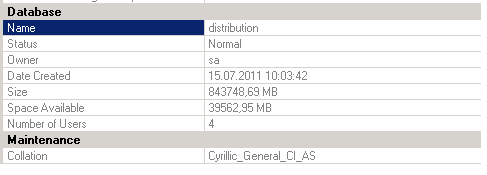
Removing outdated records can take days or even weeks, not just hours.
It is a matter of a strongly sprawling table MSrepl_commands and MSrepl_transactions. So, on the example below, the number of records is almost 1.8 billion.
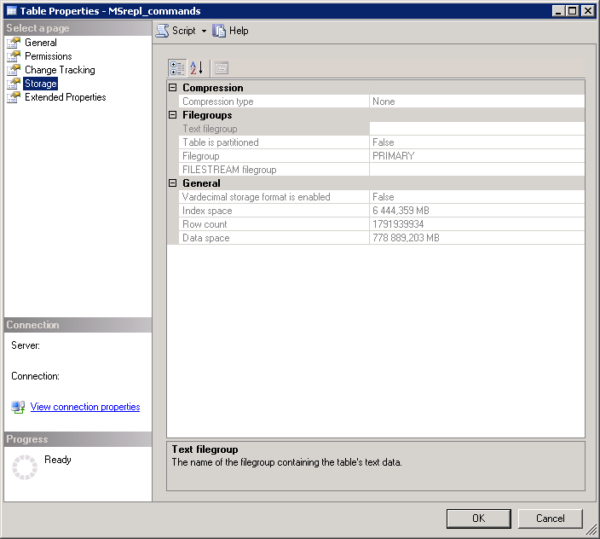
In this situation, to speed up the cleaning of the two most extensive tables, you can manually start the table cleaning by deleting most of the data using the command:
USE distribution
GO
DECLARE @rowcountCom int = 1000000
DECLARE @rowcountTr int = 10000
DELETE TOP(@rowcountCom) MSrepl_commands WITH (PAGLOCK)
FROM MSrepl_commands
WITH (INDEX(ucMSrepl_commands))
DELETE TOP(@rowcountTr) MSrepl_transactions WITH (PAGLOCK)
FROM MSrepl_transactions
WITH (INDEX(ucMSrepl_transactions))
the value for @rowcountCom and @rowcountTr specify no more than 90% of the records you have in these tables.
Once the tables have been cleared of obsolete data, you can perform the final cleanup using the command:
EXEC dbo.sp_MSdistribution_cleanup @min_distretention = 0, @max_distretention = 72
About Enteros
Enteros offers a patented database performance management SaaS platform. It proactively identifies root causes of complex business-impacting database scalability and performance issues across a growing number of clouds, RDBMS, NoSQL, and machine learning database platforms.
The views expressed on this blog are those of the author and do not necessarily reflect the opinions of Enteros Inc. This blog may contain links to the content of third-party sites. By providing such links, Enteros Inc. does not adopt, guarantee, approve, or endorse the information, views, or products available on such sites.
Are you interested in writing for Enteros’ Blog? Please send us a pitch!
RELATED POSTS
How Can Healthcare Organizations Reduce Cloud Database Costs With AIOps and FinOps
- 1 September 2026
- Database Performance Management
Healthcare organizations can reduce cloud database costs by combining AIOps with FinOps to identify inefficient workloads, detect anomalies, rightsize resources, and connect database performance with infrastructure spending. Effective healthcare cloud database cost optimization focuses on eliminating waste without compromising reliability. Enteros supports this approach through database observability, AI-powered SQL analysis, root cause analysis, performance intelligence, … Continue reading “How Can Healthcare Organizations Reduce Cloud Database Costs With AIOps and FinOps”
What Database Performance Challenges Do Hospitals Face in Cloud-Based Healthcare Systems?
Hospitals face database performance challenges such as slow SQL queries, growing healthcare data, EHR performance issues, database bottlenecks, resource contention, cloud complexity, and rising costs. Cloud-based healthcare systems require continuous database monitoring, workload optimization, anomaly detection, and root-cause analysis. AI-powered AIOps can help hospitals improve database performance, reliability, scalability, and cloud cost efficiency while supporting … Continue reading “What Database Performance Challenges Do Hospitals Face in Cloud-Based Healthcare Systems?”
How AIOps and FinOps Optimize Cloud Database Performance for Banking and BFSI
- 31 August 2026
- Database Performance Management
Introduction The banking and financial services industry is undergoing a significant transformation as institutions move critical workloads to cloud and hybrid-cloud environments. Digital banking applications, payment platforms, mobile banking, lending systems, insurance applications, fraud detection platforms, wealth management solutions, and financial analytics increasingly depend on scalable cloud infrastructure and high-performing databases. However, cloud adoption introduces … Continue reading “How AIOps and FinOps Optimize Cloud Database Performance for Banking and BFSI”
How to Optimize Media and Entertainment Database Performance with Enteros Database Software, AI-Powered Analytics, and Database Observability
- 30 August 2026
- Database Performance Management
Introduction The media and entertainment industry has become a digital-first business. Streaming services, digital publishing, online gaming content, advertising platforms, social experiences, content management systems, subscription platforms, and personalized recommendations all depend on databases. Modern media companies process enormous volumes of customer, content, advertising, transaction, and behavioral information. Read more”Indian Country” highlights Enteros and its … Continue reading “How to Optimize Media and Entertainment Database Performance with Enteros Database Software, AI-Powered Analytics, and Database Observability”