The healthcare industry is undergoing one of the most significant digital transformations in history. From electronic health records and telemedicine platforms to AI-powered diagnostics and precision medicine, modern healthcare organizations rely heavily on data-driven technologies. These innovations are revolutionizing patient care, improving clinical decision-making, and enabling hospitals and healthcare providers to deliver more efficient services.
However, as healthcare becomes more digital, the complexity of managing data infrastructure also increases. Massive volumes of patient data, imaging records, research datasets, billing information, and operational metrics must be processed quickly, securely, and cost-effectively. Without proper database performance management and cost intelligence, healthcare organizations risk experiencing performance bottlenecks, rising operational costs, and reduced system reliability.
This is where Enteros plays a transformative role. By combining database performance management, cost estimation, cost attribution, and AI-driven observability, Enteros enables healthcare organizations to optimize their digital infrastructure while maintaining financial transparency and operational efficiency.
In this blog, we will explore how database software and cost intelligence can accelerate healthcare digital transformation and how Enteros empowers organizations to achieve scalable, efficient, and cost-controlled healthcare IT environments.
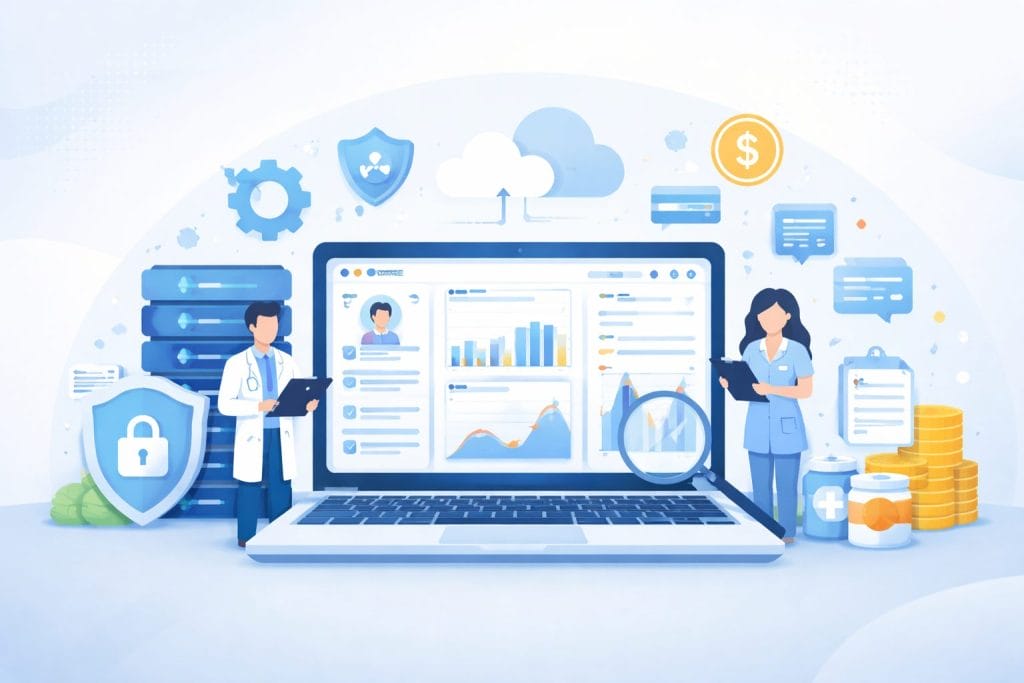
Doctors review medical data on a laptop surrounded by healthcare icons, charts, security symbols, and coins, representing digital health records and data security.
The Rise of Digital Healthcare Ecosystems
Healthcare organizations today operate within complex digital ecosystems that integrate multiple applications, platforms, and databases. These systems support a wide range of critical healthcare services such as:
- Electronic Health Records (EHR)
- Telemedicine and remote patient monitoring
- Medical imaging systems
- Clinical research databases
- Patient management systems
- Billing and insurance processing
- Population health analytics
These systems generate enormous volumes of structured and unstructured data. Managing and processing this data requires powerful databases that can handle high workloads while maintaining reliability and security. As healthcare infrastructures migrate toward hybrid and multi-cloud environments, database performance becomes even more critical.
However, with the growth of digital healthcare platforms comes a set of challenges that healthcare IT teams must address.
Key Challenges in Healthcare Digital Transformation
Despite the benefits of digital healthcare technologies, organizations often struggle with several operational and financial challenges.
1. Rapid Growth of Healthcare Data
Healthcare data is expanding at an unprecedented pace. Every patient interaction generates multiple data points including clinical notes, diagnostic reports, imaging files, lab results, and treatment histories.
This rapid growth places enormous pressure on databases to process and store data efficiently.
2. Performance Bottlenecks in Critical Systems
Healthcare applications require real-time data access. Any delay in retrieving patient information or clinical reports can impact patient outcomes.
Common performance issues include:
- Slow database queries
- Inefficient indexing
- Poor workload distribution
- Resource bottlenecks
These issues can affect critical systems such as appointment scheduling, patient monitoring, and emergency response platforms.
3. Rising Cloud Infrastructure Costs
As healthcare organizations migrate to cloud platforms, infrastructure costs can increase rapidly due to:
- Overprovisioned resources
- Inefficient workloads
- Lack of cost visibility
- Poor resource allocation
Without accurate cost intelligence, IT teams struggle to control cloud spending.
4. Limited Cost Visibility Across Departments
Healthcare organizations operate multiple departments such as radiology, cardiology, oncology, and administration. Each department uses different digital tools and systems.
However, traditional monitoring tools often fail to provide detailed insights into how infrastructure costs are distributed across departments or applications. This makes financial planning and budget allocation difficult.
The Role of Database Performance Management in Healthcare
Database performance management is the foundation of modern healthcare IT operations. It ensures that databases run efficiently, support high workloads, and deliver real-time data access for critical medical systems.
A well-optimized database environment helps healthcare organizations achieve:
- Faster data retrieval
- Improved application performance
- Reduced downtime
- Lower infrastructure costs
- Enhanced system reliability
This is where advanced database performance management platforms such as Enteros become essential.
How Enteros Enables Healthcare Digital Transformation
Enteros provides a next-generation platform designed to help healthcare organizations optimize database performance while gaining complete visibility into infrastructure costs.
The platform combines AI-powered analytics, database observability, cost estimation, and cost attribution to create a unified operational intelligence system.
1. AI-Powered Database Performance Optimization
Enteros continuously monitors database workloads across cloud and on-premise environments. Using advanced analytics and machine learning, the platform identifies performance bottlenecks and recommends optimization strategies.
These insights allow healthcare IT teams to:
- Optimize database queries
- Improve indexing strategies
- Detect anomalies early
- Prevent system outages
For example, if an EHR database begins to slow down due to inefficient queries, Enteros can automatically identify the root cause and provide optimization recommendations.
This proactive approach ensures that healthcare applications maintain high performance and reliability.
2. Intelligent Cost Estimation
One of the most powerful features of Enteros is its ability to predict infrastructure costs based on real-time workload analysis.
The platform analyzes:
- Database usage patterns
- Resource consumption
- Query behavior
- Cloud resource utilization
Using these insights, Enteros can estimate future infrastructure costs and help organizations plan budgets more accurately.
This predictive cost intelligence allows healthcare organizations to avoid unexpected cloud expenses and maintain financial stability.
3. Granular Cost Attribution
Cost attribution is critical for understanding how IT resources are consumed across healthcare operations.
Enteros enables organizations to allocate infrastructure costs to specific:
- Departments
- Applications
- Services
- Workloads
For example, a hospital can determine how much database infrastructure is consumed by radiology imaging systems compared to telehealth platforms.
This level of transparency helps leadership teams make data-driven decisions about resource allocation and operational efficiency.
4. Cloud FinOps Integration
Modern healthcare organizations rely heavily on cloud infrastructure to run critical applications. Managing cloud costs requires a disciplined financial operations strategy known as FinOps.
Enteros integrates with cloud platforms to provide real-time cost monitoring and financial governance.
This enables healthcare teams to:
- Track cloud spending in real time
- Optimize resource utilization
- Implement cost governance policies
- Align IT spending with business goals
By combining database performance management with FinOps intelligence, Enteros helps healthcare organizations maintain a balance between performance and cost efficiency.
Real-World Use Cases in Healthcare
Telemedicine Platforms
Telehealth services require high-performance databases to support video consultations, appointment scheduling, and patient data access.
Enteros helps telemedicine providers maintain consistent system performance while managing fluctuating workloads.
Electronic Health Record Systems
EHR systems generate massive volumes of patient data and require near-instant access for clinical decision-making.
Enteros ensures EHR databases remain optimized and responsive even under heavy workloads.
Medical Imaging Systems
Radiology and imaging platforms store large medical files that require high storage capacity and fast retrieval speeds.
With Enteros, healthcare organizations can optimize database storage and reduce infrastructure costs associated with imaging workloads.
Healthcare Analytics and Research
Healthcare analytics platforms analyze large datasets for medical research, predictive modeling, and population health management.
Enteros helps research organizations manage high-performance databases required for advanced analytics while maintaining cost efficiency.
Benefits of Using Enteros in Healthcare
Healthcare organizations that adopt Enteros gain several strategic advantages.
Improved Database Performance
AI-driven optimization ensures faster query response times and improved system reliability.
Cost Transparency
Granular cost attribution provides clear visibility into infrastructure spending.
Predictive Cost Planning
Cost estimation features enable accurate forecasting and budget planning.
Operational Efficiency
Automation reduces manual monitoring and troubleshooting tasks.
Enhanced Patient Care
Optimized IT infrastructure ensures healthcare providers can access critical data quickly and reliably.
The Future of Healthcare IT with Cost Intelligence
The future of healthcare will be increasingly data-driven. Technologies such as artificial intelligence, genomics, IoT-enabled medical devices, and real-time patient monitoring will continue to generate massive volumes of data.
To support these innovations, healthcare organizations must adopt intelligent database management platforms that combine performance optimization with financial visibility.
Enteros represents a new generation of healthcare IT infrastructure management—one that integrates database performance management, AI-driven analytics, and cost intelligence into a single unified platform.
By embracing these technologies, healthcare organizations can accelerate digital transformation while maintaining cost efficiency and operational resilience.
Conclusion
Digital transformation is reshaping the healthcare industry, enabling new models of patient care, clinical research, and operational efficiency. However, this transformation also brings challenges related to database performance, infrastructure scalability, and cost management.
Enteros addresses these challenges by providing a powerful platform that combines database performance management, cost estimation, and cost attribution. Through AI-driven insights and real-time observability, Enteros empowers healthcare organizations to optimize their IT infrastructure, control costs, and ensure high-performance data systems.
As healthcare continues to evolve into a fully digital ecosystem, organizations that adopt intelligent database management solutions like Enteros will be better positioned to deliver high-quality patient care while maintaining sustainable operational growth.
Frequently Asked Questions (FAQs)
1. What is healthcare digital transformation?
Healthcare digital transformation refers to the adoption of digital technologies such as electronic health records, telemedicine, AI-driven diagnostics, and cloud-based systems to improve patient care and operational efficiency.
2. Why is database performance important in healthcare?
Healthcare systems rely on databases to store and retrieve patient records, clinical data, and operational information. Poor database performance can delay medical decisions and disrupt critical healthcare services.
3. What is cost attribution in healthcare IT?
Cost attribution is the process of assigning infrastructure and operational costs to specific departments, applications, or workloads within a healthcare organization. It helps improve financial transparency and budgeting.
4. How does Enteros help healthcare organizations control IT costs?
Enteros provides cost estimation and cost attribution tools that analyze database workloads and cloud resource usage. These insights help organizations predict expenses and optimize infrastructure spending.
5. Can Enteros integrate with cloud healthcare environments?
Yes. Enteros supports hybrid and multi-cloud environments, allowing healthcare organizations to monitor and optimize database performance across cloud platforms and on-premise systems.
6. What types of healthcare systems benefit from Enteros?
Enteros can optimize performance and cost management for systems such as EHR platforms, telemedicine applications, imaging databases, healthcare analytics systems, and billing platforms.
The views expressed on this blog are those of the author and do not necessarily reflect the opinions of Enteros Inc. This blog may contain links to the content of third-party sites. By providing such links, Enteros Inc. does not adopt, guarantee, approve, or endorse the information, views, or products available on such sites.
Are you interested in writing for Enteros’ Blog? Please send us a pitch!
RELATED POSTS
What Should Healthcare IT Teams Know About AI-Driven Database Root Cause Analysis?
- 1 September 2026
- Database Performance Management
AI database root cause analysis helps healthcare IT teams identify why database performance problems occur by correlating SQL behavior, resource utilization, workload changes, wait events, locking, and historical patterns. Combined with AI database performance monitoring, it enables faster troubleshooting, earlier anomaly detection, and more proactive optimization. Enteros helps healthcare organizations investigate complex database issues before … Continue reading “What Should Healthcare IT Teams Know About AI-Driven Database Root Cause Analysis?”
How Can Hospitals Improve EHR Performance With AI-Powered Database Monitoring?
Improving EHR database performance requires continuous monitoring of SQL workloads, query latency, resource utilization, locking, wait events, and transaction patterns. AI-powered database monitoring helps hospitals detect anomalies, identify root causes, optimize inefficient queries, and anticipate capacity issues before clinicians are affected. Enteros provides intelligent database observability that helps healthcare IT teams improve EHR reliability, responsiveness, … Continue reading “How Can Hospitals Improve EHR Performance With AI-Powered Database Monitoring?”
How Does Cloud FinOps Help Banks Control Database Costs and Improve IT Efficiency?
FinOps for banks helps financial institutions control database costs by connecting cloud spending with actual workload usage, database performance, and business requirements. It enables cost visibility, accurate allocation, resource right-sizing, forecasting, and continuous optimization. Combined with database observability, database cost optimization for banks can reduce waste while protecting transaction speed, availability, scalability, security, and overall … Continue reading “How Does Cloud FinOps Help Banks Control Database Costs and Improve IT Efficiency?”
What Are the Best Ways to Improve Database Performance in Banking and BFSI?
Improving database performance in banking requires continuous database monitoring, SQL query optimization, intelligent indexing, capacity planning, anomaly detection, and proactive root cause analysis. Banks should also establish performance baselines and use AI-powered database observability to identify issues before transactions are affected. Enteros helps banking and BFSI organizations improve database reliability, scalability, efficiency, and transaction performance … Continue reading “What Are the Best Ways to Improve Database Performance in Banking and BFSI?”