Introduction
In today’s digital-first manufacturing landscape, operational efficiency is not just a competitive advantage—it is essential for survival. Manufacturers rely on a complex ecosystem of databases, applications, and cloud resources to support everything from supply chain management to real-time production analytics. Yet as systems grow more complex, ensuring high performance and cost efficiency becomes increasingly difficult. Enteros addresses this challenge with a powerful blend of database performance monitoring and cloud FinOps capabilities tailored for modern manufacturing environments.
This blog explores how Enteros—a patented SaaS-based database performance management platform—empowers manufacturers to optimize database operations, enhance financial efficiency, and ensure seamless digital transformation at scale.
The Challenges of Data and Cloud Management in Manufacturing
Manufacturing is undergoing a digital transformation driven by Industry 4.0 initiatives, which include the integration of IoT, AI, machine learning, and advanced data analytics. These changes bring new challenges:
-
Complex Data Environments: Manufacturers often use a mix of relational (RDBMS), NoSQL, and time-series databases for different applications like ERP systems, inventory tracking, or predictive maintenance.
-
Cloud Adoption: Many companies are migrating to cloud platforms to scale quickly. However, without proper monitoring, cloud spending can spiral out of control.
-
Need for Real-Time Insights: Decisions related to inventory, quality control, and production need to be data-driven and timely.
-
Performance Bottlenecks: Delays or inefficiencies in database performance can lead to downtime, production halts, or delayed product shipments.
-
Cost Attribution Issues: It is often difficult to understand which departments or workloads are driving cloud costs.
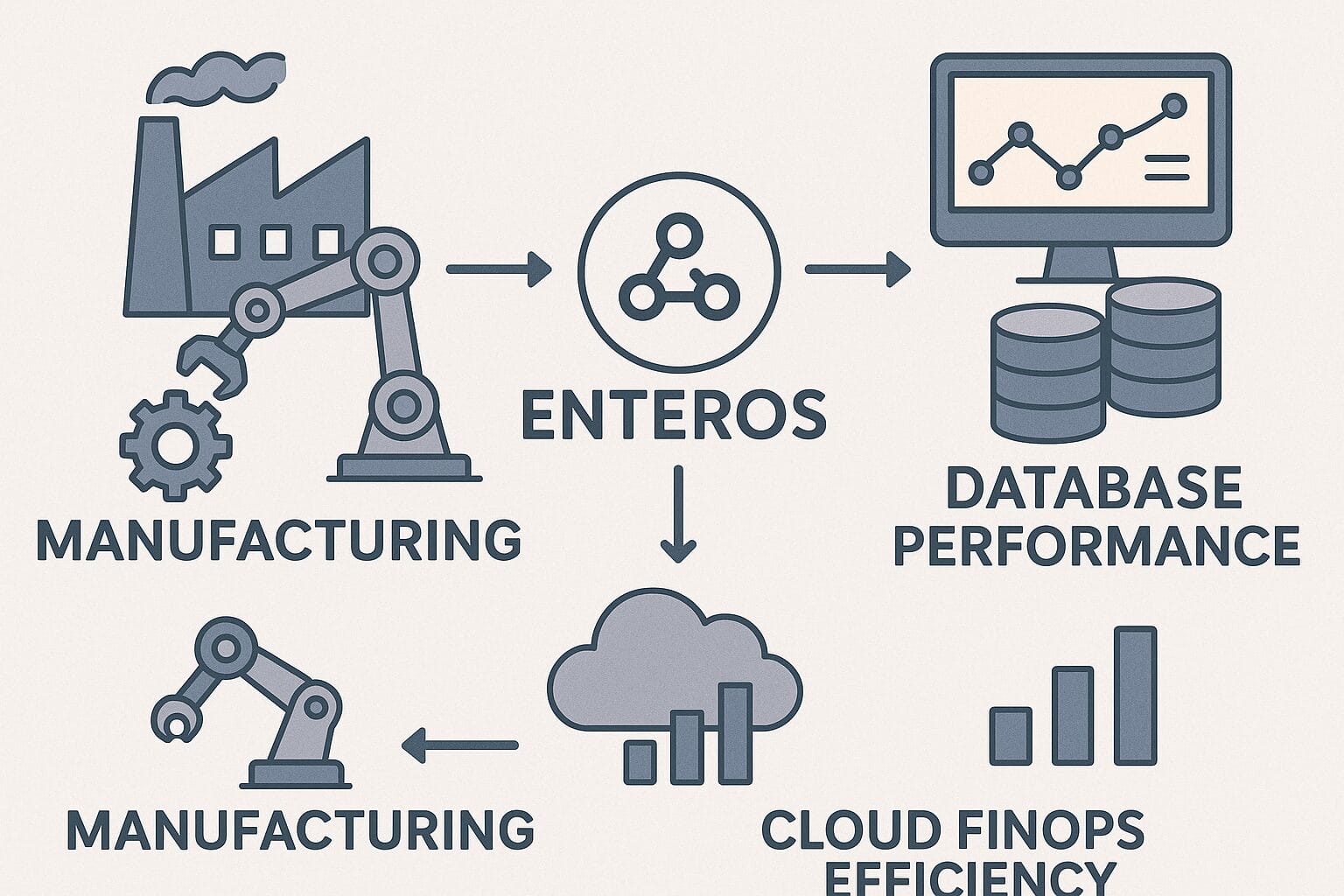
Enteros: Transforming Database Performance in Manufacturing
Enteros UpBeat, the flagship product from Enteros, is a patented SaaS platform that enables proactive monitoring and optimization of database environments across the manufacturing value chain.
1. Proactive Performance Monitoring
Enteros uses advanced statistical learning algorithms to analyze thousands of performance metrics across different database types. It identifies:
-
Abnormal spikes
-
Seasonal patterns
-
Historical performance trends
This real-time insight helps manufacturing IT teams take preemptive action before small issues escalate into major disruptions on the factory floor.
2. Multiplatform Compatibility
Whether a manufacturer uses Oracle, SQL Server, PostgreSQL, MySQL, or newer platforms like MongoDB or Amazon Aurora, Enteros can seamlessly integrate with all of them. This is critical for companies using legacy ERP systems alongside modern, cloud-native platforms.
3. Intelligent Root Cause Analysis
By detecting subtle anomalies in query patterns, memory usage, or I/O throughput, Enteros helps engineers pinpoint the root cause of performance degradation. This allows them to fix issues without having to sift through massive volumes of logs or rely solely on reactive support models.
Supporting Cloud FinOps in Manufacturing
Cloud FinOps (Financial Operations) involves the combination of financial accountability, cost transparency, and real-time data to manage cloud expenditure efficiently. For manufacturers, cloud FinOps is crucial because of the increasing reliance on cloud infrastructure for running production, analytics, and logistics workloads.
Enteros supports cloud FinOps strategies through:
1. Granular Cost Visibility
Enteros allows manufacturers to track database and cloud resource usage down to the department or project level. This facilitates accurate cost attribution and helps identify expensive or inefficient workloads.
2. Forecasting and Budgeting
Using historical performance and cost data, Enteros helps manufacturing CFOs and IT teams forecast future costs more accurately. This is especially helpful for budgeting cloud expenditures related to seasonal demand spikes or product launch cycles.
3. Optimizing Cloud Resources
Enteros can identify underutilized or misconfigured cloud database instances, enabling manufacturers to downscale or rightsize resources. This results in significant cost savings without compromising performance.
4. Supporting Reserved Instance Planning
With better forecasting, manufacturers can confidently invest in Reserved Instances or other long-term pricing models from cloud vendors, further reducing costs.
Case Example: A Manufacturing Enterprise Success Story
A global manufacturing firm specializing in industrial equipment experienced frequent downtime in their ERP and supply chain systems hosted on a hybrid cloud setup. Despite having a team of database administrators and cloud engineers, performance issues persisted and cloud costs kept rising.
After deploying Enteros UpBeat, the firm achieved:
-
A 40% reduction in cloud database costs by rightsizing instances
-
75% faster root-cause identification for performance issues
-
A new dashboard that linked cloud costs to production lines and departments
With improved observability and actionable insights, the IT and DevOps teams could focus on innovation instead of firefighting issues.
RevOps Impact: Aligning Operations with Strategic Goals
Revenue Operations (RevOps) is about unifying sales, marketing, finance, and IT processes to drive revenue growth. In manufacturing, database performance and cloud FinOps directly influence RevOps through:
-
Shorter production cycles due to fewer system delays
-
Better customer experiences enabled by real-time order tracking
-
Increased employee efficiency through faster and more stable systems
-
Data-driven decision-making using clean, well-performing databases
Enteros ensures that operational IT teams contribute strategically to top-line and bottom-line growth.
The Strategic Edge of Enteros in Manufacturing
-
Innovation Acceleration: Faster systems mean quicker development and deployment of new products or features.
-
Compliance and Risk Management: Real-time monitoring supports regulatory compliance by ensuring system reliability and data integrity.
-
Digital Transformation Enablement: Enteros serves as the performance foundation for implementing AI/ML models, IoT, and advanced analytics in smart factories.
-
Sustainability Goals: Optimizing resources reduces energy consumption, supporting environmental targets.
Frequently Asked Questions (FAQs)
Q1: What types of databases does Enteros support?
A: Enteros supports a wide range of databases including Oracle, SQL Server, MySQL, PostgreSQL, MongoDB, Amazon Aurora, and more.
Q2: How does Enteros help reduce cloud costs?
A: By identifying underutilized resources, detecting inefficiencies, and enabling accurate forecasting, Enteros helps manufacturers optimize cloud usage and cut costs.
Q3: Is Enteros suitable for hybrid or multi-cloud environments?
A: Yes, Enteros works across public, private, and hybrid cloud environments, making it ideal for modern manufacturing IT architectures.
Q4: Can Enteros integrate with ERP systems used in manufacturing?
A: Yes, Enteros can monitor the database backend of ERP systems such as SAP, Oracle E-Business Suite, and Microsoft Dynamics.
Q5: How quickly can a manufacturing company see results after deploying Enteros?
A: Many organizations report significant performance improvements and cost reductions within weeks of deploying Enteros.
The views expressed on this blog are those of the author and do not necessarily reflect the opinions of Enteros Inc. This blog may contain links to the content of third-party sites. By providing such links, Enteros Inc. does not adopt, guarantee, approve, or endorse the information, views, or products available on such sites.
Are you interested in writing for Enteros’ Blog? Please send us a pitch!
RELATED POSTS
How Can Banks Improve Database Performance for Real-Time Payment Processing?
- 7 September 2026
- Database Performance Management
Strong bank database performance is essential for real-time payment processing because every payment depends on databases retrieving, validating, updating, and recording financial information with minimal delay. Banks can improve bank database performance by optimizing high-impact SQL queries, reducing locking and resource contention, monitoring transaction latency, establishing workload baselines, planning capacity, and using database observability to … Continue reading “How Can Banks Improve Database Performance for Real-Time Payment Processing?”
How Can Database Observability Help Banks Prevent Transaction Failures and Downtime?
With database observability, banks can identify performance anomalies, see how databases are performing, find bottlenecks, and troubleshoot the root causes of transaction failures before they turn into major service outages. Database observability provides banking IT teams with increased visibility into queries, workloads, resource consumption, waits, blocking and performance patterns as they evolve. This proactive visibility … Continue reading “How Can Database Observability Help Banks Prevent Transaction Failures and Downtime?”
How Can Database Observability Help Retail Companies Resolve Performance Issues Faster?
Database observability for retail helps retailers detect, understand, and resolve performance problems faster by providing deep visibility into database workloads, queries, waits, anomalies, and dependencies. Instead of reacting only after applications slow down, retail IT teams can identify root causes earlier, reduce troubleshooting time, improve uptime, and strengthen database performance monitoring for retail across stores, … Continue reading “How Can Database Observability Help Retail Companies Resolve Performance Issues Faster?”
How Can Database Observability Help Telecom Companies Resolve Performance Issues Faster?
Database observability for telecom helps telecom companies detect, investigate, and resolve database performance problems faster by providing deeper visibility into queries, workloads, waits, dependencies, and anomalies. Instead of relying only on basic infrastructure metrics, teams can identify root causes sooner, reduce troubleshooting time, improve service reliability, and support stronger telecom database performance across complex, high-volume … Continue reading “How Can Database Observability Help Telecom Companies Resolve Performance Issues Faster?”