Introduction
The healthcare sector is under immense pressure to modernize operations while delivering high-quality, cost-effective care. Hospitals, research institutions, and pharmaceutical companies are generating massive amounts of data from electronic health records (EHRs), diagnostic imaging, genomic sequencing, clinical trials, IoT-enabled medical devices, and insurance claim systems. Managing and optimizing these vast databases is critical not only for patient care but also for operational efficiency and regulatory compliance.
At the same time, healthcare organizations must balance escalating IT costs, ensure compliance with HIPAA and GDPR regulations, and align digital transformation with financial and revenue growth goals. This is where RevOps (Revenue Operations) strategies come into play, helping institutions align IT and financial performance with measurable business outcomes.
Enter Enteros UpBeat, a patented AIops-powered database performance optimization platform, designed to help healthcare organizations maximize the value of their data infrastructure. By leveraging AI-driven observability, advanced analytics, and automation, Enteros improves database performance, reduces cloud costs, supports compliance, and aligns IT spending with RevOps efficiency.
This blog explores how Enteros enables healthcare enterprises to optimize database operations, strengthen RevOps alignment, and achieve cost-efficient scalability through AIops.
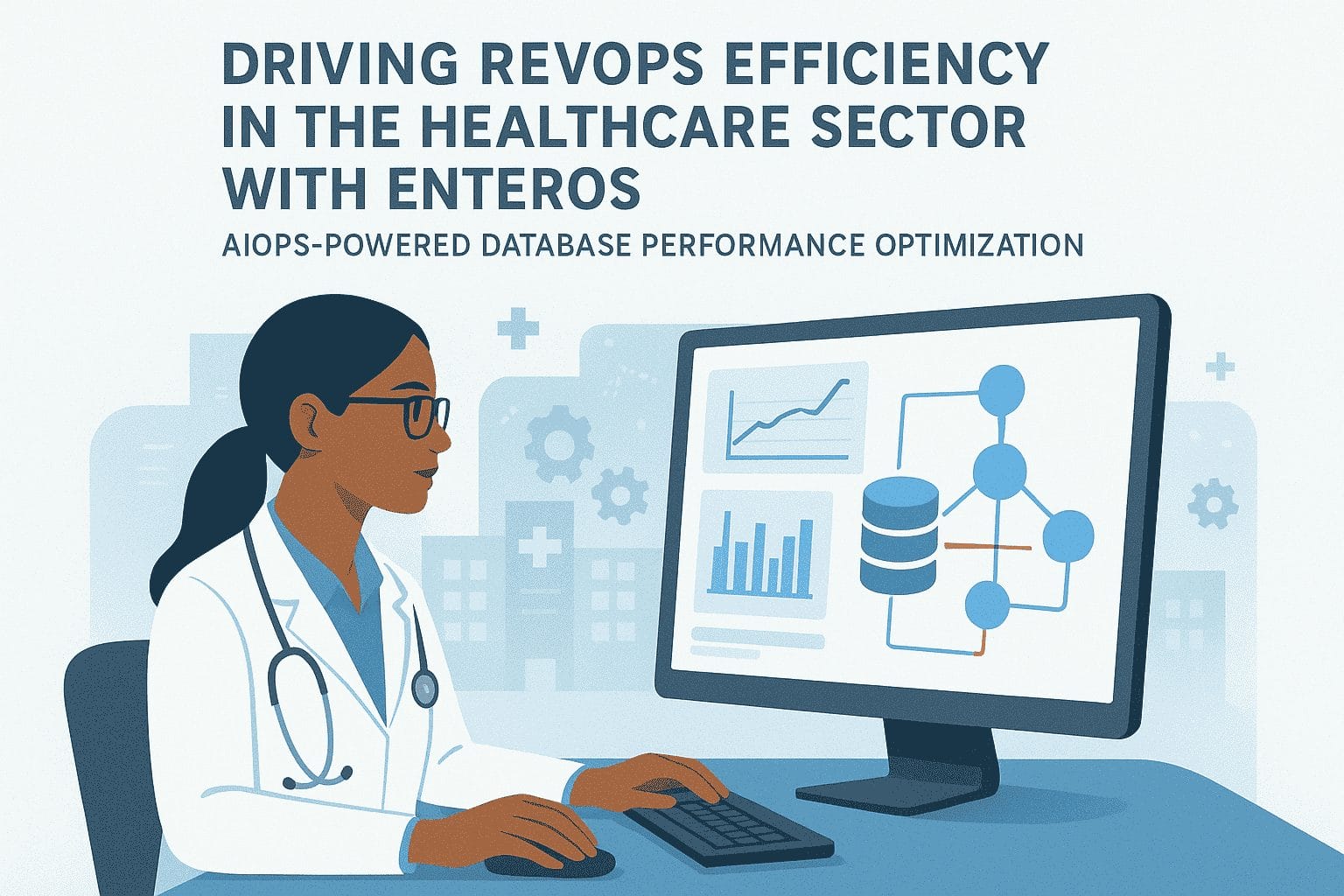
1. Why Database Performance Matters in Healthcare
Healthcare is one of the most data-intensive industries in the world. The ability to process, analyze, and retrieve data quickly impacts critical operations such as:
-
Electronic Health Records (EHRs): Patient records must be retrieved instantly by doctors, often during emergencies. Latency or downtime can impact care quality.
-
Clinical Trials & Research: Large datasets from genomic studies and drug trials require optimized databases for real-time analytics.
-
Medical Imaging Systems: Databases store massive files such as MRIs and CT scans, requiring fast access and retrieval.
-
Insurance & Billing Systems: Database inefficiencies can delay claims, increase administrative costs, and frustrate patients.
-
IoT and Remote Monitoring: Wearable devices and smart medical equipment generate continuous streams of patient health data, which must be analyzed in near real-time.
Poorly performing databases can lead to delays in diagnosis, revenue leakage, higher cloud costs, and even compliance risks. Database performance is not just an IT concern—it directly influences patient outcomes, operational continuity, and revenue flow.
2. Key Challenges in Healthcare Database Management
Despite the criticality of database systems, healthcare organizations face unique challenges:
-
Data Volume Growth: The exponential rise of structured and unstructured healthcare data overwhelms traditional databases.
-
Regulatory Compliance: Systems must meet strict compliance requirements (HIPAA, GDPR, HITECH) while managing large-scale datasets.
-
High IT Costs: Cloud migrations, over-provisioned resources, and inefficient workloads drive IT spending.
-
Siloed Systems: Legacy EHR systems, billing platforms, and research databases often lack integration, leading to inefficiency.
-
AI Workloads: Machine learning and AI applications for predictive analytics, drug discovery, and patient monitoring require optimized databases to function at scale.
These challenges demand a unified AIops-powered observability and optimization platform that ensures efficiency, compliance, and cost-effectiveness.
3. Enteros and AIops-Powered Database Optimization
Enteros UpBeat is uniquely positioned to address healthcare’s database challenges through AIops automation and advanced observability. Its platform delivers:
-
Cross-Database Monitoring: Tracks performance across RDBMS, NoSQL, ML/AI databases, and EHR systems.
-
AI-Driven Anomaly Detection: Uses advanced statistical learning to detect unusual spikes, seasonal patterns, or hidden bottlenecks.
-
Query Optimization: Improves execution speed for EHR access, medical imaging retrieval, and predictive AI workloads.
-
Proactive Scalability: Forecasts future database capacity needs, particularly during flu seasons, pandemics, or new treatment rollouts.
-
Compliance Readiness: Helps maintain performance while ensuring HIPAA and GDPR-compliant operations.
With Enteros, healthcare IT teams move from reactive troubleshooting to proactive performance management, reducing downtime and enabling smoother clinical and business operations.
4. Cloud FinOps and Healthcare Cost Management
Healthcare organizations often struggle with rising cloud infrastructure costs. AI-driven workloads, massive imaging datasets, and high compliance demands can quickly spiral into overspending.
Enteros enhances Cloud FinOps by:
-
Cost Attribution: Assigns cloud database costs across departments (clinical, R&D, billing, imaging).
-
Budget Forecasting: Predicts cost surges during clinical trials, flu seasons, or peak patient intake.
-
Rightsizing Resources: Identifies underutilized or over-provisioned cloud instances and scales them dynamically.
-
Multi-Cloud Optimization: Supports hybrid and multi-cloud strategies common in large hospital networks.
By combining database observability with Cloud FinOps practices, Enteros ensures IT spending is transparent, accountable, and aligned with patient care delivery.
5. RevOps Efficiency in Healthcare
RevOps in healthcare is about aligning IT, finance, and clinical operations to maximize revenue efficiency. Enteros enables RevOps efficiency by:
-
Reducing Downtime: Faster EHR access and billing processes minimize disruptions in patient care and revenue flow.
-
Enhancing Forecasting: Better database performance improves predictive analytics for patient demand and financial planning.
-
Supporting Faster Innovation: Streamlined IT costs free capital for new research, AI initiatives, and patient engagement systems.
-
Linking IT Investment to Revenue: Cost attribution models clarify how IT resources support billing, insurance claims, and R&D revenue streams.
With Enteros, healthcare organizations see a direct connection between database optimization, operational continuity, and revenue growth.
6. Real-World Use Cases of Enteros in Healthcare
Case Study 1: Optimizing EHR Performance
A major hospital system struggled with slow retrieval times for EHRs, impacting clinical workflows. Enteros identified bottlenecks in SQL queries and optimized performance, improving response times by 45% and reducing physician wait times during patient consultations.
Case Study 2: Reducing Cloud Costs in Imaging Systems
A radiology department storing terabytes of CT scans and MRIs faced ballooning cloud bills. Enteros applied rightsizing and cost attribution, cutting cloud costs by 28% annually while maintaining compliance.
Case Study 3: Accelerating Clinical Trial Analytics
A pharmaceutical company running genomic studies needed faster database performance for predictive analytics. Enteros’ AIops-driven optimization reduced query lag by 40%, enabling researchers to generate insights quicker and bring therapies to market faster.
7. Strategic Benefits of Enteros for Healthcare
-
Boost Database Performance: Faster EHR, research, and IoT system access.
-
Enable Cloud FinOps: Full financial accountability for IT operations.
-
Improve RevOps Efficiency: Tie IT investments directly to revenue outcomes.
-
Ensure Compliance: Maintain HIPAA/GDPR standards without performance trade-offs.
-
Support AI Workloads: Enable scalable AI-driven healthcare innovation.
-
Drive Innovation: Free up resources for patient engagement and R&D.
Conclusion
The healthcare industry is rapidly evolving under the pressures of digital transformation, regulatory compliance, and rising patient expectations. Optimized database performance is no longer a backend IT issue—it is a frontline enabler of patient care, financial health, and operational success.
With its AIops-powered database performance optimization platform, Enteros helps healthcare organizations align IT infrastructure with Cloud FinOps practices and RevOps efficiency goals. The result is a healthier balance sheet, stronger compliance posture, and enhanced patient care delivery.
As healthcare moves deeper into the era of AI-driven medicine and Industry 4.0 healthcare ecosystems, Enteros stands as a strategic partner in enabling sustainable, cost-efficient, and revenue-aligned growth.
FAQ
1. How does Enteros improve database performance in healthcare?
Enteros uses AIops algorithms to monitor, detect anomalies, and optimize queries across EHR, imaging, billing, and research databases, ensuring faster access and reduced downtime.
2. Can Enteros help reduce cloud costs in healthcare IT?
Yes. By applying Cloud FinOps principles like cost attribution, forecasting, and rightsizing, Enteros helps healthcare organizations cut unnecessary cloud spending.
3. Is Enteros compliant with healthcare regulations like HIPAA?
Enteros is designed to support compliance-driven operations, ensuring that performance optimization doesn’t compromise regulatory requirements.
4. How does Enteros enable RevOps efficiency in healthcare?
By linking IT costs to business outcomes, Enteros ensures database performance improvements translate into real revenue benefits—faster billing, fewer claim delays, and better patient throughput.
5. Does Enteros support AI and machine learning workloads in healthcare?
Absolutely. Enteros optimizes databases for machine learning and predictive analytics workloads, making it ideal for clinical trials, genomic studies, and AI-driven patient care.
The views expressed on this blog are those of the author and do not necessarily reflect the opinions of Enteros Inc. This blog may contain links to the content of third-party sites. By providing such links, Enteros Inc. does not adopt, guarantee, approve, or endorse the information, views, or products available on such sites.
Are you interested in writing for Enteros’ Blog? Please send us a pitch!
RELATED POSTS
What Are the Biggest Database Performance Challenges Facing Modern Banks?
- 4 September 2026
- Database Performance Management
Modern banks face serious database performance challenges in banking, including transaction bottlenecks, growing data volumes, slow queries, legacy infrastructure, cloud complexity, security requirements, scalability problems, and limited real-time visibility. These issues can delay payments, affect digital banking experiences, increase operational risk, and raise infrastructure costs. Effective database monitoring and optimization help banks maintain reliable, responsive … Continue reading “What Are the Biggest Database Performance Challenges Facing Modern Banks?”
How Can Banks Improve Database Performance for High-Volume Financial Transactions?
Banks can improve database performance for high-volume financial transactions by reducing query latency, optimizing indexes, balancing workloads, monitoring database behavior in real time, and identifying bottlenecks before they affect customers. A strong bank database performance strategy combines observability, capacity planning, automation, and intelligent database performance optimization to keep payment, trading, lending, and digital banking systems … Continue reading “How Can Banks Improve Database Performance for High-Volume Financial Transactions?”
What Are the Most Common Database Performance Issues in Healthcare IT Systems?
The most common database performance issues in healthcare include slow SQL queries, poor indexing, locking, blocking, high concurrency, storage latency, resource contention, execution-plan changes, database growth, and workload spikes. EHR database performance issues can slow clinical workflows and patient-facing systems. Enteros helps healthcare IT teams detect anomalies, investigate root causes, optimize SQL, and improve database … Continue reading “What Are the Most Common Database Performance Issues in Healthcare IT Systems?”
How Can Hospitals Improve Database Performance for Faster EHR and Clinical Workflows?
Improving hospital database performance requires continuous monitoring, SQL optimization, indexing, workload analysis, anomaly detection, root cause analysis, and proactive capacity planning. Hospitals should also track latency, locking, storage I/O, and resource utilization across EHR and clinical systems. Enteros helps healthcare IT teams use AI-powered observability and performance intelligence to improve reliability, responsiveness, scalability, and healthcare … Continue reading “How Can Hospitals Improve Database Performance for Faster EHR and Clinical Workflows?”