Introduction
The financial sector is undergoing an unprecedented transformation fueled by digital banking, fintech innovation, high-frequency trading, and AI-driven decision-making. Every transaction, whether it’s a micro-payment, an algorithmic trade, or a real-time fraud check, generates massive volumes of structured and unstructured data. Managing this data at scale while ensuring speed, compliance, and cost efficiency has become one of the sector’s greatest challenges.
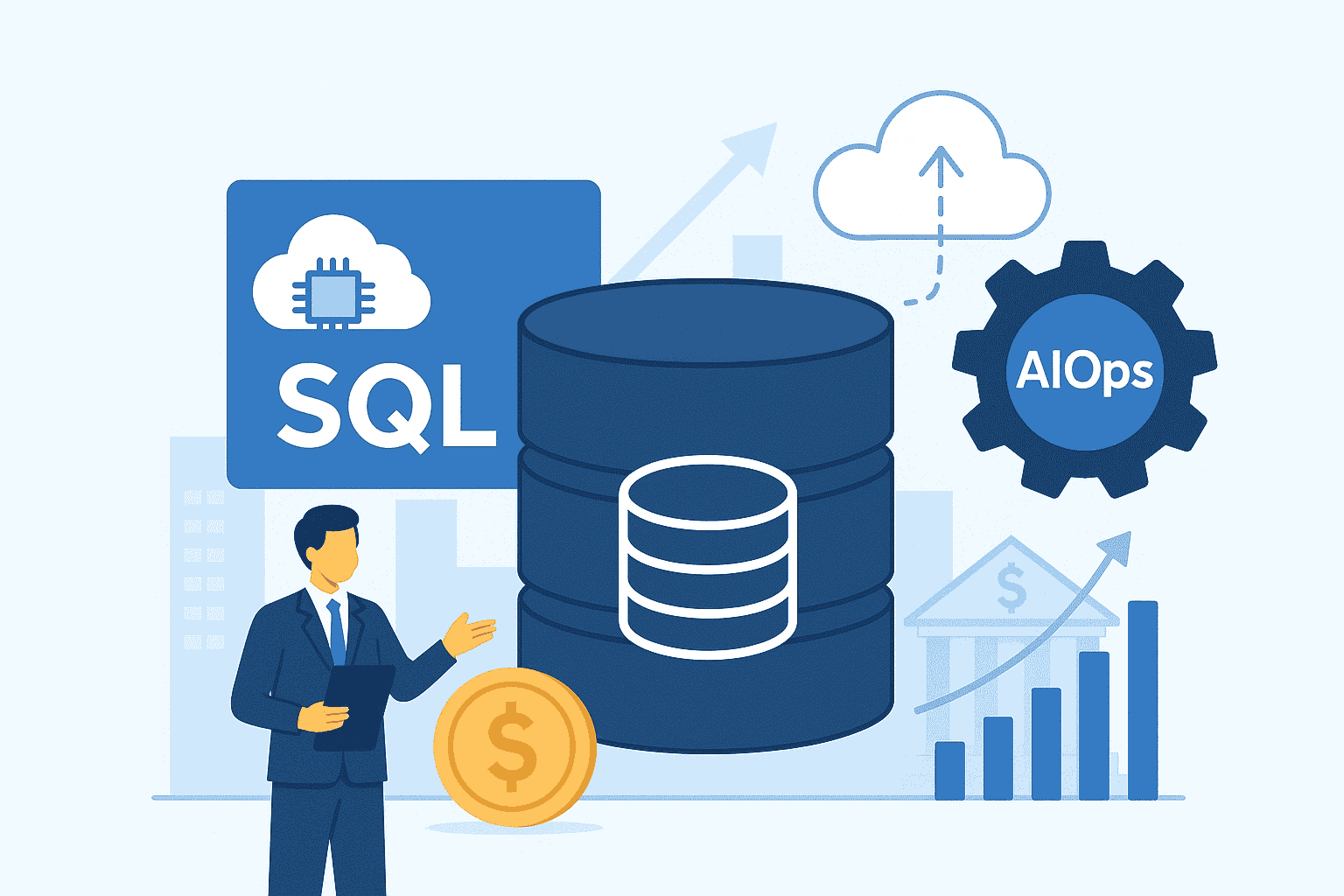
Enter Enteros, an advanced database performance management and observability platform, purpose-built to address these challenges. By combining AI SQL, AIOps automation, and Cloud FinOps frameworks, Enteros delivers smarter cost attribution, optimized resource allocation, and robust database performance tuning across complex, multi-cloud financial environments.
This blog explores how Enteros helps financial organizations gain transparency, reduce operational costs, improve regulatory compliance, and drive RevOps efficiency through cutting-edge AI-driven approaches.
The Challenges of Database Performance and Cost Attribution in the Financial Sector
1. Exploding Data Volumes
Financial institutions process petabytes of transactions, risk simulations, customer analytics, and compliance reports daily. Inefficient database performance leads to delays in settlements, poor trading execution, and dissatisfied clients.
2. Complex Multi-Cloud Architectures
Banks and fintech companies increasingly rely on hybrid and multi-cloud models across Azure, AWS, and GCP. While this provides agility, it complicates cost attribution and resource visibility, making it difficult to assign expenses to business units, departments, or customer-facing applications.
3. Compliance and Regulatory Pressure
Frameworks like Basel III, PCI DSS, and GDPR require strict auditing and reporting. Without transparent cost attribution and database observability, financial institutions risk compliance failures and hefty penalties.
4. Shared Resource Costs
Financial institutions often operate on shared cloud resources (compute, storage, networking). Without intelligent AI-driven cost attribution, shared expenses are distributed inefficiently, leading to budget disputes across teams and inaccurate reporting.
5. Pressure on RevOps Efficiency
Revenue Operations (RevOps) teams in financial institutions require end-to-end visibility of database costs tied directly to revenue-driving functions. Poor attribution obscures profitability insights and slows down strategic decision-making.
Enteros’ Solution: AI SQL, AIOps, and Cloud FinOps for the Financial Sector
1. AI SQL for Intelligent Query Optimization
Traditional SQL queries struggle under the weight of big data in financial services. Enteros’ AI SQL engine applies advanced machine learning to:
-
Automatically detect slow-running queries and recommend rewrites.
-
Optimize data-intensive queries for high-frequency trading, fraud detection, and risk modeling.
-
Predict query resource usage, preventing unexpected cloud cost spikes.
-
Provide real-time insights into transaction workloads.
With AI SQL, financial firms can speed up database performance while lowering query-related cloud costs.
2. AIOps for Automated Root-Cause Analysis and Anomaly Detection
Enteros leverages AIOps (Artificial Intelligence for IT Operations) to:
-
Continuously monitor millions of database performance metrics across cloud platforms.
-
Detect anomalies in latency, throughput, or resource spikes before they impact trading systems.
-
Use AI-driven root-cause analysis to resolve bottlenecks faster.
-
Enable self-healing automation, reducing downtime in mission-critical financial applications.
For example, if a sudden surge in risk calculation queries slows performance, Enteros’ AIOps platform can pinpoint the root cause and recommend automated fixes without waiting for human intervention.
3. Cloud FinOps for Smarter Cost Attribution
Enteros aligns with Cloud FinOps principles to bring financial accountability to cloud spending. Using advanced AI-based attribution models, Enteros helps financial firms:
-
Disaggregate shared cloud costs across departments (e.g., retail banking, investment banking, fintech apps).
-
Attribute database usage costs to specific revenue-generating applications.
-
Build accurate forecasting models for future cloud resource consumption.
-
Provide chargeback and showback models to ensure transparency across business units.
This allows CFOs and RevOps leaders in financial institutions to gain complete cost transparency, making strategic budgeting decisions much more precise.
4. Enhanced Observability and Performance Management
Unlike traditional monitoring tools, Enteros’ observability-first platform correlates cost and performance data together. This ensures that:
-
Every performance bottleneck is analyzed in terms of both technical and financial impact.
-
Decision-makers can view costs at the granularity of queries, databases, or business services.
-
Teams can align database performance goals with revenue targets, enhancing RevOps efficiency.
Real-World Use Case: Enteros in a Global Investment Bank
A leading investment bank faced issues with inconsistent cloud costs, trading platform slowdowns, and lack of transparency in database usage attribution.
With Enteros:
-
AI SQL reduced trade execution query latency by 40%.
-
AIOps automation detected anomalies in regulatory reporting systems before they caused compliance delays.
-
Cloud FinOps attribution models provided transparency across trading desks, enabling accurate cost distribution.
-
The bank achieved $15M in annual cloud savings, while maintaining near real-time performance for critical trading workloads.
Strategic Benefits for the Financial Sector
-
Cost Transparency – Full visibility into cloud and database expenses across units.
-
Operational Efficiency – Automated anomaly detection and AI SQL-driven optimization reduce IT workloads.
-
Regulatory Compliance – Cost and performance observability ensures audit readiness.
-
RevOps Efficiency – Clear attribution ties IT spending to revenue-driving activities.
-
Future-Ready Scaling – Predictive models support growth in digital payments, fintech, and GenAI-driven banking apps.
Frequently Asked Questions (FAQ)
1. What makes Enteros different from traditional database monitoring tools?
Unlike standard monitoring solutions, Enteros correlates performance metrics with financial costs. This allows banks to not only detect slowdowns but also understand their cost impact in a Cloud FinOps context.
2. How does Enteros support RevOps teams in financial institutions?
Enteros provides granular cost attribution models, enabling RevOps leaders to link IT spending directly to revenue-generating functions, such as digital banking apps, trading systems, or fraud detection.
3. Can Enteros help reduce compliance risks?
Yes. Enteros offers audit-ready reporting with cost and performance observability. This ensures compliance with Basel III, PCI DSS, GDPR, and SOX regulations.
4. How does AI SQL reduce costs in the financial sector?
By optimizing queries automatically, AI SQL reduces unnecessary compute consumption in cloud databases, lowering cloud bills while accelerating high-volume financial transactions.
5. Is Enteros suitable for hybrid and multi-cloud environments?
Absolutely. Enteros is designed for multi-cloud observability and cost attribution, working seamlessly across AWS, Azure, GCP, and on-premises environments.
6. How does Enteros improve RevOps efficiency?
By aligning database performance with revenue-driven outcomes, Enteros ensures that every dollar spent on cloud resources contributes to business growth.
7. Can Enteros forecast future costs in financial databases?
Yes. Using AI-based forecasting models, Enteros predicts resource usage trends, enabling banks to budget cloud spending accurately while avoiding unexpected spikes.
The views expressed on this blog are those of the author and do not necessarily reflect the opinions of Enteros Inc. This blog may contain links to the content of third-party sites. By providing such links, Enteros Inc. does not adopt, guarantee, approve, or endorse the information, views, or products available on such sites.
Are you interested in writing for Enteros’ Blog? Please send us a pitch!
RELATED POSTS
What Are the Biggest Database Performance Challenges Facing Modern Banks?
- 4 September 2026
- Database Performance Management
Modern banks face serious database performance challenges in banking, including transaction bottlenecks, growing data volumes, slow queries, legacy infrastructure, cloud complexity, security requirements, scalability problems, and limited real-time visibility. These issues can delay payments, affect digital banking experiences, increase operational risk, and raise infrastructure costs. Effective database monitoring and optimization help banks maintain reliable, responsive … Continue reading “What Are the Biggest Database Performance Challenges Facing Modern Banks?”
How Can Banks Improve Database Performance for High-Volume Financial Transactions?
Banks can improve database performance for high-volume financial transactions by reducing query latency, optimizing indexes, balancing workloads, monitoring database behavior in real time, and identifying bottlenecks before they affect customers. A strong bank database performance strategy combines observability, capacity planning, automation, and intelligent database performance optimization to keep payment, trading, lending, and digital banking systems … Continue reading “How Can Banks Improve Database Performance for High-Volume Financial Transactions?”
What Are the Most Common Database Performance Issues in Healthcare IT Systems?
The most common database performance issues in healthcare include slow SQL queries, poor indexing, locking, blocking, high concurrency, storage latency, resource contention, execution-plan changes, database growth, and workload spikes. EHR database performance issues can slow clinical workflows and patient-facing systems. Enteros helps healthcare IT teams detect anomalies, investigate root causes, optimize SQL, and improve database … Continue reading “What Are the Most Common Database Performance Issues in Healthcare IT Systems?”
How Can Hospitals Improve Database Performance for Faster EHR and Clinical Workflows?
Improving hospital database performance requires continuous monitoring, SQL optimization, indexing, workload analysis, anomaly detection, root cause analysis, and proactive capacity planning. Hospitals should also track latency, locking, storage I/O, and resource utilization across EHR and clinical systems. Enteros helps healthcare IT teams use AI-powered observability and performance intelligence to improve reliability, responsiveness, scalability, and healthcare … Continue reading “How Can Hospitals Improve Database Performance for Faster EHR and Clinical Workflows?”