Introduction
The healthcare sector is experiencing a digital revolution fueled by generative AI, big data analytics, cloud computing, and automation. Hospitals, pharmaceutical companies, insurers, and research institutions are increasingly leveraging advanced technologies to improve patient outcomes, accelerate drug discovery, enhance operational efficiency, and personalize healthcare services.
However, this transformation comes with challenges. Healthcare organizations must deal with massive amounts of sensitive data, escalating cloud costs, complex AI workloads, and strict compliance requirements. Performance bottlenecks in databases and IT systems can directly impact patient care, revenue cycles, and innovation speed.
Enteros, with its patented SaaS platform Enteros UpBeat, addresses these challenges head-on. By combining performance management, Cloud FinOps, and generative AI integration, Enteros empowers healthcare organizations to achieve operational efficiency, cost savings, and improved revenue alignment.
In this blog, we’ll explore how Enteros revolutionizes performance management in healthcare by aligning IT operations with Cloud FinOps principles and the transformative power of generative AI.
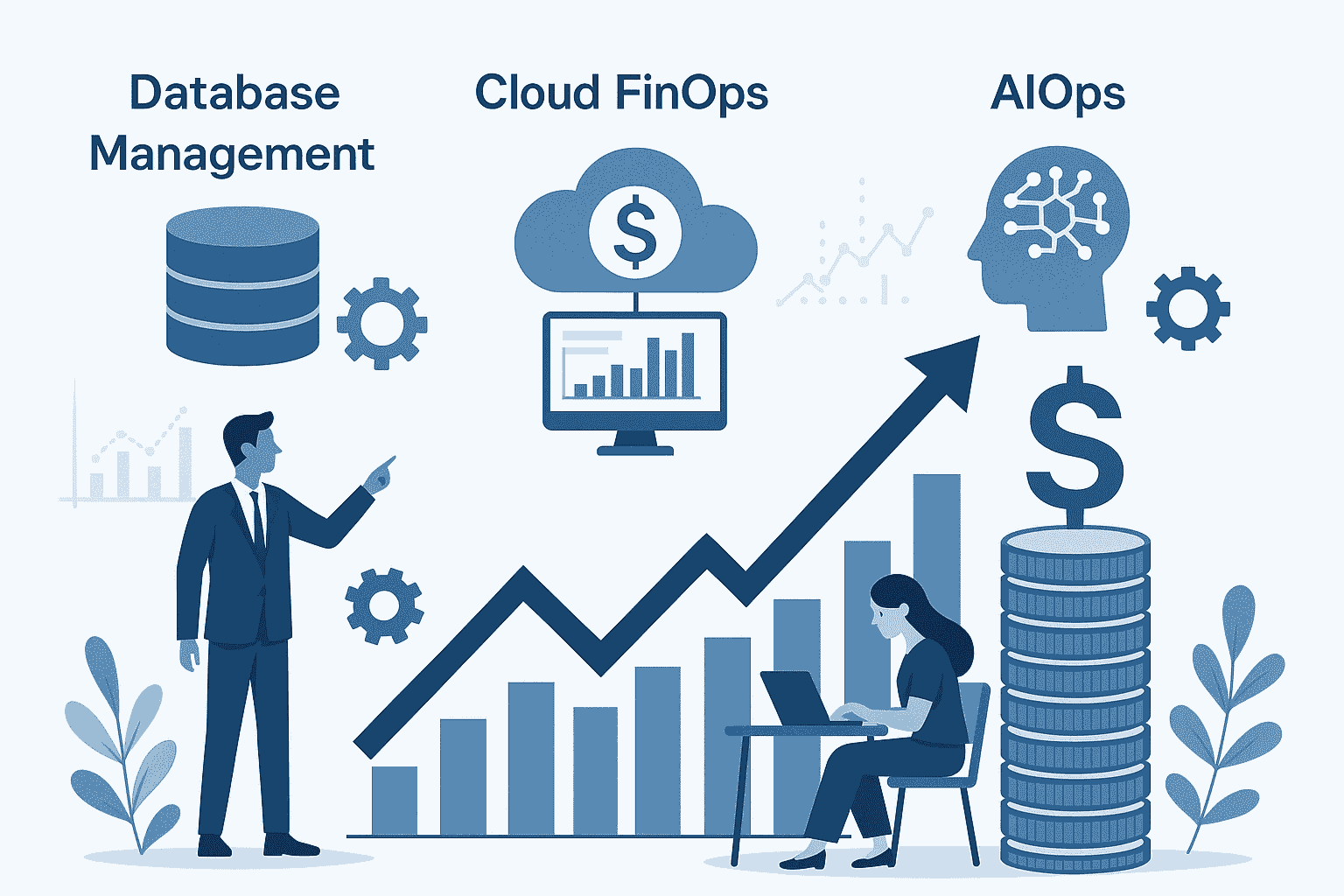
1. Why Performance Management is Critical in Healthcare
Healthcare is one of the most data-intensive industries. Databases and IT systems support critical processes such as:
-
Electronic Health Records (EHRs): Patient data, diagnostics, and medical histories.
-
Clinical Research & Trials: Drug discovery, testing, and regulatory compliance.
-
Medical Imaging & Diagnostics: AI-powered image analysis, pathology, and predictive diagnostics.
-
Hospital Operations: Scheduling, billing, supply chain, and workforce management.
-
Insurance & Revenue Cycle Management: Claims processing, fraud detection, and financial forecasting.
Any disruption or inefficiency in database operations can result in:
-
Delayed patient care (e.g., slow EHR retrieval).
-
Regulatory non-compliance due to inaccurate or delayed reporting.
-
Missed research milestones in drug discovery or trials.
-
Escalating cloud costs without financial accountability.
-
Revenue leakage from delayed billing or claim processing.
Effective performance management is no longer optional—it’s a strategic necessity for healthcare providers and enterprises.
2. Challenges in Healthcare IT and Cloud Costs
Healthcare organizations face unique challenges in managing IT performance and cloud costs:
-
Exploding Data Volumes: With EHRs, IoT devices, wearables, and imaging systems, data grows exponentially.
-
AI & Generative AI Workloads: Training and running AI models consumes massive compute and storage resources.
-
Cloud Cost Overruns: Over-provisioned or underutilized resources lead to runaway cloud bills.
-
Lack of Cost Attribution: Difficulty in assigning IT spend to departments like research, operations, or patient care.
-
Strict Compliance & Security Needs: HIPAA, GDPR, and other regulations demand robust monitoring and reporting.
-
RevOps Misalignment: IT performance and spending often lack clear ties to healthcare revenue and outcomes.
Without intelligent solutions, healthcare organizations risk inefficiency, non-compliance, and reduced competitiveness.
3. Enteros UpBeat: AI-Driven Performance Management for Healthcare
Enteros UpBeat uses AI and advanced statistical learning algorithms to deliver proactive performance management across diverse database environments—RDBMS, NoSQL, machine learning, and more.
Key capabilities for healthcare include:
-
Proactive anomaly detection: Identifies abnormal spikes in database workloads, reducing downtime in EHRs or medical imaging systems.
-
Seasonality analysis: Recognizes predictable demand surges, such as flu season or COVID-19 spikes, and optimizes resources accordingly.
-
Query optimization: Accelerates response times in clinical research databases and billing systems.
-
AI workload support: Ensures smooth execution of generative AI models for drug discovery, diagnostics, and patient care.
-
Scalability prediction: Forecasts database resource requirements for future patient loads or research initiatives.
By ensuring continuous, high-performance databases, Enteros enables healthcare providers to deliver faster, safer, and more cost-effective care.
4. Cloud FinOps in Healthcare
Cloud FinOps has become essential for healthcare organizations seeking to control costs and align IT spending with value delivery. Enteros enhances Cloud FinOps with:
-
Granular Cost Attribution: Assigns IT and database costs to departments like radiology, oncology research, or revenue cycle management.
-
Forecasting & Budgeting: Predicts future cloud spend based on patient volume, clinical trials, or seasonal demands.
-
Rightsizing Resources: Prevents waste by automatically scaling databases up or down based on workload demand.
-
Multi-Cloud Optimization: Supports hybrid or global cloud strategies common in large hospital systems and research networks.
This financial accountability ensures IT investments directly support healthcare delivery and revenue growth.
5. Generative AI and Healthcare Transformation
Generative AI is reshaping healthcare by enabling:
-
Drug Discovery & Development: Generating new molecular structures, speeding up R&D pipelines.
-
Medical Imaging Analysis: AI-assisted scans for faster and more accurate diagnosis.
-
Personalized Treatment Plans: Using AI-driven recommendations tailored to individual patients.
-
Clinical Documentation: Automatically generating summaries and reports from physician notes.
However, these workloads are resource-intensive and require robust database and infrastructure performance.
Enteros supports generative AI adoption by:
-
Optimizing databases for AI model training and inference.
-
Reducing compute and storage costs through Cloud FinOps strategies.
-
Ensuring high availability for AI-driven diagnostic and treatment tools.
-
Aligning AI workloads with RevOps efficiency, tying innovations directly to financial outcomes.
6. Real-World Use Cases of Enteros in Healthcare
Case Study 1: Optimizing EHR Performance
A large hospital network struggled with slow EHR systems that delayed patient care. Enteros identified query bottlenecks, reducing latency by 40% and improving physician productivity.
Case Study 2: Cost Attribution for Research
A pharmaceutical company faced challenges in allocating cloud spend across its clinical research divisions. Enteros implemented granular cost attribution, improving budget accountability and saving $20 million annually.
Case Study 3: Generative AI in Drug Discovery
A biotech firm running AI-driven molecular simulations experienced escalating cloud costs. Enteros introduced FinOps forecasting and workload optimization, cutting costs by 25% while accelerating R&D timelines.
7. Strategic Benefits of Enteros for Healthcare
-
Boost Performance Management: Optimize EHR, clinical research, and imaging systems.
-
Enable Cloud FinOps: Financial accountability and cost control across cloud resources.
-
Support Generative AI Workloads: Ensure AI-driven innovations run efficiently.
-
Improve Cost Attribution: Transparent allocation of IT spend across departments.
-
Enhance RevOps Alignment: Tie IT performance directly to patient outcomes and revenue.
-
Ensure Compliance: Maintain HIPAA, GDPR, and regulatory requirements with robust monitoring.
Conclusion
The healthcare sector is at the intersection of technology, cost management, and innovation. As generative AI, cloud computing, and big data reshape healthcare delivery, organizations must prioritize database performance and financial accountability.
Enteros UpBeat provides the foundation for this transformation—offering proactive performance management, enabling Cloud FinOps practices, and powering generative AI integration. The result is reduced costs, improved performance, regulatory compliance, and a clear link between IT operations and healthcare outcomes.
As healthcare organizations move deeper into digital transformation, Enteros stands as a strategic partner enabling efficiency, innovation, and patient-centric growth.
FAQ
1. How does Enteros improve healthcare database performance?
Enteros detects anomalies, optimizes queries, and ensures high availability for EHRs, clinical research, and AI workloads.
2. Can Enteros help reduce cloud costs in healthcare?
Yes. By applying FinOps principles like forecasting, rightsizing, and cost attribution, Enteros helps healthcare organizations cut unnecessary cloud spend.
3. How does Enteros support generative AI in healthcare?
Enteros optimizes databases and infrastructure to support resource-heavy AI workloads like drug discovery, medical imaging, and personalized care.
4. Is Enteros compliant with healthcare regulations?
Absolutely. Enteros enhances compliance with HIPAA, GDPR, and other regulatory standards through robust monitoring and reporting.
5. How does Enteros connect IT performance with revenue outcomes?
By reducing downtime, improving efficiency, and controlling cloud costs, Enteros ties IT investments directly to patient care quality and revenue cycle efficiency.
The views expressed on this blog are those of the author and do not necessarily reflect the opinions of Enteros Inc. This blog may contain links to the content of third-party sites. By providing such links, Enteros Inc. does not adopt, guarantee, approve, or endorse the information, views, or products available on such sites.
Are you interested in writing for Enteros’ Blog? Please send us a pitch!
RELATED POSTS
What Are the Biggest Database Performance Challenges Facing Modern Banks?
- 4 September 2026
- Database Performance Management
Modern banks face serious database performance challenges in banking, including transaction bottlenecks, growing data volumes, slow queries, legacy infrastructure, cloud complexity, security requirements, scalability problems, and limited real-time visibility. These issues can delay payments, affect digital banking experiences, increase operational risk, and raise infrastructure costs. Effective database monitoring and optimization help banks maintain reliable, responsive … Continue reading “What Are the Biggest Database Performance Challenges Facing Modern Banks?”
How Can Banks Improve Database Performance for High-Volume Financial Transactions?
Banks can improve database performance for high-volume financial transactions by reducing query latency, optimizing indexes, balancing workloads, monitoring database behavior in real time, and identifying bottlenecks before they affect customers. A strong bank database performance strategy combines observability, capacity planning, automation, and intelligent database performance optimization to keep payment, trading, lending, and digital banking systems … Continue reading “How Can Banks Improve Database Performance for High-Volume Financial Transactions?”
What Are the Most Common Database Performance Issues in Healthcare IT Systems?
The most common database performance issues in healthcare include slow SQL queries, poor indexing, locking, blocking, high concurrency, storage latency, resource contention, execution-plan changes, database growth, and workload spikes. EHR database performance issues can slow clinical workflows and patient-facing systems. Enteros helps healthcare IT teams detect anomalies, investigate root causes, optimize SQL, and improve database … Continue reading “What Are the Most Common Database Performance Issues in Healthcare IT Systems?”
How Can Hospitals Improve Database Performance for Faster EHR and Clinical Workflows?
Improving hospital database performance requires continuous monitoring, SQL optimization, indexing, workload analysis, anomaly detection, root cause analysis, and proactive capacity planning. Hospitals should also track latency, locking, storage I/O, and resource utilization across EHR and clinical systems. Enteros helps healthcare IT teams use AI-powered observability and performance intelligence to improve reliability, responsiveness, scalability, and healthcare … Continue reading “How Can Hospitals Improve Database Performance for Faster EHR and Clinical Workflows?”