Introduction
Modern real estate enterprises run on digital platforms. Property listings, tenant management systems, smart building IoT integrations, CRM platforms, financial modeling tools, leasing analytics, and investor dashboards all depend on cloud-hosted databases.
From commercial real estate firms managing global portfolios to proptech startups scaling digital marketplaces, the cloud has become foundational.
But here’s the challenge:
Cloud growth without database intelligence leads to cloud waste.
Unused compute. Overprovisioned databases. Idle storage. Inefficient SQL. Redundant replicas. Poor workload planning.
In real estate—where margins are tightly tied to occupancy rates, leasing velocity, and operational efficiency—cloud waste directly erodes profitability.
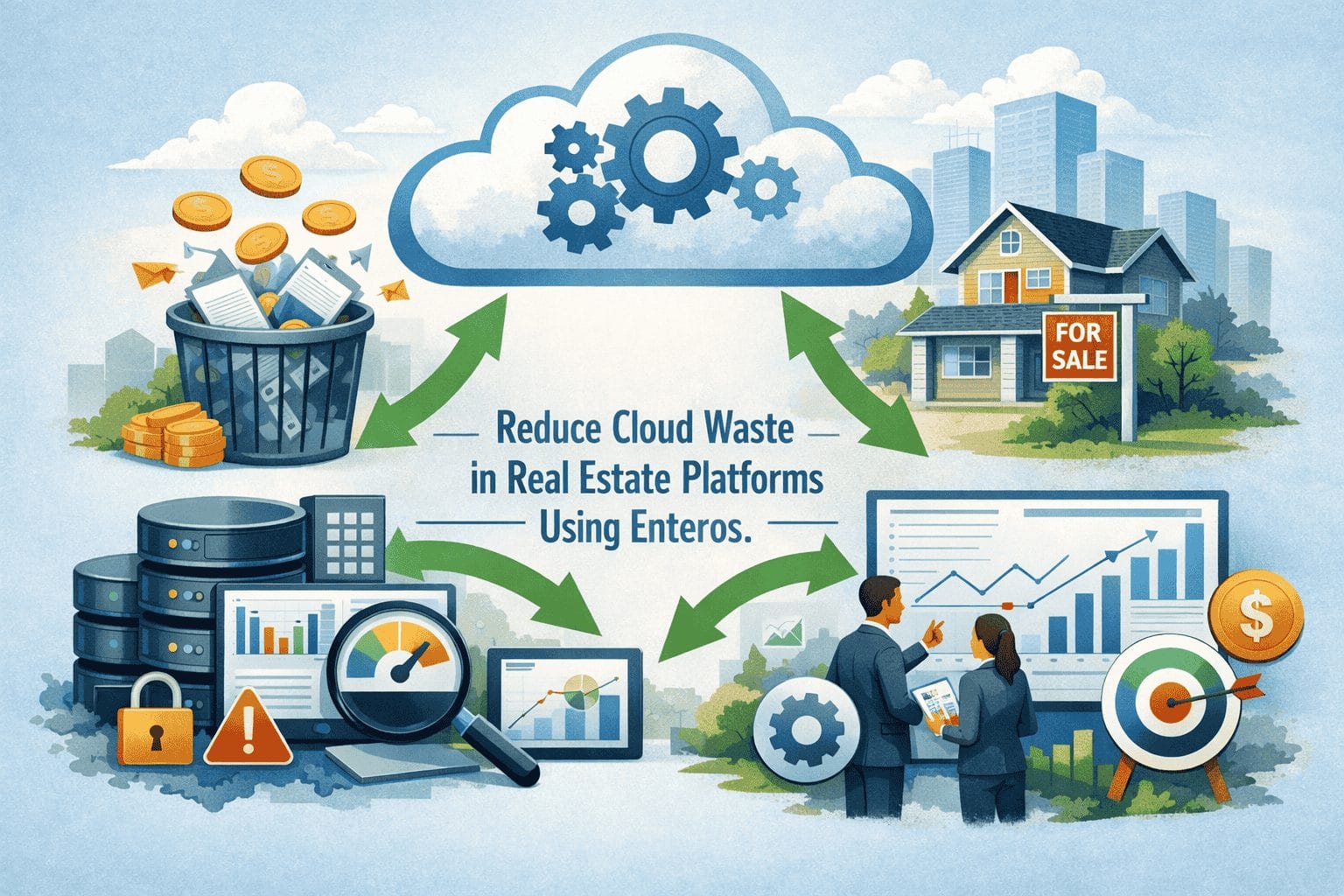
This is where Enteros transforms the equation. By combining AI-powered database intelligence, performance observability, cost attribution, and Cloud FinOps governance, Enteros enables real estate organizations to reduce cloud waste while improving performance and RevOps efficiency.
Let’s explore how.
1. The Real Estate Cloud Explosion: Growth Without Governance
Real estate platforms have evolved rapidly:
-
Property listing marketplaces
-
Lease management SaaS
-
Smart building IoT integrations
-
Tenant experience apps
-
Revenue forecasting tools
-
Investment analytics dashboards
Each of these systems runs on databases.
And databases are the largest cloud cost driver in most real estate IT environments.
Typical cloud issues in real estate platforms include:
-
Overprovisioned database instances “just in case”
-
Excessive storage growth without lifecycle management
-
Duplicate environments (dev/test/prod)
-
Unoptimized SQL increasing CPU consumption
-
Poor workload distribution across clusters
-
Lack of cost visibility per property or business unit
Without granular visibility, IT teams overspend to maintain “stability.”
Without cost attribution, finance cannot tie infrastructure to revenue.
Without performance intelligence, scaling becomes guesswork.
2. Where Cloud Waste Actually Happens in Database Environments
Cloud waste is rarely obvious. It hides in:
1️⃣ Idle Compute
Instances running at 10–15% utilization.
2️⃣ Inefficient Queries
Poorly written SQL that consumes excessive CPU and memory.
3️⃣ Storage Bloat
Historical listing data and logs retained indefinitely.
4️⃣ Redundant Replication
Multiple replicas created for “resilience” but rarely used.
5️⃣ Reactive Scaling
Scaling vertically instead of optimizing workloads.
In many real estate organizations, 30–40% of database cloud spend is avoidable with the right intelligence layer.
But traditional monitoring tools focus on uptime — not financial efficiency.
3. Enteros Database Intelligence: From Monitoring to Financial Optimization
Enteros goes beyond traditional monitoring. It provides:
-
Deep SQL-level analysis
-
Resource utilization modeling
-
AI-driven anomaly detection
-
Cost-performance correlation
-
Workload behavior insights
Instead of asking:
“Is the database up?”
Enteros enables teams to ask:
“Is the database financially optimized for this workload?”
The Key Shift:
Performance and cost are mathematically connected.
At a simplified level:
CloudCost=Compute+Storage+Network+IdleOverheadCloud Cost = Compute + Storage + Network + Idle Overhead
When SQL inefficiencies increase compute usage, costs rise.
When storage grows without governance, costs rise.
When idle overhead persists, costs rise.
Enteros makes these relationships visible and actionable.
4. Cloud FinOps for Real Estate: Turning Cost into a Managed KPI
Cloud FinOps is not just about reducing spend.
It’s about aligning cloud investment with business outcomes.
In real estate, this means connecting:
-
Property portfolio performance
-
Occupancy rates
-
Leasing velocity
-
Transaction volume
-
Investor ROI
With database infrastructure cost.
The Real Problem:
Most real estate CFOs see a single cloud bill.
They don’t see:
-
Which property system drives costs
-
Which region consumes excess compute
-
Which workload generates revenue vs waste
Enteros enables granular cost attribution, mapping database workloads to:
-
Individual properties
-
Geographic portfolios
-
Business units
-
Digital platforms
This transparency transforms cloud from an uncontrollable expense into a measurable operational lever.
5. AI-Driven SQL Optimization: The Fastest Path to Waste Reduction
In most real estate systems, inefficient SQL is the largest cost multiplier.
Examples include:
-
Unindexed search queries in listing platforms
-
Large joins across historical leasing data
-
Aggregation-heavy investor dashboards
-
Poor query plans in CRM integrations
These inefficiencies increase:
-
CPU consumption
-
Memory usage
-
Disk I/O
-
Scaling requirements
Enteros uses AI-powered SQL intelligence to:
-
Identify top cost-driving queries
-
Detect regression patterns
-
Recommend optimization paths
-
Quantify cost impact of improvements
The relationship between performance and cost can be conceptualized as:
PerformanceEfficiency∝1/ResourceWastePerformance Efficiency \propto 1 / Resource Waste
As waste decreases, efficiency increases.
As efficiency increases, required infrastructure decreases.
This is how performance optimization directly reduces cloud bills.
6. RevOps Efficiency: Connecting Infrastructure to Revenue Growth
Revenue Operations (RevOps) in real estate connects:
-
Marketing
-
Leasing
-
Sales
-
Property management
-
Finance
Digital systems power each of these functions.
When database performance degrades:
-
Listing searches slow down
-
Tenant portals lag
-
CRM data synchronization fails
-
Reporting dashboards delay
-
Leasing approvals stall
Performance inefficiencies don’t just increase costs — they reduce revenue velocity.
Enteros aligns infrastructure health with RevOps outcomes by:
-
Detecting anomalies before they impact tenant experience
-
Preventing checkout or application failures
-
Identifying database bottlenecks affecting lead conversion
-
Enabling proactive capacity planning
Instead of reacting to outages, real estate firms move toward predictive performance governance.
7. Real Estate Use Case: Reducing Cloud Waste with Enteros
Let’s consider a commercial real estate platform managing:
-
20,000 properties
-
Multi-region cloud deployment
-
High-volume listing traffic
-
Real-time tenant management
Initial Challenges:
-
35% database overprovisioning
-
Frequent performance spikes during listing updates
-
No cost attribution by property region
-
Escalating cloud bills year-over-year
Enteros Implementation:
-
SQL workload analysis identified top 5 cost-driving queries.
-
Idle compute instances were flagged across non-peak hours.
-
Storage growth trends were mapped to inactive data segments.
-
Cost was attributed to geographic regions.
Results:
-
22% reduction in database compute spend
-
18% storage optimization
-
30% fewer performance incidents
-
Improved leasing platform responsiveness
Most importantly, cloud spending became predictable and aligned with revenue-producing workloads.
8. From Reactive IT to Autonomous Database Governance
Traditional IT in real estate operates in firefighting mode:
-
Performance issue → Scale up
-
Complaint → Add resources
-
Traffic spike → Upgrade instance
Enteros enables a shift toward:
-
Predictive anomaly detection
-
Intelligent workload modeling
-
AI-assisted performance tuning
-
Continuous cost-performance governance
This is the foundation of autonomous database operations.
And for real estate firms competing in digital-first markets, this capability becomes a strategic differentiator.
9. The Strategic Impact: Competitive Advantage Through Efficiency
Reducing cloud waste is not just a financial win.
It enables:
-
Faster innovation cycles
-
Lower operating costs per property
-
Improved tenant digital experience
-
Higher investor confidence
-
Stronger EBITDA margins
In competitive real estate markets, cost efficiency + performance excellence = sustainable advantage.
Enteros transforms database infrastructure from a back-end technical concern into a revenue-aligned strategic asset.
10. The Future: AI-Native Real Estate Infrastructure
The next wave of real estate technology includes:
-
AI-driven pricing models
-
Predictive occupancy analytics
-
Smart building automation
-
Automated leasing workflows
-
Generative AI tenant engagement tools
All of these depend on optimized databases.
Without database intelligence, AI-driven growth will amplify cloud waste.
With Enteros, real estate platforms can scale confidently — knowing performance, cost, and revenue are aligned.
Conclusion: Cloud Waste Is Optional — Intelligence Is Not
Cloud overspend in real estate platforms is not inevitable.
It results from:
-
Lack of database visibility
-
Poor SQL optimization
-
No cost attribution
-
Reactive scaling practices
Enteros addresses all four.
By combining AI-driven database intelligence, Cloud FinOps governance, and RevOps alignment, Enteros empowers real estate organizations to:
-
Reduce cloud waste
-
Improve performance stability
-
Increase revenue velocity
-
Strengthen financial transparency
In today’s competitive property market, infrastructure efficiency is no longer an IT metric — it is a business imperative.
FAQ: Reducing Cloud Waste in Real Estate with Enteros
1. What causes the most cloud waste in real estate platforms?
The biggest drivers are overprovisioned databases, inefficient SQL queries, unused storage, and lack of cost attribution by property or business unit.
2. How does Enteros reduce database cloud costs?
Enteros analyzes SQL workloads, resource utilization, and performance patterns to identify inefficiencies and quantify their financial impact.
3. What is Cloud FinOps in real estate?
Cloud FinOps is the practice of aligning cloud infrastructure spending with property-level revenue, occupancy performance, and business outcomes.
4. How does database performance affect RevOps efficiency?
Slow databases impact tenant portals, leasing workflows, CRM integrations, and reporting systems — directly slowing revenue operations.
5. Can Enteros attribute costs to individual properties?
Yes. Enteros enables workload-level cost attribution, allowing organizations to map database consumption to properties, regions, or platforms.
6. Does reducing cloud waste affect performance negatively?
No. In fact, SQL optimization and workload tuning typically improve performance while reducing infrastructure needs.
7. How quickly can real estate firms see results?
Many organizations see measurable cost reductions and performance improvements within weeks of implementation.
8. Is Enteros suitable for multi-cloud real estate environments?
Yes. Enteros provides visibility across hybrid and multi-cloud database deployments.
9. How does AI improve database governance?
AI enables anomaly detection, regression identification, and intelligent workload forecasting — reducing manual intervention.
10. Why is cloud cost transparency important for CFOs?
Transparent cost attribution allows CFOs to align infrastructure spending with revenue-generating assets and improve margin planning.
The views expressed on this blog are those of the author and do not necessarily reflect the opinions of Enteros Inc. This blog may contain links to the content of third-party sites. By providing such links, Enteros Inc. does not adopt, guarantee, approve, or endorse the information, views, or products available on such sites.
Are you interested in writing for Enteros’ Blog? Please send us a pitch!
RELATED POSTS
What Causes Slow EHR Performance, and How Can Hospitals Fix It?
- 2 September 2026
- Database Performance Management
Slow EHR performance is commonly caused by inefficient SQL queries, poor indexing, database locking, high concurrency, storage latency, insufficient resources, workload spikes, and execution-plan changes. Hospitals can improve performance through continuous database monitoring, SQL optimization, anomaly detection, root cause analysis, capacity planning, and intelligent observability. Enteros helps healthcare IT teams identify bottlenecks and support proactive … Continue reading “What Causes Slow EHR Performance, and How Can Hospitals Fix It?”
How Can Retailers Keep Databases Fast During Sales, Promotions, and Peak Shopping Periods?
Retailers can maintain fast retail database performance during sales and peak shopping periods by optimizing SQL queries, improving indexes, monitoring workloads continuously, detecting anomalies, planning capacity, and scaling resources intelligently. Effective database optimization for eCommerce helps prevent checkout delays, inventory bottlenecks, and slow product searches. Enteros provides AI-powered observability and performance intelligence to support reliable, … Continue reading “How Can Retailers Keep Databases Fast During Sales, Promotions, and Peak Shopping Periods?”
How Can Telecom Providers Reduce Database Downtime and Improve Customer Experience?
Improving telecom database performance requires continuous monitoring, SQL optimization, anomaly detection, intelligent capacity planning, and faster root cause analysis. Effective database monitoring for telecom companies helps providers identify bottlenecks before they disrupt billing, subscriber services, provisioning, or customer applications. Enteros provides AI-powered database observability that helps telecom teams improve uptime, reliability, scalability, operational efficiency, and … Continue reading “How Can Telecom Providers Reduce Database Downtime and Improve Customer Experience?”
How Can Retail Companies Improve Database Performance for Faster Customer Transactions?
Improving retail database performance requires continuous monitoring, SQL query optimization, workload analysis, intelligent indexing, anomaly detection, and proactive capacity planning. Retailers should identify bottlenecks before they affect checkout, payments, inventory, or product searches. Enteros helps retail IT teams use AI-driven observability, predictive analytics, and performance intelligence to improve transaction speed, scalability, reliability, and overall digital … Continue reading “How Can Retail Companies Improve Database Performance for Faster Customer Transactions?”