MongoDB Documentation

MongoDB Documentation – There are several methods to update Document in MongoDB:
- updateOne: refreshes one document that meets the filtering criteria and returns information about the update operation
- updateMany: refreshes all documents that meet the filtering criteria and returns information about the update operation
- findOneAndUpdate: refreshes one document that meets the filter criteria and returns an updated document.
findOneAndUpdate
The findOneAndUpdate() method updates one element. It accepts the following parameters:
- The criterion for filtering the document to be updated
- Update option
- Additional update options, which are null by default
- The callback function that is performed during an update
For example, let’s update the first user in the database who is 21 years old:
const MongoClient = require("mongodb").MongoClient;
const url = "mongodb://localhost:27017/";
const mongoClient = new MongoClient(url, { useNewUrlParser: true });
let users = [{name: "Bob", age: 34} , {name: "Alice", age: 21}, {name: "Tom", age: 45}];
mongoClient.connect(function(err, client){
if(err) return console.log(err);
const db = client.db("usersdb");
const col = db.collection("usersdb");
col.insertMany(users, function(err, results){
col.findOneAndUpdate(
{age: 21}, // sampling criterion
{$set: {age: 25}}, // update parameter
function(err, result){
console.log(result);
client.close();
}
);
});
});
At first, 3 users shall be added to the database, and after the addition is updated.
The object { $set shall be used for updating: object {age: 25}}. The $set parameter shall update the values for a single field or group of fields. In this case, the age field shall be changed.
The third parameter, the callback function, displays the update result. By default, this is the old state of the modified document:
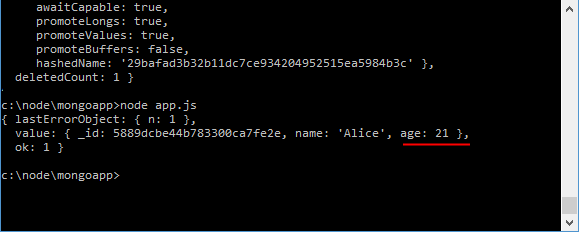
But, let’s say, after the update, we want to get not the old but the new state of the modified document. To do this, we can specify additional update options.
const MongoClient = require("mongodb").MongoClient;
const url = "mongodb://localhost:27017/";
const mongoClient = new MongoClient(url, { useNewUrlParser: true });
mongoClient.connect(function(err, client){
if(err) return console.log(err);
const db = client.db("usersdb");
const col = db.collection("usersdb");
col.findOneAndUpdate(
{name: "Bob"}, // sampling criterion
{$set: {name: "Sam"}}, // update parameter
{ // additional update options
returnOriginal: false
},
function(err, result){
console.log(result);
client.close();
}
);
});

updateMany
The updateMany() method allows you to update all documents in the collection that meet the filtering criteria:
const MongoClient = require("mongodb").MongoClient;
const url = "mongodb://localhost:27017/";
const mongoClient = new MongoClient(url, { useNewUrlParser: true });
mongoClient.connect(function(err, client){
if(err) return console.log(err);
const db = client.db("usersdb");
const col = db.collection("usersdb");
col.updateMany(
{name: "Sam"}, // filter criterion
{$set: {name: "Bob"}}, // update parameter
function(err, result){
console.log(result);
client.close();
}
);
});
updateOne
The updateOne() method is similar to the updateMany method except that it updates only one element. Unlike the findOneAndUpdate() method, it does not return a modified document:
const MongoClient = require("mongodb").MongoClient;
const url = "mongodb://localhost:27017/";
const mongoClient = new MongoClient(url, { useNewUrlParser: true });
mongoClient.connect(function(err, client){
if(err) return console.log(err);
const db = client.db("usersdb");
const col = db.collection("usersdb");
col.updateOne(
{name: "Tom"},
{$set: {name: "Tom Junior", age:33}},
function(err, result){
console.log(result);
client.close();
}
);
});
Database, Collections, Documents: MongoDB
Enteros
About Enteros
IT organizations routinely spend days and weeks troubleshooting production database performance issues across multitudes of critical business systems. Fast and reliable resolution of database performance problems by Enteros enables businesses to generate and save millions of direct revenue, minimize waste of employees’ productivity, reduce the number of licenses, servers, and cloud resources and maximize the productivity of the application, database, and IT operations teams.
The views expressed on this blog are those of the author and do not necessarily reflect the opinions of Enteros Inc. This blog may contain links to the content of third-party sites. By providing such links, Enteros Inc. does not adopt, guarantee, approve, or endorse the information, views, or products available on such sites.
Are you interested in writing for Enteros’ Blog? Please send us a pitch!
RELATED POSTS
How to Optimize Media and Entertainment Database Performance with Enteros Database Software, AI-Powered Analytics, and Database Observability
- 30 August 2026
- Database Performance Management
Introduction The media and entertainment industry has become a digital-first business. Streaming services, digital publishing, online gaming content, advertising platforms, social experiences, content management systems, subscription platforms, and personalized recommendations all depend on databases. Modern media companies process enormous volumes of customer, content, advertising, transaction, and behavioral information. Read more”Indian Country” highlights Enteros and its … Continue reading “How to Optimize Media and Entertainment Database Performance with Enteros Database Software, AI-Powered Analytics, and Database Observability”
How to Optimize Manufacturing Database Performance with Enteros Database Software, AIOps, and Predictive Analytics
Introduction Manufacturing is becoming increasingly dependent on digital infrastructure. Modern factories use enterprise resource planning (ERP), manufacturing execution systems (MES), supply-chain platforms, warehouse management systems, industrial IoT, quality management applications, predictive maintenance, and advanced analytics to manage production. Behind these systems are databases processing enormous amounts of operational information. Production schedules, inventory levels, machine data, … Continue reading “How to Optimize Manufacturing Database Performance with Enteros Database Software, AIOps, and Predictive Analytics”
The Future of Industry-Specific Cloud Optimization with AIOps, FinOps, and AI-Powered Database Management
- 28 August 2026
- Database Performance Management
Introduction Cloud computing has become a foundational component of digital transformation across industries. Banking organizations use cloud platforms to support digital payments and online banking. Healthcare providers rely on cloud infrastructure for digital health applications and patient services. Educational institutions operate learning management systems and virtual classrooms in the cloud. Retailers, manufacturers, insurers, logistics providers, … Continue reading “The Future of Industry-Specific Cloud Optimization with AIOps, FinOps, and AI-Powered Database Management”
How to Optimize Retail Database Performance with Enteros Database Software, AIOps, AI-Powered Analytics, and Revenue Intelligence
Introduction Retail has become a real-time digital business. Ecommerce, mobile applications, point-of-sale systems, inventory platforms, loyalty programs, customer analytics, supply chain systems, recommendation engines, and payment platforms all depend on databases. Retailers also experience highly variable demand. Read more”Indian Country” highlights Enteros and its database performance management platform *Black Friday, holiday shopping, product launches, flash … Continue reading “How to Optimize Retail Database Performance with Enteros Database Software, AIOps, AI-Powered Analytics, and Revenue Intelligence”