Introduction
The financial sector, increasingly dependent on cloud-native technologies, faces unique challenges in managing vast data volumes, compliance obligations, and cost control. With this backdrop, optimizing cloud budgeting becomes not only a necessity for financial firms but also a strategic differentiator. Revenue Operations (RevOps), when combined with performance monitoring and advanced database management, becomes a powerful lever for operational efficiency.
Enteros, a modern AIOps and observability platform, brings a robust approach to cloud cost management, resource planning, and database performance—empowering financial institutions to create more accurate budgets, increase ROI, and align IT operations with business growth.
The Financial Sector’s Cloud Budgeting Landscape
Cloud transformation in banking, insurance, and financial services offers flexibility, scalability, and innovation. However, it also introduces complexities in tracking expenses across multi-cloud environments, forecasting future usage, and assigning accurate costs to different departments or business units.
Financial organizations struggle with:
-
Unpredictable cloud spend due to overprovisioned resources.
-
Poor cost attribution leading to budgeting errors.
-
Underutilized services, like idle storage or unused compute instances.
-
Compliance and regulatory overhead in resource tracking.
To navigate this complexity, financial institutions need real-time visibility, performance insights, and forecasting tools rooted in data science—capabilities that Enteros enables.
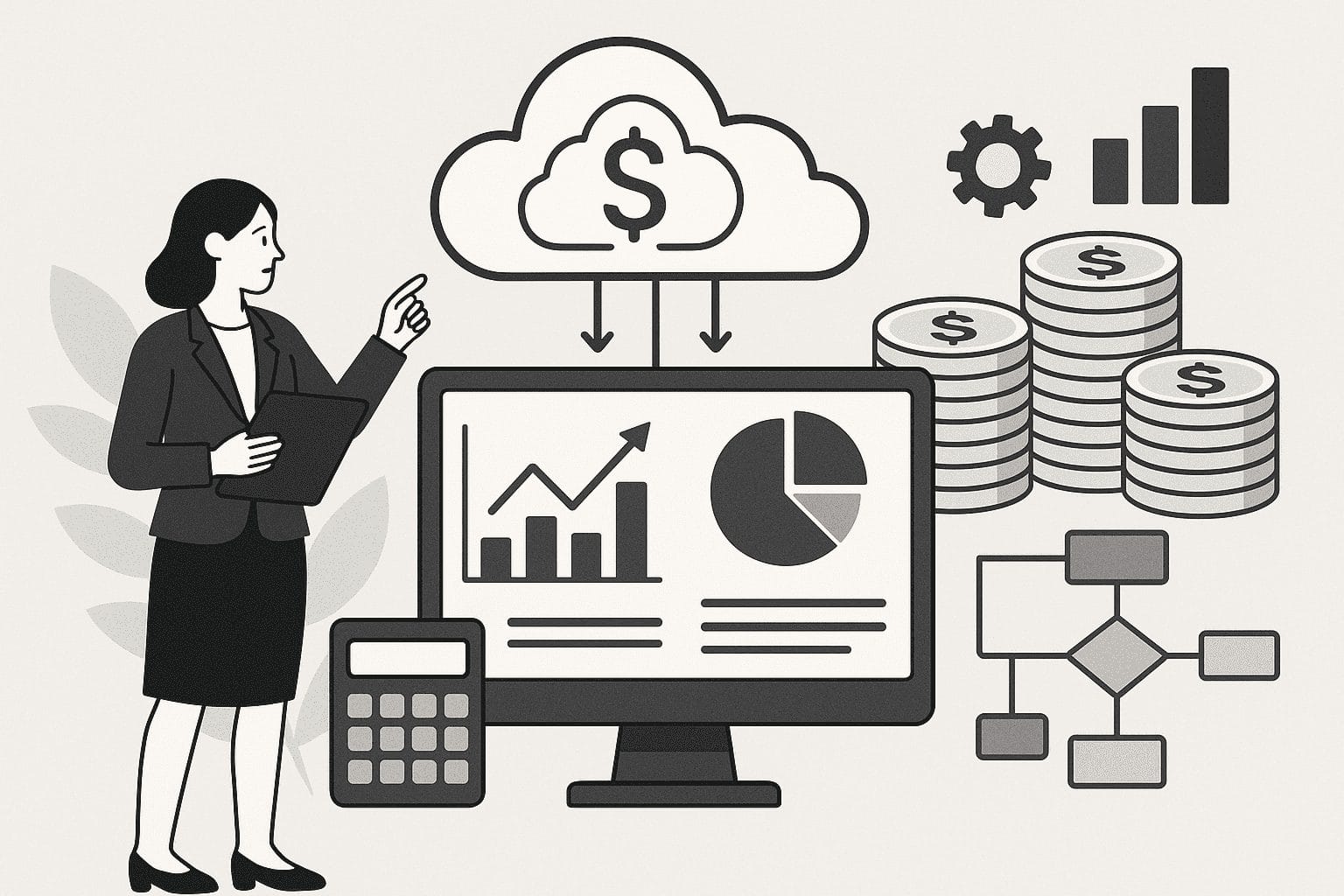
Introducing Enteros: A Game-Changer in Cloud-Based Budgeting
Enteros is an AIOps-driven observability platform purpose-built to improve database performance and control cloud costs through data-driven insights. At its core, Enteros supports:
-
Performance monitoring
-
Database workload analytics
-
Cloud FinOps
-
Resource group modeling
-
Revenue operations (RevOps) alignment
By combining statistical learning algorithms with dynamic infrastructure insights, Enteros supports proactive cost control and budget forecasting in complex IT environments.
Key Features of Enteros That Support Financial Sector Budgeting
1. Database Performance Optimization
Databases are the heartbeat of any financial service. Whether it’s real-time transaction processing, credit scoring, fraud detection, or risk analysis, performance lag can impact both customer experience and regulatory compliance.
Enteros continuously monitors database workloads, identifies anomalies, and detects root causes of inefficiencies—such as poorly optimized queries, lock contention, or inefficient indexing. This not only enhances performance but also reduces compute usage and costs.
Impact on Budgeting:
-
Fewer resources required for peak performance
-
Reduced need for overprovisioning
-
Accurate modeling of resource usage over time
2. Intelligent Resource Grouping
Financial institutions typically operate with hundreds of cloud services spread across departments, functions, and geographies. Enteros enables logical resource grouping, helping organizations to:
-
Allocate costs per team or application
-
Understand shared resource dependencies
-
Model departmental cloud usage behavior
These resource groups enable granular visibility and cost control, which is essential for precise budgeting and chargeback models.
3. AIOps-Powered Forecasting Models
Enteros integrates machine learning algorithms to project future usage and costs. These predictive models consider historical usage trends, seasonal fluctuations, and event-driven spikes (e.g., end-of-quarter reporting or tax season).
This forecasting capability helps IT and finance teams prepare for upcoming needs with improved accuracy.
Impact on Financial Institutions:
-
Improved budget forecasting
-
Avoidance of surprise costs
-
Preparation for compliance audits
4. Integration with Revenue Operations (RevOps)
RevOps integrates sales, marketing, and customer success to drive revenue growth. In financial firms, aligning RevOps with IT operations is crucial to ensure:
-
Reliable digital services for customers
-
Accurate data flow for customer analytics
-
Lower operational costs contributing to profit margins
Enteros supports RevOps by ensuring reliable infrastructure, tracking usage-based costs, and linking IT activities to business outcomes.
5. Cloud Cost Estimation and Budget Reporting
Enteros transforms complex usage data into digestible reports, enabling cost estimation based on amortized, unblended, and blended billing models. This includes:
-
Cost per application or business unit
-
Variance against budget forecasts
-
Trends over time for future planning
These insights are vital in the financial sector where governance and accountability are tightly monitored.
6. Compliance and Governance Support
Enteros supports data lineage, access control monitoring, and performance logs—ensuring transparency for audits and financial regulations like SOX, GDPR, and PCI-DSS.
By offering traceable usage and cost data, it helps finance and IT teams stay compliant while optimizing budgets.
Real-World Use Case: A Mid-Sized Bank in Transition
A regional bank migrating to AWS encountered spiraling cloud costs, especially in its analytics division. Using Enteros, the bank was able to:
-
Identify 23% overprovisioned compute resources
-
Reallocate database instances to appropriate tiers
-
Implement workload forecasting to inform budgets
-
Model resource groups aligned with departments
The result: a 17% reduction in monthly cloud spend, improved forecasting accuracy, and smoother collaboration between IT and finance.
Benefits Summary
| Benefit | Description |
|---|---|
| Accurate Forecasting | Predict future usage and budget with ML models |
| Performance Tuning | Lower resource usage through optimized queries |
| Resource Visibility | Track usage per team or project |
| Cost Attribution | Assign costs correctly across departments |
| Operational Efficiency | Reduce waste and improve system uptime |
| Regulatory Compliance | Transparent logs and audit trails |
Frequently Asked Questions (FAQs)
Q1: What makes Enteros different from traditional monitoring tools?
Enteros combines performance observability with cloud cost analytics, while most monitoring tools focus solely on uptime or alerts. It provides AI-driven insights across both performance and financial dimensions.
Q2: How does Enteros support Cloud FinOps in practice?
It integrates with cloud providers to deliver real-time usage and cost data, offers forecasting tools, and supports cost attribution models that help FinOps teams track spending by team, application, or feature.
Q3: Can Enteros help reduce cloud costs?
Yes. Enteros identifies idle resources, over-provisioned systems, and inefficient workloads. These insights allow organizations to reduce unnecessary spend without compromising performance.
Q4: Which databases are supported by Enteros?
Enteros supports a wide range including Oracle, SQL Server, PostgreSQL, MySQL, MongoDB, and cloud databases such as AWS RDS and Azure SQL.
Q5: Is Enteros suitable for startups as well as large enterprises?
Yes. Its modular pricing and flexible architecture allow organizations of any size to adopt Enteros and scale as they grow.
Q6: Can Enteros integrate with existing DevOps and CI/CD workflows?
Absolutely. It supports integrations with Jenkins, GitHub Actions, Terraform, Kubernetes, and can trigger alerts and actions via popular messaging and ITSM platforms.
The views expressed on this blog are those of the author and do not necessarily reflect the opinions of Enteros Inc. This blog may contain links to the content of third-party sites. By providing such links, Enteros Inc. does not adopt, guarantee, approve, or endorse the information, views, or products available on such sites.
Are you interested in writing for Enteros’ Blog? Please send us a pitch!
RELATED POSTS
How Can Banks Improve Database Performance for Real-Time Payment Processing?
- 7 September 2026
- Database Performance Management
Strong bank database performance is essential for real-time payment processing because every payment depends on databases retrieving, validating, updating, and recording financial information with minimal delay. Banks can improve bank database performance by optimizing high-impact SQL queries, reducing locking and resource contention, monitoring transaction latency, establishing workload baselines, planning capacity, and using database observability to … Continue reading “How Can Banks Improve Database Performance for Real-Time Payment Processing?”
How Can Database Observability Help Banks Prevent Transaction Failures and Downtime?
With database observability, banks can identify performance anomalies, see how databases are performing, find bottlenecks, and troubleshoot the root causes of transaction failures before they turn into major service outages. Database observability provides banking IT teams with increased visibility into queries, workloads, resource consumption, waits, blocking and performance patterns as they evolve. This proactive visibility … Continue reading “How Can Database Observability Help Banks Prevent Transaction Failures and Downtime?”
How Can Database Observability Help Retail Companies Resolve Performance Issues Faster?
Database observability for retail helps retailers detect, understand, and resolve performance problems faster by providing deep visibility into database workloads, queries, waits, anomalies, and dependencies. Instead of reacting only after applications slow down, retail IT teams can identify root causes earlier, reduce troubleshooting time, improve uptime, and strengthen database performance monitoring for retail across stores, … Continue reading “How Can Database Observability Help Retail Companies Resolve Performance Issues Faster?”
How Can Database Observability Help Telecom Companies Resolve Performance Issues Faster?
Database observability for telecom helps telecom companies detect, investigate, and resolve database performance problems faster by providing deeper visibility into queries, workloads, waits, dependencies, and anomalies. Instead of relying only on basic infrastructure metrics, teams can identify root causes sooner, reduce troubleshooting time, improve service reliability, and support stronger telecom database performance across complex, high-volume … Continue reading “How Can Database Observability Help Telecom Companies Resolve Performance Issues Faster?”