Introduction
Digital payment platforms have become the backbone of the global digital economy. From mobile wallets and online banking to peer-to-peer transfers and real-time payment gateways, billions of financial transactions are processed every day. Consumers and businesses expect instant, secure, and reliable payment experiences, making performance a critical factor for payment infrastructure.
Behind every seamless digital payment lies a complex network of applications, APIs, and databases processing transaction requests in milliseconds. However, as payment platforms scale and transaction volumes grow, database performance challenges become increasingly difficult to manage.
Traditional monitoring tools often struggle to keep up with modern, cloud-native payment ecosystems. They generate alerts but fail to deliver deep insights or predictive intelligence. As a result, organizations frequently discover performance issues only after customers experience delays or transaction failures.
This is where intelligent database performance monitoring powered by AI, machine learning, and advanced analytics is transforming how payment platforms manage and optimize their infrastructure.
Modern platforms such as Enteros UpBeat enable organizations to move beyond reactive monitoring toward proactive performance optimization. By analyzing thousands of database metrics in real time, these platforms detect anomalies, predict potential bottlenecks, and automatically recommend optimization strategies.
In this blog, we explore how intelligent database monitoring helps digital payment platforms deliver faster transactions, stronger reliability, and scalable financial infrastructure.
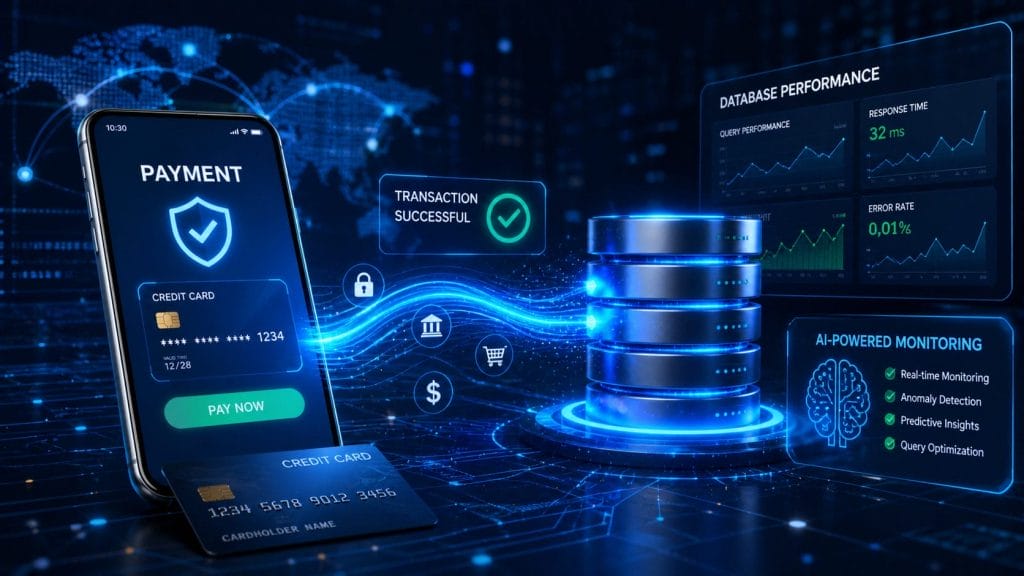
A digital illustration of mobile payment with a credit card, a smartphone, database icons, and data analytics graphics showing secure, successful transaction and AI-powered monitoring for optimizing database performance.
The Rise of Digital Payment Ecosystems
Over the past decade, digital payment systems have evolved dramatically. Today’s platforms power a wide range of financial activities including:
- Mobile payments
- Online banking transfers
- E-commerce checkouts
- Digital wallets
- Subscription payments
- Real-time settlement systems
These platforms operate in highly dynamic environments where millions of users may access services simultaneously. Payment infrastructures must therefore support:
- High transaction throughput
- Low latency processing
- Real-time fraud detection
- Regulatory compliance
- 24/7 availability
Even a few milliseconds of delay can impact customer experience, disrupt financial workflows, or cause failed transactions.
At the center of this entire ecosystem lies one critical component: database performance.
Why Database Performance Matters in Digital Payments
Digital payment platforms rely heavily on databases to store, retrieve, and process transactional data. Each payment request triggers multiple database operations including:
- Transaction validation
- Account balance verification
- Fraud detection checks
- Payment authorization
- Transaction logging
- Settlement updates
When databases perform efficiently, payments are processed instantly. However, if database performance degrades, payment platforms can experience:
- Slow transaction processing
- Failed payment requests
- System downtime
- Customer dissatisfaction
- Revenue loss
Modern digital payment infrastructures generate massive volumes of data that must be processed in real time. Financial systems often manage millions of transactions per minute, making performance optimization essential.
Key Database Performance Challenges in Payment Platforms
Despite advances in cloud technology and distributed architectures, payment platforms continue to face several performance challenges.
1. High Transaction Volumes
Digital payment systems must process enormous transaction volumes. During peak periods such as sales events or holidays, payment platforms may experience traffic spikes that strain database infrastructure.
Without intelligent monitoring, sudden workload increases can lead to resource bottlenecks and degraded performance.
2. Complex Distributed Architectures
Modern payment platforms operate across hybrid and multi-cloud environments. Databases may span multiple regions, services, and storage systems.
This complexity makes it difficult for traditional monitoring tools to provide a unified view of performance across infrastructure layers.
3. Query Inefficiencies
Poorly optimized SQL queries, inefficient indexing strategies, and outdated database configurations can significantly impact performance.
As payment systems scale, these inefficiencies become more difficult to identify and resolve manually.
4. Incident Overload for DevOps Teams
Operations teams often face alert fatigue due to large volumes of monitoring notifications.
Traditional monitoring tools may generate thousands of alerts without providing clear root-cause insights, slowing down incident resolution.
5. Rising Infrastructure Costs
Overprovisioning database resources is a common strategy used to maintain performance. However, this approach significantly increases cloud infrastructure costs.
Organizations need intelligent insights that balance performance optimization with cost efficiency.
The Role of Intelligent Database Performance Monitoring
To address these challenges, modern digital payment platforms are adopting AI-driven database performance monitoring.
Unlike traditional monitoring solutions, intelligent platforms analyze large volumes of performance data and automatically identify hidden patterns, anomalies, and optimization opportunities.
Advanced platforms use statistical models, machine learning algorithms, and predictive analytics to continuously monitor database environments.
These systems deliver key capabilities such as:
- Real-time performance analytics
- Automated anomaly detection
- Predictive performance insights
- Query optimization recommendations
- Intelligent root-cause analysis
By leveraging these capabilities, organizations can detect potential issues long before they impact customers.
How AI-Driven Monitoring Optimizes Payment Platforms
1. Real-Time Anomaly Detection
AI-powered monitoring platforms continuously analyze database performance metrics including:
- Query latency
- CPU utilization
- Memory usage
- Lock contention
- Transaction throughput
Machine learning models establish performance baselines and automatically detect deviations from normal behavior.
This enables teams to identify potential issues early and take corrective action before performance deteriorates.
2. Automated SQL Query Optimization
Payment platforms rely heavily on complex SQL queries for transaction processing and analytics.
AI-driven monitoring tools analyze query execution plans and recommend optimization strategies such as:
- Query rewriting
- Index optimization
- Partitioning strategies
- Statistics updates
Automated SQL optimization significantly reduces query latency and improves overall system efficiency.
3. Intelligent Root Cause Analysis
One of the most valuable features of intelligent monitoring platforms is automated root cause analysis.
Instead of simply generating alerts, these systems correlate performance data across:
- Databases
- Applications
- Cloud infrastructure
- Microservices
- Network layers
This correlation enables teams to identify the true cause of performance problems in seconds rather than hours.
4. Predictive Performance Insights
AI systems analyze historical workload data and predict future performance trends.
This allows organizations to anticipate potential issues such as:
- Capacity limitations
- Query performance regressions
- Resource saturation
- Infrastructure bottlenecks
Predictive insights help teams proactively optimize infrastructure before problems arise.
5. Cost-Efficient Infrastructure Optimization
Intelligent monitoring platforms also provide insights into database resource utilization.
By identifying underutilized or inefficient resources, organizations can optimize infrastructure provisioning and reduce cloud spending.
This approach aligns performance optimization with financial efficiency.
Benefits of Intelligent Database Monitoring for Payment Platforms
Adopting AI-driven database performance monitoring provides several strategic advantages for digital payment platforms.
1. Faster Transaction Processing
Optimized databases ensure payment requests are processed quickly, reducing latency and improving customer satisfaction.
2. Improved System Reliability
Proactive monitoring prevents downtime and ensures payment platforms remain available even during high traffic periods.
3. Enhanced Fraud Detection Infrastructure
Real-time database performance supports advanced fraud detection systems that rely on rapid analytics and data processing.
4. Reduced Operational Complexity
Automated performance insights reduce the need for manual troubleshooting and simplify infrastructure management.
5. Lower Cloud Infrastructure Costs
AI-driven optimization helps organizations eliminate resource waste and optimize infrastructure utilization.
The Future of Digital Payment Performance Management
As digital payment ecosystems continue to grow, database performance management will become even more critical.
Emerging trends shaping the future include:
AI-Driven Autonomous Operations
Future database systems will increasingly rely on self-optimizing algorithms capable of automatically tuning performance.
Real-Time Financial Analytics
Payment platforms will require faster data processing capabilities to support advanced analytics and personalized financial services.
Multi-Cloud Payment Infrastructure
Organizations will deploy payment platforms across multiple cloud environments to improve scalability and resilience.
AI-Enhanced Fraud Prevention
Intelligent systems will analyze transaction patterns in real time to detect fraud more accurately and efficiently.
Conclusion
Digital payment platforms operate in one of the most demanding technology environments. With millions of transactions processed every minute, database performance plays a critical role in ensuring seamless financial operations.
Traditional monitoring tools are no longer sufficient to manage the complexity and scale of modern payment infrastructures. Instead, organizations must adopt intelligent database performance monitoring powered by AI and advanced analytics.
Platforms such as Enteros UpBeat enable organizations to move from reactive monitoring to proactive optimization by delivering real-time insights, automated root cause analysis, predictive intelligence, and cost-efficient performance management.
By embracing intelligent monitoring strategies, digital payment providers can ensure faster transactions, stronger infrastructure reliability, and scalable financial services for the future.
FAQs
1. Why is database performance important for digital payment platforms?
Digital payment systems rely on databases to process transactions, verify balances, and store financial records. Poor database performance can cause slow transactions, payment failures, and system downtime.
2. What is intelligent database performance monitoring?
Intelligent monitoring uses AI and machine learning to analyze database metrics, detect anomalies, and automatically recommend optimization strategies.
3. How does AI improve payment infrastructure performance?
AI analyzes large volumes of database performance data to identify patterns, detect performance bottlenecks, and predict future issues before they impact users.
4. Can intelligent monitoring reduce infrastructure costs?
Yes. By identifying inefficient resource usage and optimizing database workloads, AI-driven monitoring platforms help organizations reduce cloud infrastructure expenses.
5. What challenges do payment platforms face with database performance?
Common challenges include high transaction volumes, query inefficiencies, complex cloud environments, alert fatigue, and rising infrastructure costs.
The views expressed on this blog are those of the author and do not necessarily reflect the opinions of Enteros Inc. This blog may contain links to the content of third-party sites. By providing such links, Enteros Inc. does not adopt, guarantee, approve, or endorse the information, views, or products available on such sites.
Are you interested in writing for Enteros’ Blog? Please send us a pitch!
RELATED POSTS
What Should Healthcare IT Teams Know About AI-Driven Database Root Cause Analysis?
- 1 September 2026
- Database Performance Management
AI database root cause analysis helps healthcare IT teams identify why database performance problems occur by correlating SQL behavior, resource utilization, workload changes, wait events, locking, and historical patterns. Combined with AI database performance monitoring, it enables faster troubleshooting, earlier anomaly detection, and more proactive optimization. Enteros helps healthcare organizations investigate complex database issues before … Continue reading “What Should Healthcare IT Teams Know About AI-Driven Database Root Cause Analysis?”
How Can Hospitals Improve EHR Performance With AI-Powered Database Monitoring?
Improving EHR database performance requires continuous monitoring of SQL workloads, query latency, resource utilization, locking, wait events, and transaction patterns. AI-powered database monitoring helps hospitals detect anomalies, identify root causes, optimize inefficient queries, and anticipate capacity issues before clinicians are affected. Enteros provides intelligent database observability that helps healthcare IT teams improve EHR reliability, responsiveness, … Continue reading “How Can Hospitals Improve EHR Performance With AI-Powered Database Monitoring?”
How Does Cloud FinOps Help Banks Control Database Costs and Improve IT Efficiency?
FinOps for banks helps financial institutions control database costs by connecting cloud spending with actual workload usage, database performance, and business requirements. It enables cost visibility, accurate allocation, resource right-sizing, forecasting, and continuous optimization. Combined with database observability, database cost optimization for banks can reduce waste while protecting transaction speed, availability, scalability, security, and overall … Continue reading “How Does Cloud FinOps Help Banks Control Database Costs and Improve IT Efficiency?”
What Are the Best Ways to Improve Database Performance in Banking and BFSI?
Improving database performance in banking requires continuous database monitoring, SQL query optimization, intelligent indexing, capacity planning, anomaly detection, and proactive root cause analysis. Banks should also establish performance baselines and use AI-powered database observability to identify issues before transactions are affected. Enteros helps banking and BFSI organizations improve database reliability, scalability, efficiency, and transaction performance … Continue reading “What Are the Best Ways to Improve Database Performance in Banking and BFSI?”