The healthcare sector is undergoing a rapid digital transformation. Hospitals, clinics, research centers, and telemedicine providers increasingly rely on sophisticated IT infrastructures to manage patient records, support diagnostics, and enable data-driven decision-making. From Electronic Health Records (EHR) and imaging systems to remote patient monitoring platforms and clinical analytics, modern healthcare environments generate massive volumes of data every day.
To manage these complex ecosystems, healthcare organizations must ensure that their database systems remain fast, reliable, and scalable. Even minor performance issues can disrupt clinical workflows, delay patient care, and increase operational costs. AI-driven database monitoring has emerged as a powerful solution for maintaining high performance in these mission-critical environments.
Platforms like Enteros leverage artificial intelligence, machine learning, and advanced analytics to continuously monitor database workloads, detect anomalies, and optimize performance across healthcare IT infrastructures. This article explores how AI-driven database monitoring helps healthcare organizations improve system reliability, reduce costs, and support better patient outcomes.
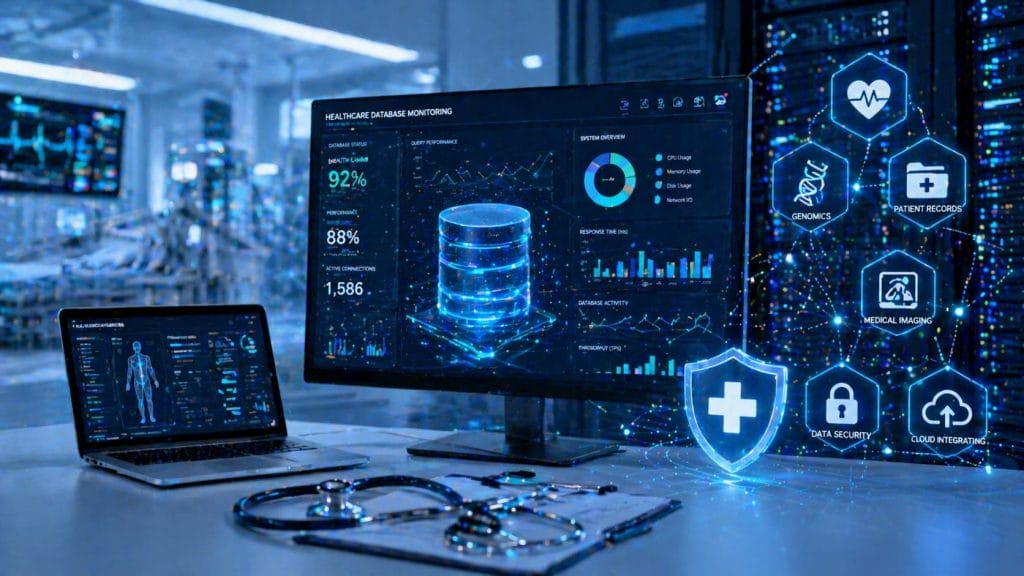
A computer monitor and laptop display healthcare data analytics; medical icons, digital security graphics, and AI-driven database monitoring visuals are overlaid, with a stethoscope and clipboard on the desk—a nod to modern Healthcare IT.
The Growing Role of Data in Healthcare IT
Healthcare organizations depend on data to power nearly every aspect of their operations. Modern healthcare IT systems integrate multiple applications and databases, including:
- Electronic Health Record (EHR) systems
- Hospital Information Systems (HIS)
- Telemedicine platforms
- Medical imaging databases
- Clinical research data systems
- Billing and insurance platforms
- Patient portals and mobile health applications
These systems must process and store enormous volumes of data generated by patient interactions, medical devices, and diagnostic technologies. Healthcare data is expanding rapidly due to innovations such as wearable health devices, genomic research, and AI-driven clinical analytics.
As the healthcare industry becomes more data-centric, database performance becomes a critical component of patient care and operational efficiency.
Why Database Performance Is Critical in Healthcare
Databases serve as the backbone of healthcare IT infrastructure. They store patient histories, medical imaging results, treatment plans, and financial records. Healthcare professionals rely on these systems to access information quickly and accurately.
Poor database performance can lead to several problems, including:
- Delayed access to patient records
- Slow diagnostic workflows
- Disrupted clinical operations
- Reduced productivity for healthcare staff
- Increased risk of system outages
For example, when clinicians experience slow database queries during patient consultations, treatment decisions may be delayed. Healthcare organizations must therefore ensure that their database environments operate with high availability and minimal latency.
Modern healthcare systems operate 24/7, making downtime or slow performance unacceptable. Reliable database monitoring and optimization tools are essential to maintaining continuous system availability.
Challenges in Healthcare Database Management
Managing database performance in healthcare environments is particularly challenging due to the complexity of healthcare IT ecosystems.
Rapid Data Growth
Healthcare generates massive amounts of structured and unstructured data, including medical imaging files, patient records, and research datasets. These growing datasets place significant pressure on database infrastructure and storage systems.
Complex IT Environments
Many healthcare organizations operate hybrid IT environments that combine on-premises databases with cloud platforms. Monitoring performance across multiple database technologies can be difficult without advanced analytics tools.
Compliance and Security Requirements
Healthcare data is highly sensitive and subject to strict regulatory frameworks such as HIPAA and GDPR. Monitoring tools must ensure that data access, usage patterns, and system activity remain compliant with these regulations.
Real-Time Performance Requirements
Healthcare professionals often require real-time access to medical data for diagnosis and treatment decisions. Any delay in retrieving information can negatively impact patient outcomes.
Rising Infrastructure Costs
Cloud adoption has improved scalability for healthcare organizations but has also introduced new cost management challenges. Inefficient database workloads can lead to higher cloud spending.
These challenges highlight the need for intelligent monitoring platforms capable of analyzing complex database environments in real time.
What Is AI-Driven Database Monitoring?
AI-driven database monitoring uses machine learning algorithms and advanced analytics to analyze database performance metrics continuously. Unlike traditional monitoring tools that rely on manual alerts, AI-powered systems automatically detect anomalies and predict potential issues.
AI monitoring platforms evaluate multiple performance indicators, including:
- Query execution times
- CPU and memory utilization
- Transaction throughput
- Disk I/O performance
- Database lock contention
By analyzing these metrics in real time, AI systems can detect abnormal patterns that may indicate emerging performance problems.
AI monitoring tools also use predictive analytics to forecast future performance trends, allowing IT teams to proactively address potential bottlenecks before they affect system operations.
How AI-Driven Database Monitoring Improves Healthcare IT Performance
AI-powered monitoring solutions provide several key benefits for healthcare IT teams.
Real-Time Performance Monitoring
AI monitoring platforms continuously track thousands of performance metrics across database environments. This real-time visibility allows healthcare IT teams to identify issues quickly and maintain optimal system performance.
Continuous monitoring is especially important in healthcare environments where system reliability is essential for patient care.
Anomaly Detection and Predictive Insights
AI algorithms establish baseline performance patterns for database systems. When unusual activity occurs—such as sudden spikes in query execution times—the system automatically alerts IT teams.
This proactive approach enables organizations to resolve issues before they affect clinical operations.
Predictive analytics also helps organizations forecast future resource needs, enabling more efficient capacity planning.
Intelligent Query Optimization
Healthcare applications often involve complex database queries to retrieve patient histories, imaging results, and clinical reports.
AI-driven monitoring tools analyze query performance and identify inefficient queries that consume excessive resources. These insights help IT teams optimize database structures, indexing strategies, and execution plans.
Improved query efficiency leads to faster application performance and smoother clinical workflows.
Automated Root Cause Analysis
When database performance issues occur, identifying the root cause can be time-consuming. AI-driven monitoring platforms automatically correlate performance metrics across applications, infrastructure, and database layers.
This automated root cause analysis reduces the time required to identify and resolve performance issues, enabling faster incident resolution.
Improved Resource Allocation
AI monitoring tools analyze historical workload patterns to determine how resources are used across healthcare applications.
These insights allow organizations to optimize database infrastructure by reallocating resources more efficiently and avoiding over-provisioning.
Enhancing Healthcare Operations with Intelligent Monitoring
Healthcare organizations benefit from AI-driven database monitoring in several ways.
Improved Clinical Workflows
Fast database performance enables clinicians to access patient data instantly, improving diagnosis accuracy and treatment planning.
Reduced System Downtime
Continuous monitoring and predictive alerts help IT teams identify problems before they cause system outages.
Better Patient Experiences
Reliable IT systems ensure that healthcare providers can deliver timely services without technical disruptions.
Enhanced Data Security
Monitoring platforms track system behavior and detect unusual access patterns, helping organizations identify potential security threats.
Optimizing Cloud Costs in Healthcare IT
Many healthcare organizations are migrating database workloads to cloud environments to support scalability and digital transformation initiatives.
However, cloud infrastructure costs can increase rapidly if database workloads are not properly optimized.
AI-driven monitoring tools help healthcare organizations control cloud spending by:
- Identifying underutilized resources
- Detecting inefficient database queries
- Monitoring database storage usage
- Recommending right-sizing strategies
These insights help organizations align IT performance with financial efficiency, ensuring that resources are used effectively.
The Role of Enteros in Healthcare Database Optimization
Enteros provides an AI-driven performance management platform designed to optimize database performance across complex IT environments.
The platform combines several advanced capabilities, including:
- AIOps-driven performance monitoring
- Real-time database observability
- AI-powered anomaly detection
- Automated root cause analysis
- Cloud FinOps cost management
By analyzing billions of performance metrics in real time, Enteros helps healthcare IT teams detect early signs of database slowdowns and prevent system disruptions.
The platform also provides unified observability across databases, applications, and infrastructure layers, enabling IT teams to monitor performance from a single dashboard.
This integrated approach helps healthcare organizations maintain high system availability while controlling operational costs.
Supporting Healthcare Innovation Through Intelligent IT
Healthcare technology is evolving rapidly with innovations such as:
- AI-driven diagnostics
- Precision medicine
- Remote patient monitoring
- Predictive healthcare analytics
These technologies rely heavily on powerful data infrastructures capable of processing large volumes of medical data.
AI-driven database monitoring ensures that healthcare IT systems can support these innovations without performance limitations.
By optimizing database performance and improving infrastructure efficiency, healthcare organizations can accelerate digital transformation initiatives and deliver better patient care.
The Future of Healthcare Database Management
The amount of healthcare data generated worldwide is expected to grow exponentially in the coming years. As data volumes increase, healthcare organizations will need advanced monitoring solutions capable of managing highly complex database environments.
AI-driven monitoring will play a central role in this transformation by enabling:
- Predictive performance management
- Autonomous database optimization
- Real-time anomaly detection
- Intelligent capacity planning
These capabilities will allow healthcare IT teams to move from reactive troubleshooting to proactive performance management.
Conclusion
Healthcare organizations operate in one of the most data-intensive industries in the world. From patient records and medical imaging to telemedicine platforms and AI-driven diagnostics, reliable data systems are essential for delivering high-quality care.
AI-driven database monitoring provides the intelligence needed to maintain high performance across complex healthcare IT environments. By leveraging machine learning and advanced analytics, healthcare organizations can detect performance issues early, optimize resource usage, and ensure continuous system availability.
Solutions like Enteros empower healthcare providers to transform database performance management into a strategic advantage. By improving reliability, optimizing costs, and enabling scalable infrastructure, AI-driven monitoring helps healthcare organizations deliver better patient outcomes while supporting the future of digital healthcare.
FAQs
What is AI-driven database monitoring in healthcare?
AI-driven database monitoring uses machine learning and analytics to track database performance metrics, detect anomalies, and optimize system performance in healthcare IT environments.
Why is database performance important in healthcare?
Healthcare systems rely on databases to store and retrieve patient data, diagnostic reports, and clinical records. Slow database performance can delay medical decisions and disrupt healthcare workflows.
How does AI help improve healthcare IT performance?
AI analyzes performance data to detect patterns, predict potential issues, and automate performance optimization, allowing IT teams to maintain reliable healthcare systems.
Can AI monitoring reduce healthcare IT costs?
Yes. AI monitoring tools identify inefficient resource usage and optimize infrastructure allocation, helping healthcare organizations reduce cloud and operational costs.
How does Enteros support healthcare database management?
Enteros provides AI-driven database performance monitoring, anomaly detection, and cloud cost optimization tools that help healthcare organizations maintain reliable and efficient IT systems.
The views expressed on this blog are those of the author and do not necessarily reflect the opinions of Enteros Inc. This blog may contain links to the content of third-party sites. By providing such links, Enteros Inc. does not adopt, guarantee, approve, or endorse the information, views, or products available on such sites.
Are you interested in writing for Enteros’ Blog? Please send us a pitch!
RELATED POSTS
What Should Healthcare IT Teams Know About AI-Driven Database Root Cause Analysis?
- 1 September 2026
- Database Performance Management
AI database root cause analysis helps healthcare IT teams identify why database performance problems occur by correlating SQL behavior, resource utilization, workload changes, wait events, locking, and historical patterns. Combined with AI database performance monitoring, it enables faster troubleshooting, earlier anomaly detection, and more proactive optimization. Enteros helps healthcare organizations investigate complex database issues before … Continue reading “What Should Healthcare IT Teams Know About AI-Driven Database Root Cause Analysis?”
How Can Hospitals Improve EHR Performance With AI-Powered Database Monitoring?
Improving EHR database performance requires continuous monitoring of SQL workloads, query latency, resource utilization, locking, wait events, and transaction patterns. AI-powered database monitoring helps hospitals detect anomalies, identify root causes, optimize inefficient queries, and anticipate capacity issues before clinicians are affected. Enteros provides intelligent database observability that helps healthcare IT teams improve EHR reliability, responsiveness, … Continue reading “How Can Hospitals Improve EHR Performance With AI-Powered Database Monitoring?”
How Does Cloud FinOps Help Banks Control Database Costs and Improve IT Efficiency?
FinOps for banks helps financial institutions control database costs by connecting cloud spending with actual workload usage, database performance, and business requirements. It enables cost visibility, accurate allocation, resource right-sizing, forecasting, and continuous optimization. Combined with database observability, database cost optimization for banks can reduce waste while protecting transaction speed, availability, scalability, security, and overall … Continue reading “How Does Cloud FinOps Help Banks Control Database Costs and Improve IT Efficiency?”
What Are the Best Ways to Improve Database Performance in Banking and BFSI?
Improving database performance in banking requires continuous database monitoring, SQL query optimization, intelligent indexing, capacity planning, anomaly detection, and proactive root cause analysis. Banks should also establish performance baselines and use AI-powered database observability to identify issues before transactions are affected. Enteros helps banking and BFSI organizations improve database reliability, scalability, efficiency, and transaction performance … Continue reading “What Are the Best Ways to Improve Database Performance in Banking and BFSI?”