Introduction
Revenue Operations (RevOps) has evolved from a coordination function into a strategic growth engine. Today’s organizations rely on RevOps to unify sales, marketing, customer success, finance, and IT around one common objective: predictable revenue growth.
But there’s a hidden challenge most revenue leaders underestimate.
Behind every CRM workflow, marketing automation campaign, subscription billing system, product analytics dashboard, and customer data platform lies a complex database infrastructure. When those systems slow down, overconsume resources, or operate without cost visibility, revenue predictability collapses.
This is where Enteros becomes a critical RevOps enabler. By combining AI-powered SQL intelligence, performance management, cost estimation, and granular cost attribution, Enteros transforms backend database operations into a measurable, optimized revenue advantage.
This guide explains who should use Enteros for RevOps efficiency—and why.
1. The RevOps Complexity Problem: Growth Without Visibility
Modern RevOps environments typically include:
-
CRM platforms
-
Marketing automation tools
-
Subscription billing systems
-
Product usage analytics
-
Customer data platforms
-
Data warehouses
-
Revenue intelligence dashboards
Each system relies heavily on database performance and cloud infrastructure.
The Core RevOps Challenges
-
Performance Bottlenecks Affecting Revenue
-
Slow CRM reports
-
Delayed lead routing
-
Lagging dashboards
-
Sluggish billing processes
-
-
Cost Blind Spots
-
Unclear cloud spend allocation
-
Overprovisioned databases
-
Storage bloat
-
Inefficient SQL workloads
-
-
Disconnected Financial and Technical Teams
-
IT optimizes performance.
-
Finance controls budgets.
-
RevOps needs both aligned.
-
Without integrated performance and cost intelligence, revenue operations become reactive instead of strategic.
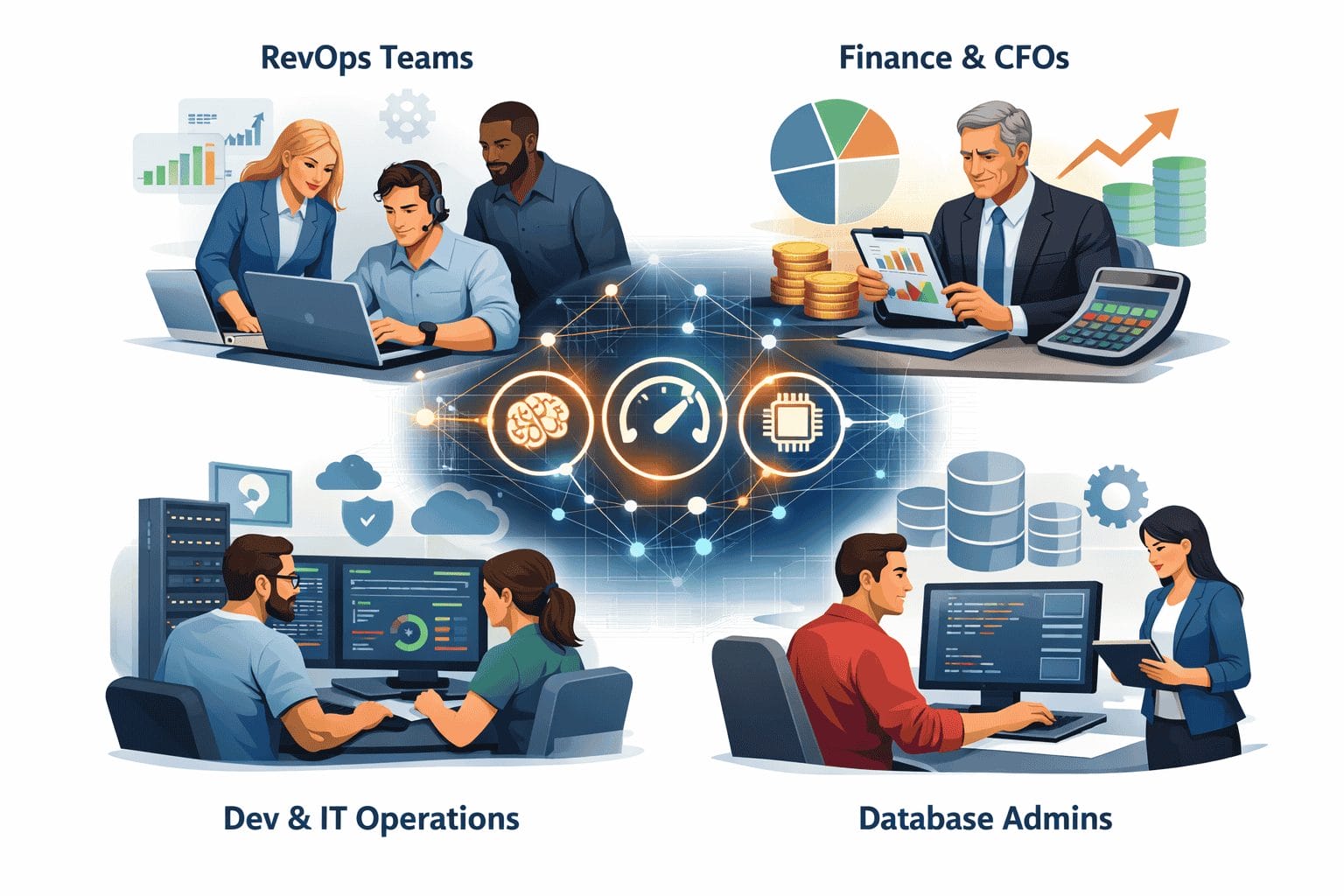
2. Who Should Use Enteros? (Primary Personas)
Enteros is not just a DBA tool. It is a revenue infrastructure intelligence platform. The following stakeholders benefit the most:
A. Chief Revenue Officers (CROs)
CROs are responsible for predictable growth.
Why CROs Need Enteros
-
Faster CRM performance improves sales velocity.
-
Reliable analytics enable accurate forecasting.
-
Cost attribution connects infrastructure spending to revenue generation.
-
Reduced system outages protect pipeline momentum.
With AI-driven performance optimization, CROs gain confidence that revenue infrastructure will not become a bottleneck.
B. RevOps Leaders
RevOps leaders sit at the intersection of systems, analytics, and revenue strategy.
Enteros Benefits for RevOps Teams
-
End-to-end performance visibility
-
Clear cost estimation for new tools and integrations
-
Root cause analysis for reporting delays
-
Optimization of database-driven workflows
RevOps efficiency improves when database intelligence supports operational strategy.
C. FinOps and Finance Teams
Cloud spending often grows faster than revenue.
Enteros provides:
-
Granular cost attribution
-
Database-level cost estimation
-
Workload-based expense allocation
-
Predictive cloud spend forecasting
This allows finance teams to:
-
Budget accurately
-
Prevent cost overruns
-
Align IT investment with revenue contribution
D. Database Administrators (DBAs)
DBAs traditionally focus on uptime and tuning.
With Enteros, they gain:
-
AI SQL fingerprinting
-
Anomaly detection
-
Query regression alerts
-
Automated performance baselines
This shifts DBAs from reactive firefighting to proactive optimization.
E. DevOps and Platform Engineers
DevOps teams manage scaling, deployments, and infrastructure reliability.
Enteros helps them:
-
Detect inefficient queries after deployments
-
Prevent performance regressions
-
Optimize cloud resource allocation
-
Reduce unnecessary scaling events
3. AI-Powered Cost Estimation: Making Growth Predictable
One of the biggest RevOps challenges is forecasting infrastructure cost as revenue scales.
Traditional Problem
When pipeline grows:
-
More users log into CRM
-
More data flows into analytics
-
More marketing campaigns generate data
-
Storage requirements expand
Without accurate cost estimation, scaling becomes financially unpredictable.
Enteros Approach
Enteros analyzes:
-
SQL workload growth patterns
-
Query frequency increases
-
Storage expansion trends
-
Compute utilization changes
This allows organizations to:
-
Estimate database costs before scaling
-
Model infrastructure impact of new campaigns
-
Forecast cost-per-revenue-dollar accurately
-
Plan growth initiatives with financial precision
RevOps becomes proactive instead of reactive.
4. Cost Attribution: Linking IT Spend to Revenue Streams
Many organizations know their total cloud bill but cannot answer:
-
Which sales region drives the most infrastructure cost?
-
Which marketing channel generates expensive database workloads?
-
Which product tier consumes the most storage?
-
Which customer segment increases compute intensity?
Enteros Solves This by Mapping:
Database resources → Applications → Revenue streams → Business units
With this visibility, leaders can:
-
Identify revenue-negative infrastructure patterns
-
Optimize high-cost, low-return workflows
-
Adjust pricing models based on infrastructure consumption
-
Improve gross margin predictability
Cost attribution transforms financial transparency into strategic advantage.
5. Performance Optimization: Removing Revenue Bottlenecks
Revenue operations depend on real-time responsiveness.
Performance slowdowns can cause:
-
Delayed lead assignment
-
CRM lag during demos
-
Inaccurate real-time dashboards
-
Billing delays
-
Subscription provisioning failures
Enteros Performance Intelligence Includes:
-
SQL query regression detection
-
Historical workload baselining
-
Real-time anomaly alerts
-
Automated root cause identification
-
Index optimization insights
Instead of diagnosing problems after revenue impact, teams fix issues before they escalate.
Performance stability directly supports revenue acceleration.
6. RevOps Efficiency Gains Across the Organization
When Enteros integrates into RevOps environments, organizations see measurable improvements:
Operational Benefits
-
Reduced incident response time
-
Fewer emergency scaling events
-
Improved system uptime
-
Predictable reporting performance
Financial Benefits
-
Reduced cloud waste
-
Controlled storage growth
-
Smarter scaling decisions
-
Improved gross margin
Strategic Benefits
-
Data-driven budgeting
-
Clear ROI on infrastructure
-
Aligned IT and revenue leadership
-
Sustainable growth planning
RevOps efficiency becomes systemic—not situational.
7. The Strategic Outcome: Revenue Infrastructure as a Competitive Advantage
Organizations that leverage AI-driven database intelligence gain:
-
Stable backend systems
-
Transparent cost models
-
Predictable scaling economics
-
Faster time-to-insight
-
Confident forecasting
Instead of being constrained by infrastructure uncertainty, revenue teams operate with clarity.
Enteros enables:
-
Performance-led growth
-
Financially disciplined scaling
-
Data-driven revenue planning
-
Cross-functional alignment
RevOps maturity increases dramatically when performance management and cost estimation are unified.
Conclusion: Turning Infrastructure Intelligence into Revenue Confidence
RevOps efficiency is no longer just about dashboards and alignment meetings. It is about ensuring that every backend system supporting revenue operates:
-
Efficiently
-
Transparently
-
Predictably
-
Scalably
Enteros provides:
-
AI SQL–driven performance optimization
-
Granular cost attribution
-
Predictive cost estimation
-
Proactive anomaly detection
-
Cross-team financial visibility
For CROs, RevOps leaders, FinOps teams, DBAs, and DevOps engineers, the question is no longer whether infrastructure matters—it is how intelligently it is managed.
Organizations seeking predictable revenue growth, margin stability, and operational excellence should consider Enteros as a foundational component of modern RevOps strategy.
FAQ: Enteros for RevOps Efficiency
1. How does Enteros improve RevOps efficiency?
Enteros provides AI-driven performance monitoring and cost attribution at the SQL level, ensuring backend systems operate efficiently and predictably.
2. Is Enteros only for database teams?
No. While DBAs benefit significantly, RevOps leaders, finance teams, CROs, and DevOps engineers also gain strategic insights.
3. How does cost estimation support revenue forecasting?
By analyzing workload trends and infrastructure growth patterns, Enteros predicts future database costs tied to revenue expansion.
4. Can Enteros reduce cloud waste?
Yes. It identifies inefficient queries, overprovisioned resources, and unnecessary scaling, reducing overspending.
5. Does Enteros integrate with cloud environments?
Yes. Enteros supports hybrid and multi-cloud architectures, enabling consistent visibility across environments.
6. How does performance optimization affect sales teams?
Faster CRM systems, real-time dashboards, and stable reporting directly improve sales productivity and forecasting accuracy.
7. What is the difference between monitoring and AIOps?
Monitoring reports metrics. AIOps uses AI models to detect anomalies, predict issues, and identify root causes automatically.
8. Can Enteros support high-growth SaaS companies?
Absolutely. Its predictive cost modeling and performance intelligence are ideal for scaling subscription-based businesses.
9. How quickly can organizations see results?
Many teams observe performance and cost visibility improvements within weeks of deployment.
10. What is the long-term benefit?
Long-term benefits include predictable infrastructure economics, improved revenue margin, cross-team alignment, and scalable growth confidence.
The views expressed on this blog are those of the author and do not necessarily reflect the opinions of Enteros Inc. This blog may contain links to the content of third-party sites. By providing such links, Enteros Inc. does not adopt, guarantee, approve, or endorse the information, views, or products available on such sites.
Are you interested in writing for Enteros’ Blog? Please send us a pitch!
RELATED POSTS
What Causes Slow EHR Performance, and How Can Hospitals Fix It?
- 2 September 2026
- Database Performance Management
Slow EHR performance is commonly caused by inefficient SQL queries, poor indexing, database locking, high concurrency, storage latency, insufficient resources, workload spikes, and execution-plan changes. Hospitals can improve performance through continuous database monitoring, SQL optimization, anomaly detection, root cause analysis, capacity planning, and intelligent observability. Enteros helps healthcare IT teams identify bottlenecks and support proactive … Continue reading “What Causes Slow EHR Performance, and How Can Hospitals Fix It?”
How Can Retailers Keep Databases Fast During Sales, Promotions, and Peak Shopping Periods?
Retailers can maintain fast retail database performance during sales and peak shopping periods by optimizing SQL queries, improving indexes, monitoring workloads continuously, detecting anomalies, planning capacity, and scaling resources intelligently. Effective database optimization for eCommerce helps prevent checkout delays, inventory bottlenecks, and slow product searches. Enteros provides AI-powered observability and performance intelligence to support reliable, … Continue reading “How Can Retailers Keep Databases Fast During Sales, Promotions, and Peak Shopping Periods?”
How Can Telecom Providers Reduce Database Downtime and Improve Customer Experience?
Improving telecom database performance requires continuous monitoring, SQL optimization, anomaly detection, intelligent capacity planning, and faster root cause analysis. Effective database monitoring for telecom companies helps providers identify bottlenecks before they disrupt billing, subscriber services, provisioning, or customer applications. Enteros provides AI-powered database observability that helps telecom teams improve uptime, reliability, scalability, operational efficiency, and … Continue reading “How Can Telecom Providers Reduce Database Downtime and Improve Customer Experience?”
How Can Retail Companies Improve Database Performance for Faster Customer Transactions?
Improving retail database performance requires continuous monitoring, SQL query optimization, workload analysis, intelligent indexing, anomaly detection, and proactive capacity planning. Retailers should identify bottlenecks before they affect checkout, payments, inventory, or product searches. Enteros helps retail IT teams use AI-driven observability, predictive analytics, and performance intelligence to improve transaction speed, scalability, reliability, and overall digital … Continue reading “How Can Retail Companies Improve Database Performance for Faster Customer Transactions?”