Introduction
Artificial intelligence is rapidly moving from pilot projects to enterprise-scale operations. Companies in e-commerce, fintech, healthcare, and logistics are embedding AI into mission-critical workflows. These systems rely on massive volumes of real-time data to deliver accurate predictions and fast insights.
But while most organizations focus on GPUs, cloud compute, and advanced algorithms, they often underestimate the role of databases. Without a resilient and high-performing database foundation, AI projects can hit scaling walls, trigger unexpected costs, and fail to meet business expectations.
This article explores the hidden database risks in AI workloads, why they matter for scalability and ROI, and how enterprises can address them effectively.
The Overlooked Database Challenge
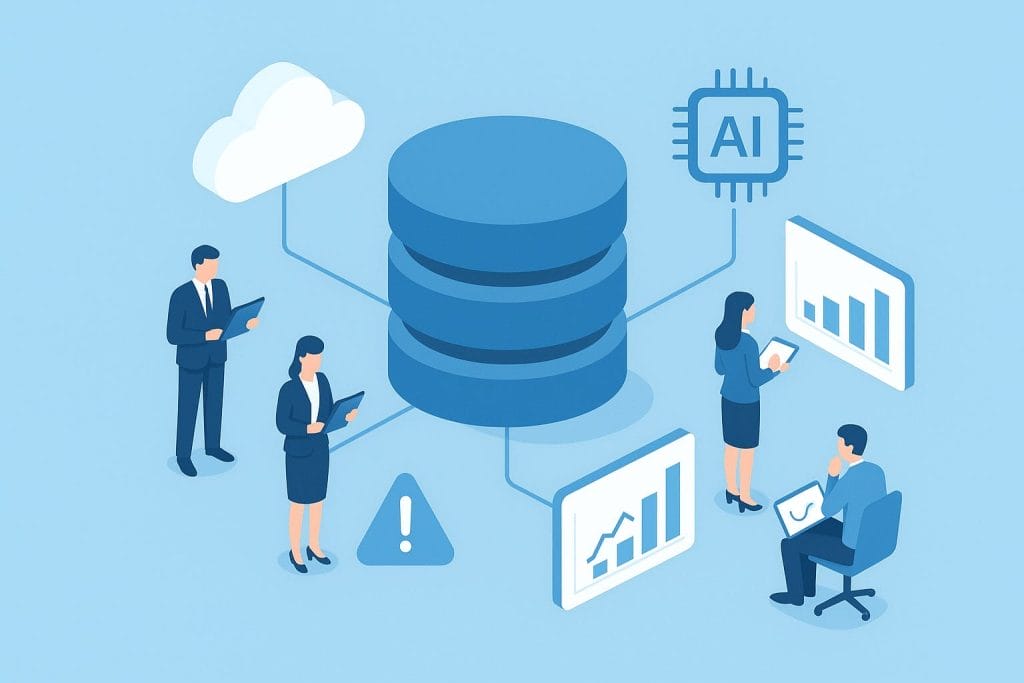
AI workloads are unlike traditional applications. Training models requires access to terabytes of historical data, while inference demands real-time responsiveness. Databases must deliver both high throughput and low latency, often under unpredictable workload spikes.
When database systems cannot keep up, the entire AI pipeline suffers. Training cycles stretch longer, delaying innovation. Inference lags lead to poor user experiences in recommendation engines, fraud detection, or healthcare diagnostics. What looks like a GPU or cloud scaling problem is often rooted in database inefficiencies.
The Risks of Ignoring Database Performance
The performance gap may not be obvious at first, but its consequences grow quickly:
-
Slower innovation cycles — training models takes longer, delaying new features and insights.
-
Escalating infrastructure costs — teams overprovision cloud resources to mask inefficiencies.
-
Eroded business trust — when “real-time” AI outputs arrive too late to be actionable.
-
Operational fragility — scaling up becomes unpredictable, increasing risk of outages.
In short, the hidden database layer becomes the weak link in AI adoption — undermining both technical performance and financial outcomes.
Why Databases Must Scale With AI
To succeed, enterprises need databases that are not only fast but also adaptive. Systems must:
-
Scale elastically with fluctuating AI workloads.
-
Support diverse environments across SQL, NoSQL, and cloud-native platforms.
-
Deliver real-time responsiveness for inference and analytics.
-
Optimize costs proactively to prevent overspending on infrastructure.
Proactive monitoring is also essential. Rather than reacting to alerts after problems arise, organizations must detect root causes early and optimize performance before bottlenecks derail critical projects.
How Enteros UpBeat Helps
Enteros UpBeat addresses these challenges by providing AI-driven insights into database performance. Its platform detects inefficiencies across multiple database types, forecasts workload impact, and prevents costly overprovisioning.
By aligning database performance with business priorities, it enables enterprises to accelerate training cycles, support real-time inference, and scale AI initiatives sustainably. The result is faster innovation, lower costs, and greater confidence in enterprise AI adoption.
Conclusion
AI has the potential to transform industries, but performance risks in the database layer often stand in the way. For CIOs and CTOs, managing these risks is not just a technical necessity — it’s a business imperative.
With platforms like Enteros UpBeat, enterprises can ensure their databases scale in lockstep with AI workloads, unlocking both technical excellence and measurable ROI.
FAQ: AI Workloads and Databases
Q1: Why are databases so critical in scaling AI?
Because they control how efficiently models can access, process, and respond to massive volumes of data.
Q2: What happens if performance gaps remain hidden?
Costs rise, project timelines slip, and business users lose trust in AI-driven outcomes.
Q3: How does Enteros UpBeat reduce risk?
By using AI-driven root cause detection to eliminate bottlenecks before they slow scaling.
The views expressed on this blog are those of the author and do not necessarily reflect the opinions of Enteros Inc. This blog may contain links to the content of third-party sites. By providing such links, Enteros Inc. does not adopt, guarantee, approve, or endorse the information, views, or products available on such sites.
Are you interested in writing for Enteros’ Blog? Please send us a pitch!
RELATED POSTS
How AIOps and FinOps Optimize Cloud Database Performance for Banking and BFSI
- 31 August 2026
- Database Performance Management
Introduction The banking and financial services industry is undergoing a significant transformation as institutions move critical workloads to cloud and hybrid-cloud environments. Digital banking applications, payment platforms, mobile banking, lending systems, insurance applications, fraud detection platforms, wealth management solutions, and financial analytics increasingly depend on scalable cloud infrastructure and high-performing databases. However, cloud adoption introduces … Continue reading “How AIOps and FinOps Optimize Cloud Database Performance for Banking and BFSI”
How to Optimize Media and Entertainment Database Performance with Enteros Database Software, AI-Powered Analytics, and Database Observability
- 30 August 2026
- Database Performance Management
Introduction The media and entertainment industry has become a digital-first business. Streaming services, digital publishing, online gaming content, advertising platforms, social experiences, content management systems, subscription platforms, and personalized recommendations all depend on databases. Modern media companies process enormous volumes of customer, content, advertising, transaction, and behavioral information. Read more”Indian Country” highlights Enteros and its … Continue reading “How to Optimize Media and Entertainment Database Performance with Enteros Database Software, AI-Powered Analytics, and Database Observability”
How to Optimize Manufacturing Database Performance with Enteros Database Software, AIOps, and Predictive Analytics
Introduction Manufacturing is becoming increasingly dependent on digital infrastructure. Modern factories use enterprise resource planning (ERP), manufacturing execution systems (MES), supply-chain platforms, warehouse management systems, industrial IoT, quality management applications, predictive maintenance, and advanced analytics to manage production. Behind these systems are databases processing enormous amounts of operational information. Production schedules, inventory levels, machine data, … Continue reading “How to Optimize Manufacturing Database Performance with Enteros Database Software, AIOps, and Predictive Analytics”
The Future of Industry-Specific Cloud Optimization with AIOps, FinOps, and AI-Powered Database Management
- 28 August 2026
- Database Performance Management
Introduction Cloud computing has become a foundational component of digital transformation across industries. Banking organizations use cloud platforms to support digital payments and online banking. Healthcare providers rely on cloud infrastructure for digital health applications and patient services. Educational institutions operate learning management systems and virtual classrooms in the cloud. Retailers, manufacturers, insurers, logistics providers, … Continue reading “The Future of Industry-Specific Cloud Optimization with AIOps, FinOps, and AI-Powered Database Management”