Introduction
Autonomous vehicles promise a future of safer roads, fewer accidents, and optimized traffic. But behind the sleek exterior and AI-driven software lies a hidden dependency: the performance of underlying databases. Every millisecond matters when a car is making split-second decisions in traffic. A small delay in data processing can mean the difference between avoiding a collision and causing one.
In this article, we explore why real-time database performance is critical for autonomous vehicles, what risks emerge from slow or inefficient systems, and how the industry can mitigate these challenges.
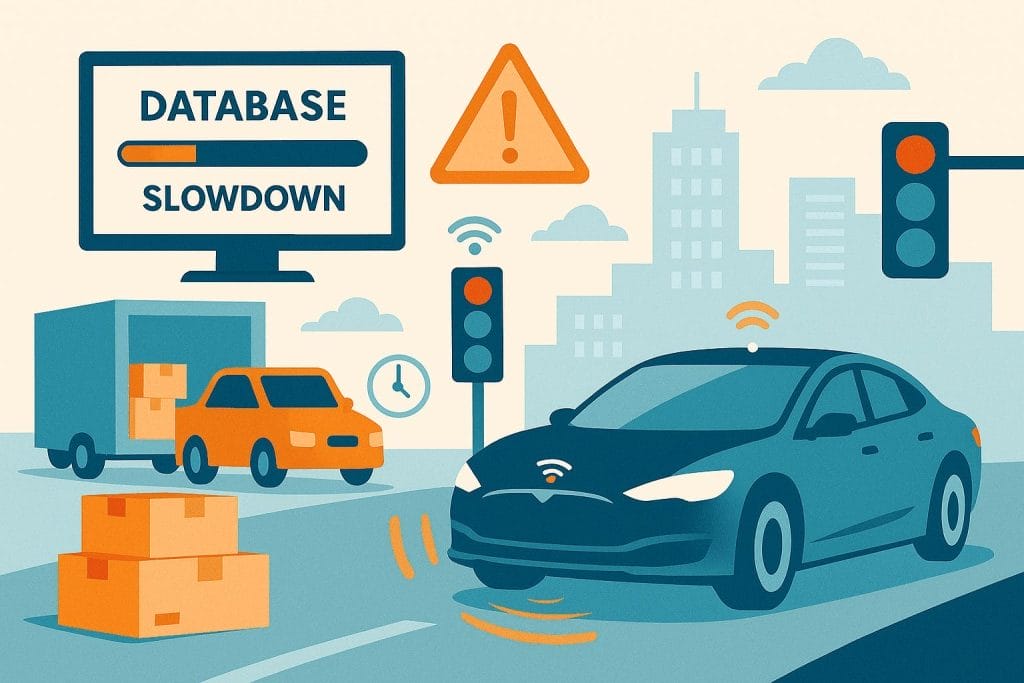
Why Databases Are the Hidden Brain of Autonomous Cars
At first glance, we think of autonomous driving as an AI problem. In reality, AI is only as good as the data layer that feeds it. Cars collect data from sensors, connect it with high-definition maps, and then process decisions in real time. This chain only works if the database keeps pace.
-
Sensor data — lidar, radar, and cameras generate terabytes every second.
-
Mapping and navigation — high-definition maps must refresh continuously.
-
Decision-making — AI models query databases thousands of times per minute.
When that chain is delayed by even a fraction of a second, outcomes can turn dangerous.
The Risks of Database Latency in Autonomous Driving
The consequences of slow queries are not abstract — they translate into real safety risks. A 200-millisecond delay in recognizing a pedestrian could be the difference between a near miss and an accident. Similarly, navigation systems relying on stale data may reroute incorrectly, while overloaded systems can crash entirely.
The stakes are incredibly high. Latency in this industry doesn’t just frustrate users — it endangers lives.
Why Current Infrastructure Struggles
Traditional database architectures were never designed for the extreme demands of autonomous driving. They struggle with concurrency, choke on unpredictable input spikes, and lack predictive monitoring. Even cloud-native databases need reinforcement to guarantee the sub-millisecond responsiveness required on the road.
Future-Proofing Autonomous Vehicle Databases
To close this gap, manufacturers need to:
-
Continuously monitor query performance and set real-time alerts.
-
Leverage AI-driven anomaly detection to catch issues before failure.
-
Run real-world load simulations to prepare for extreme conditions.
-
Adopt distributed, resilient DB architectures with built-in failover.
These practices move databases from reactive tools to proactive guardians of safety.
Conclusion
The autonomous vehicle race isn’t only about better algorithms or sleeker designs. It’s about building an invisible but vital foundation — databases capable of real-time decision-making. Those who overlook this hidden layer risk safety, compliance, and trust.
FAQ
Q1: Why are databases so important for autonomous vehicles?
They process sensor, navigation, and AI decision data in real time.
Q2: How much latency is critical in autonomous driving?
Even 100–200 ms can affect reaction times and raise accident risk.
Q3: Can traditional databases handle this workload?
Not reliably — most lack the scalability and concurrency needed.
Q4: What’s the best approach?
Continuous monitoring and optimization with distributed architectures.
The views expressed on this blog are those of the author and do not necessarily reflect the opinions of Enteros Inc. This blog may contain links to the content of third-party sites. By providing such links, Enteros Inc. does not adopt, guarantee, approve, or endorse the information, views, or products available on such sites.
Are you interested in writing for Enteros’ Blog? Please send us a pitch!
RELATED POSTS
How AIOps and FinOps Optimize Cloud Database Performance for Banking and BFSI
- 31 August 2026
- Database Performance Management
Introduction The banking and financial services industry is undergoing a significant transformation as institutions move critical workloads to cloud and hybrid-cloud environments. Digital banking applications, payment platforms, mobile banking, lending systems, insurance applications, fraud detection platforms, wealth management solutions, and financial analytics increasingly depend on scalable cloud infrastructure and high-performing databases. However, cloud adoption introduces … Continue reading “How AIOps and FinOps Optimize Cloud Database Performance for Banking and BFSI”
How to Optimize Media and Entertainment Database Performance with Enteros Database Software, AI-Powered Analytics, and Database Observability
- 30 August 2026
- Database Performance Management
Introduction The media and entertainment industry has become a digital-first business. Streaming services, digital publishing, online gaming content, advertising platforms, social experiences, content management systems, subscription platforms, and personalized recommendations all depend on databases. Modern media companies process enormous volumes of customer, content, advertising, transaction, and behavioral information. Read more”Indian Country” highlights Enteros and its … Continue reading “How to Optimize Media and Entertainment Database Performance with Enteros Database Software, AI-Powered Analytics, and Database Observability”
How to Optimize Manufacturing Database Performance with Enteros Database Software, AIOps, and Predictive Analytics
Introduction Manufacturing is becoming increasingly dependent on digital infrastructure. Modern factories use enterprise resource planning (ERP), manufacturing execution systems (MES), supply-chain platforms, warehouse management systems, industrial IoT, quality management applications, predictive maintenance, and advanced analytics to manage production. Behind these systems are databases processing enormous amounts of operational information. Production schedules, inventory levels, machine data, … Continue reading “How to Optimize Manufacturing Database Performance with Enteros Database Software, AIOps, and Predictive Analytics”
The Future of Industry-Specific Cloud Optimization with AIOps, FinOps, and AI-Powered Database Management
- 28 August 2026
- Database Performance Management
Introduction Cloud computing has become a foundational component of digital transformation across industries. Banking organizations use cloud platforms to support digital payments and online banking. Healthcare providers rely on cloud infrastructure for digital health applications and patient services. Educational institutions operate learning management systems and virtual classrooms in the cloud. Retailers, manufacturers, insurers, logistics providers, … Continue reading “The Future of Industry-Specific Cloud Optimization with AIOps, FinOps, and AI-Powered Database Management”