Introduction
Digital twins—virtual replicas of physical factories—are redefining modern manufacturing. They simulate processes, predict failures, and continuously optimize production. But there is a critical dependency often overlooked: the performance of the databases that power them. When databases stall, even for seconds, digital twins lose accuracy, workflows freeze, and automation systems fail to deliver.
In this article, we’ll explore why database latency is a hidden bottleneck in Industry 4.0, the specific risks it creates, and practical steps manufacturers can take to mitigate them.
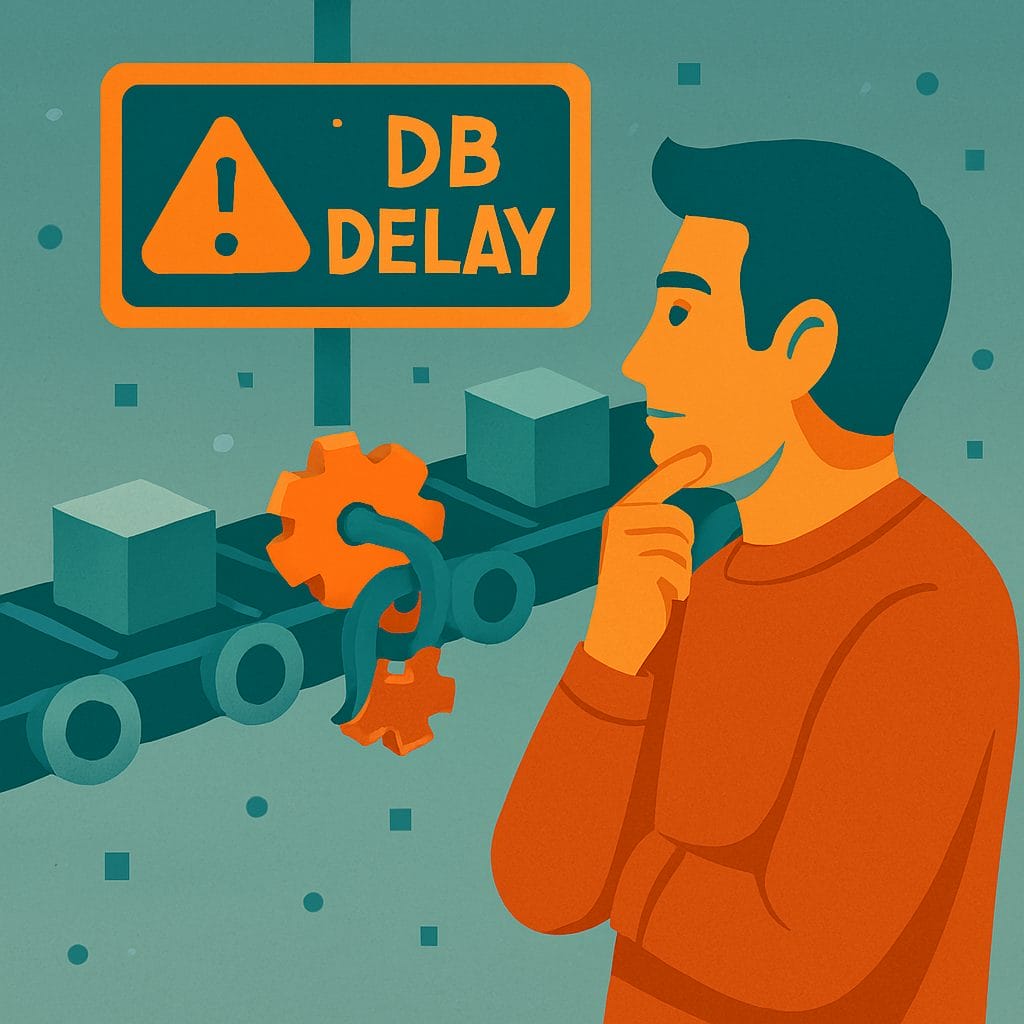
The Invisible Bottleneck in Industry 4.0
Factories running digital twins deal with unprecedented data intensity:
-
Thousands of IoT sensors stream readings every millisecond.
-
Simulation engines generate real-time predictions.
-
Control systems adjust machinery on the fly.
When databases can’t keep pace with this load, the consequences are immediate: robotic arms pause, conveyor belts misalign, and predictive maintenance systems lose reliability.
👉 Example: A global automotive manufacturer reported that a 7-second DB delay during line calibration caused over 4 hours of unplanned downtime, costing nearly $2M in lost production.
Why Database Performance Matters More Than Ever
Database slowdowns in automation aren’t just technical glitches — they’re business risks.
-
Safety hazards: delayed control signals can cause robotic arms to misalign or safety triggers to miss thresholds.
-
Production losses: even a few seconds of latency can cascade into hours of downtime.
-
Forecasting errors: predictive models become unreliable if they rely on incomplete or delayed data.
-
Financial impact: studies show that every hour of unplanned downtime in manufacturing costs between $100K and $500K, depending on the scale.
Practical Solutions for Scalable Digital Twins
Forward-looking manufacturers are rethinking their database architectures and monitoring practices:
1. Low-Latency DB Architectures
Adopting architectures built for IoT-scale workloads reduces query bottlenecks. Key techniques include sharding, in-memory processing, and event-driven pipelines.
2. Intelligent Monitoring
Machine learning–based monitoring adapts to seasonal and workload variations. For example, it can distinguish between a harmless spike at quarter-end and an early warning of a systemic bottleneck.
3. Proactive Optimization
Rather than reacting to slowdowns, leading organizations invest in proactive optimization tools. Platforms such as Enteros UpBeat can automatically surface hidden inefficiencies before they impact production lines.
Case Insight: Predictive Maintenance at Scale
A European aerospace supplier struggled with database lag during real-time stress simulations for aircraft components. Initial response was to add more servers—but costs ballooned, and delays persisted.
Only after optimizing queries and adopting ML-based monitoring did latency drop by 38%, enabling the company to scale simulations without overspending on infrastructure.
Checklist: Reducing DB Risks in Industry 4.0
-
Map all IoT and digital twin data flows.
-
Benchmark query performance under peak load.
-
Track key metrics: query latency, throughput, error rate.
-
Separate “critical control loops” from non-critical workloads.
-
Adopt proactive DB optimization before scaling hardware.
FAQ
Q1: What makes databases mission-critical for digital twins?
They’re the backbone of sensor processing, simulation feedback, and control loops that keep smart factories running.
Q2: Why isn’t scaling hardware enough?
Because inefficiencies in queries and schema design persist regardless of hardware spend.
Q3: What metrics should manufacturers monitor?
Median/95th percentile latency, query execution time, failure recovery speed, and data freshness.
Q4: What’s the ROI of DB optimization?
Every 1% increase in uptime translates directly into recovered production hours and avoided revenue loss.
Conclusion
Digital twins are no longer futuristic—they’re already reshaping global manufacturing. But without agile, low-latency databases, even the smartest factory can grind to a halt.
For manufacturers, the lesson is clear: database performance isn’t just an IT concern, it’s a core business capability. Those who address it proactively will unlock the true potential of Industry 4.0.
The views expressed on this blog are those of the author and do not necessarily reflect the opinions of Enteros Inc. This blog may contain links to the content of third-party sites. By providing such links, Enteros Inc. does not adopt, guarantee, approve, or endorse the information, views, or products available on such sites.
Are you interested in writing for Enteros’ Blog? Please send us a pitch!
RELATED POSTS
How Can Banks Prevent Database Bottlenecks in Real-Time Financial Transactions?
- 1 September 2026
- Database Performance Management
Banks can prevent database bottlenecks in banking by continuously monitoring SQL workloads, optimizing queries and indexes, detecting resource contention, analyzing transaction latency, and identifying anomalies before performance declines. Effective database performance monitoring for banks provides real-time workload visibility and faster root cause analysis. Enteros helps financial institutions identify database inefficiencies and maintain reliable, scalable transaction … Continue reading “How Can Banks Prevent Database Bottlenecks in Real-Time Financial Transactions?”
Why Is Database Observability Important for Modern Hospitals and Healthcare IT Teams?
Database observability in healthcare is important because hospitals depend on databases to power EHRs, patient portals, clinical applications, billing, analytics, and other essential systems. It gives healthcare IT teams deeper visibility into SQL workloads, resource usage, bottlenecks, and performance changes. Enteros supports this approach with database observability, AI-powered analysis, anomaly detection, and root cause analysis … Continue reading “Why Is Database Observability Important for Modern Hospitals and Healthcare IT Teams?”
How Can Healthcare Organizations Reduce Cloud Database Costs With AIOps and FinOps
Healthcare organizations can reduce cloud database costs by combining AIOps with FinOps to identify inefficient workloads, detect anomalies, rightsize resources, and connect database performance with infrastructure spending. Effective healthcare cloud database cost optimization focuses on eliminating waste without compromising reliability. Enteros supports this approach through database observability, AI-powered SQL analysis, root cause analysis, performance intelligence, … Continue reading “How Can Healthcare Organizations Reduce Cloud Database Costs With AIOps and FinOps”
What Database Performance Challenges Do Hospitals Face in Cloud-Based Healthcare Systems?
Hospitals face database performance challenges such as slow SQL queries, growing healthcare data, EHR performance issues, database bottlenecks, resource contention, cloud complexity, and rising costs. Cloud-based healthcare systems require continuous database monitoring, workload optimization, anomaly detection, and root-cause analysis. AI-powered AIOps can help hospitals improve database performance, reliability, scalability, and cloud cost efficiency while supporting … Continue reading “What Database Performance Challenges Do Hospitals Face in Cloud-Based Healthcare Systems?”