Introduction
Genomics research and drug discovery generate some of the world’s largest datasets. Sequencing, molecular simulations, and clinical trial analytics all rely on vast, high-speed databases. Yet many organizations struggle when data systems lag, slowing the path from discovery to treatment.
In this article, we explore why genomics is so dependent on database performance, the risks of latency, and how solutions like Enteros can accelerate drug discovery and precision medicine.
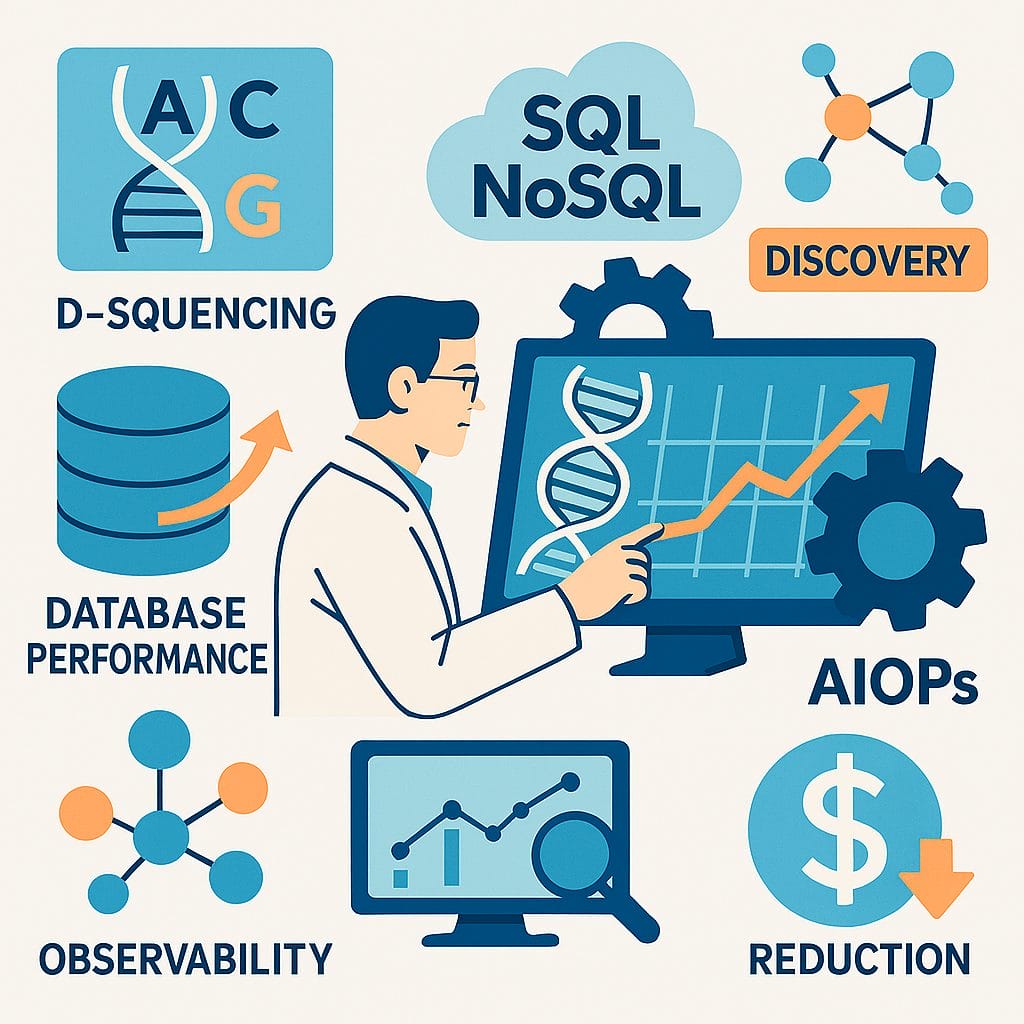
The Data Challenge in Genomics
Genomics and drug discovery involve:
- Processing terabytes of sequencing data.
- Running complex molecular models.
- Coordinating global clinical trial information.
- Ensuring regulatory compliance and secure patient data handling.
Any delay in database performance directly impacts research timelines and costs.
When Databases Become a Bottleneck
Database slowdowns in genomics create critical barriers:
- Extended drug discovery cycles.
- Missed opportunities in personalized medicine.
- Increased infrastructure costs from unnecessary scaling.
- Delayed responses to emerging health threats.
For pharma and biotech companies, time lost to database inefficiency can mean billions in delayed revenues — and lives waiting longer for treatment.
Why Legacy Tools Aren’t Enough
Traditional monitoring tools weren’t built for multi-cloud, data-heavy genomics pipelines. They often provide surface-level insights, pushing teams to add servers instead of addressing root causes. This approach wastes resources and fails to speed up discovery.
Enteros UpBeat: Accelerating Drug Discovery
Enteros UpBeat enables genomics leaders to move faster and more efficiently by:
- Detecting root causes of latency in SQL, NoSQL, and cloud-native DBs.
- Scaling smoothly to handle peaks in sequencing workloads.
- Reducing costs by eliminating unnecessary infrastructure.
- Ensuring uptime so researchers and clinical teams never lose momentum.
The Bigger Picture
As genomics reshapes the future of medicine, database performance is no longer a back-end concern — it’s a strategic enabler of innovation. By keeping data systems fast, scalable, and cost-efficient, organizations can accelerate discovery, reduce costs, and bring life-saving treatments to patients faster.
Conclusion
Database performance is the invisible accelerator of modern drug discovery. With Enteros UpBeat, genomics companies can overcome bottlenecks, scale securely, and deliver on the promise of precision medicine.
FAQ
Q1: Why is database performance critical in genomics?
Because sequencing, simulations, and trials generate massive, time-sensitive datasets that require instant processing.
Q2: What risks do slow databases create in drug discovery?
They extend research cycles, increase costs, and delay bringing treatments to patients.
Q3: How are genomics workloads different from other industries?
They involve higher data volumes, complex models, and stricter compliance requirements than most sectors.
Q4: How does Enteros UpBeat support genomics organizations?
It ensures real-time database performance, scalability, and cost efficiency across hybrid data environments.
The views expressed on this blog are those of the author and do not necessarily reflect the opinions of Enteros Inc. This blog may contain links to the content of third-party sites. By providing such links, Enteros Inc. does not adopt, guarantee, approve, or endorse the information, views, or products available on such sites.
Are you interested in writing for Enteros’ Blog? Please send us a pitch!
RELATED POSTS
How AIOps and FinOps Optimize Cloud Database Performance for Banking and BFSI
- 31 August 2026
- Database Performance Management
Introduction The banking and financial services industry is undergoing a significant transformation as institutions move critical workloads to cloud and hybrid-cloud environments. Digital banking applications, payment platforms, mobile banking, lending systems, insurance applications, fraud detection platforms, wealth management solutions, and financial analytics increasingly depend on scalable cloud infrastructure and high-performing databases. However, cloud adoption introduces … Continue reading “How AIOps and FinOps Optimize Cloud Database Performance for Banking and BFSI”
How to Optimize Media and Entertainment Database Performance with Enteros Database Software, AI-Powered Analytics, and Database Observability
- 30 August 2026
- Database Performance Management
Introduction The media and entertainment industry has become a digital-first business. Streaming services, digital publishing, online gaming content, advertising platforms, social experiences, content management systems, subscription platforms, and personalized recommendations all depend on databases. Modern media companies process enormous volumes of customer, content, advertising, transaction, and behavioral information. Read more”Indian Country” highlights Enteros and its … Continue reading “How to Optimize Media and Entertainment Database Performance with Enteros Database Software, AI-Powered Analytics, and Database Observability”
How to Optimize Manufacturing Database Performance with Enteros Database Software, AIOps, and Predictive Analytics
Introduction Manufacturing is becoming increasingly dependent on digital infrastructure. Modern factories use enterprise resource planning (ERP), manufacturing execution systems (MES), supply-chain platforms, warehouse management systems, industrial IoT, quality management applications, predictive maintenance, and advanced analytics to manage production. Behind these systems are databases processing enormous amounts of operational information. Production schedules, inventory levels, machine data, … Continue reading “How to Optimize Manufacturing Database Performance with Enteros Database Software, AIOps, and Predictive Analytics”
The Future of Industry-Specific Cloud Optimization with AIOps, FinOps, and AI-Powered Database Management
- 28 August 2026
- Database Performance Management
Introduction Cloud computing has become a foundational component of digital transformation across industries. Banking organizations use cloud platforms to support digital payments and online banking. Healthcare providers rely on cloud infrastructure for digital health applications and patient services. Educational institutions operate learning management systems and virtual classrooms in the cloud. Retailers, manufacturers, insurers, logistics providers, … Continue reading “The Future of Industry-Specific Cloud Optimization with AIOps, FinOps, and AI-Powered Database Management”