Introduction
Insurance companies operate some of the most data-intensive business processes in the financial services industry. Policy administration, underwriting, claims, billing, customer portals, fraud detection, actuarial analysis, and regulatory reporting all depend on reliable data infrastructure.
The insurance industry is also undergoing rapid digital transformation. Customers increasingly expect instant policy quotes, digital claims, mobile applications, personalized products, and real-time service.
Behind these experiences are databases processing millions of records and transactions.
When database performance deteriorates, insurers can experience slower claims processing, delayed customer interactions, inefficient analytics, and increased infrastructure costs.
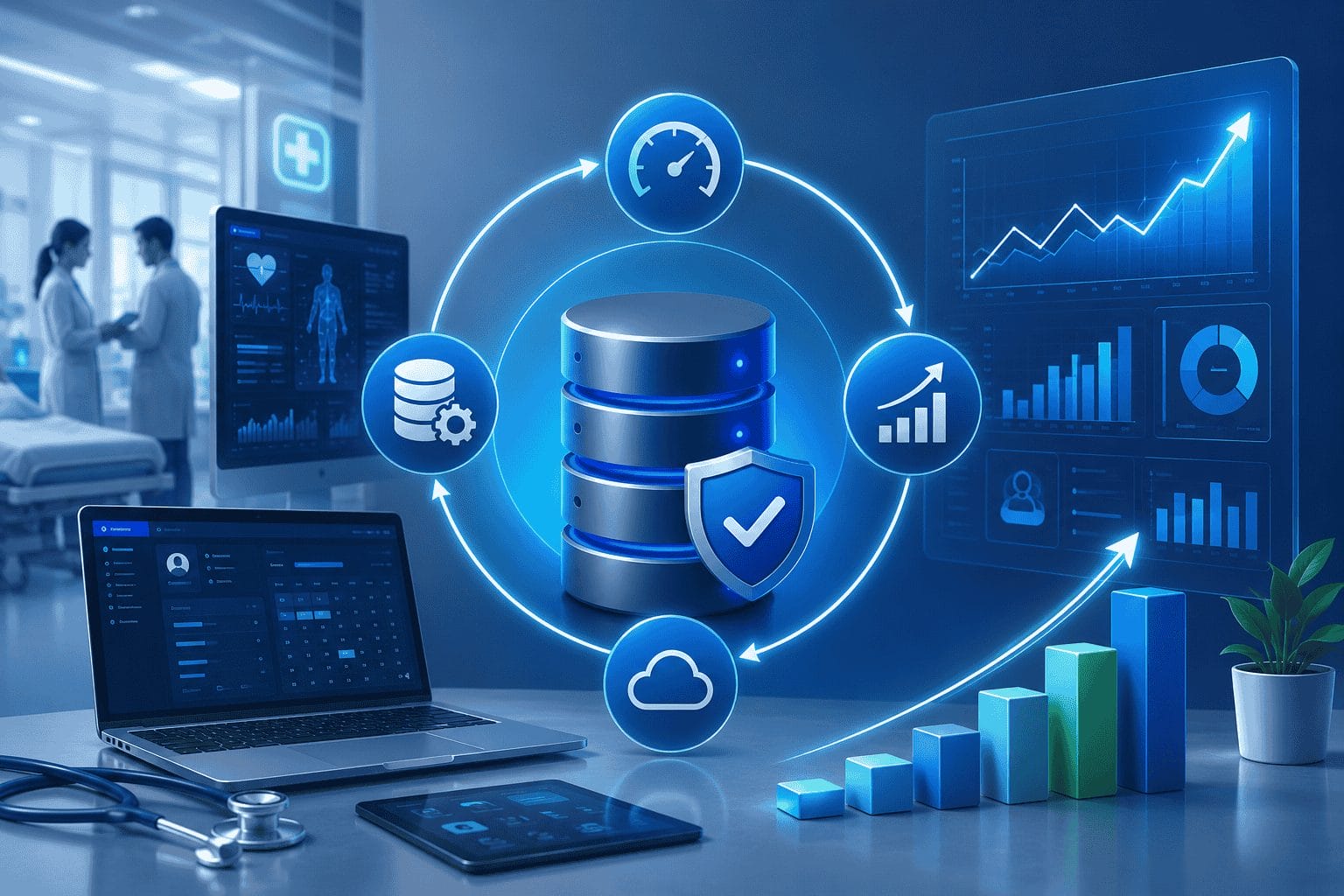
Enteros UpBeat provides Database Observability, AI-powered Analytics, SQL Performance Intelligence, AIOps, Predictive Analytics, Root Cause Analysis, and Cloud FinOps to help insurance organizations improve database performance and operational efficiency.
1. Why Insurance Databases Are Becoming More Complex
Insurance applications process information across the entire customer lifecycle.
Database workloads can include:
- Policy records
- Customer profiles
- Claims
- Premium calculations
- Underwriting
- Payments
- Agent systems
- Fraud analytics
- Actuarial models
- Regulatory reporting
At the same time, insurers increasingly integrate cloud applications, analytics platforms, AI systems, mobile applications, and third-party data services.
This creates a distributed technology environment where a performance issue can originate in one layer but affect multiple applications.
2. Database Performance and Claims Processing
Claims processing is a particularly important area for database performance.
Claims systems must retrieve policy information, customer history, documentation, payment information, and other relevant data.
If database queries become inefficient, claims applications may slow down.
Enteros can help identify expensive SQL, abnormal workloads, resource constraints, and database performance anomalies.
This allows IT teams to investigate whether problems originate from:
- Query execution
- Database configuration
- Resource utilization
- Workload spikes
- Concurrency
- Capacity constraints
3. AI-Powered Analytics for Insurance
Insurance organizations generate historical data that can be used to identify workload patterns.
Enteros uses statistical learning and AI-driven analytics to identify abnormal database behavior, seasonal changes, and performance inefficiencies.
This can be valuable during predictable periods such as:
- Renewal cycles
- Open enrollment
- Year-end reporting
- Catastrophe-related claims
- Regulatory reporting
- Large marketing campaigns
Predictive workload intelligence can help teams prepare database infrastructure before demand increases.
4. AI SQL and Query Optimization
Insurance databases frequently execute complex queries.
Underwriting, claims, actuarial analytics, fraud detection, and reporting can all create resource-intensive database workloads.
Enteros’ AI SQL capabilities are designed to identify inefficient queries and provide optimization insights.
By identifying inefficient SQL, insurance organizations can potentially:
- Reduce query execution time
- Improve application responsiveness
- Reduce infrastructure consumption
- Improve analytics performance
5. AIOps and Automated Root Cause Analysis
Insurance companies often have large IT environments where database problems can involve multiple dependencies.
AIOps can help correlate performance signals and identify potential root causes.
Enteros positions AIOps as a key capability for anomaly detection, Root Cause Analysis, predictive insights, and automation.
This can reduce the time database teams spend manually searching through large volumes of performance data.
6. Cloud FinOps for Insurance
Insurers increasingly use cloud infrastructure for analytics, customer applications, AI, and enterprise systems.
But cloud flexibility can also create cost-management challenges.
Enteros connects database performance intelligence with FinOps practices such as cost attribution, forecasting, resource optimization, and financial accountability.
This allows technology and finance leaders to better understand the relationship between:
Database workload → Infrastructure consumption → Cloud cost → Business application
7. RevOps and Customer Experience
Insurance companies increasingly compete through digital customer experiences.
Quote generation, policy changes, payments, claims status, and customer portals all depend on responsive applications.
Enteros’ platform positioning includes RevOps insights intended to connect database performance with revenue-critical workflows.
This is important because application latency can become a customer experience problem.
8. Business Benefits
Insurance organizations can use database performance intelligence to support:
- Faster claims processing
- Improved customer applications
- Better underwriting performance
- Faster analytics
- Improved fraud-detection workloads
- Better cloud cost management
- More efficient database operations
- Faster Root Cause Analysis
Conclusion
Insurance companies are becoming increasingly dependent on digital platforms and data-intensive analytics.
Database performance therefore affects more than IT infrastructure. It can influence customer experience, claims operations, analytics, productivity, and technology economics.
Enteros provides a unified approach combining Database Observability, AI-powered Analytics, SQL Performance Intelligence, AIOps, Predictive Analytics, Root Cause Analysis, RevOps insights, and Cloud FinOps.
FAQs
1. How can Enteros help insurance companies?
It helps insurance IT teams identify database performance bottlenecks, optimize SQL, analyze anomalies, forecast capacity, and improve cloud efficiency.
2. Can Enteros support claims applications?
Yes. Database performance intelligence can be applied to supported database environments powering claims systems.
3. How can insurers use predictive analytics?
Predictive workload analysis can help organizations understand future performance and capacity requirements.
4. Can Enteros connect database performance to FinOps?
Yes. Enteros combines database performance intelligence with cloud cost and resource optimization.
5. Does Enteros support RevOps?
Enteros positions RevOps as one of the business dimensions supported by its database performance intelligence platform.
The views expressed on this blog are those of the author and do not necessarily reflect the opinions of Enteros Inc. This blog may contain links to the content of third-party sites. By providing such links, Enteros Inc. does not adopt, guarantee, approve, or endorse the information, views, or products available on such sites.
Are you interested in writing for Enteros’ Blog? Please send us a pitch!
RELATED POSTS
The Future of Industry-Specific Cloud Optimization with AIOps, FinOps, and AI-Powered Database Management
- 28 August 2026
- Database Performance Management
Introduction Cloud computing has become a foundational component of digital transformation across industries. Banking organizations use cloud platforms to support digital payments and online banking. Healthcare providers rely on cloud infrastructure for digital health applications and patient services. Educational institutions operate learning management systems and virtual classrooms in the cloud. Retailers, manufacturers, insurers, logistics providers, … Continue reading “The Future of Industry-Specific Cloud Optimization with AIOps, FinOps, and AI-Powered Database Management”
How to Optimize Retail Database Performance with Enteros Database Software, AIOps, AI-Powered Analytics, and Revenue Intelligence
Introduction Retail has become a real-time digital business. Ecommerce, mobile applications, point-of-sale systems, inventory platforms, loyalty programs, customer analytics, supply chain systems, recommendation engines, and payment platforms all depend on databases. Retailers also experience highly variable demand. Read more”Indian Country” highlights Enteros and its database performance management platform *Black Friday, holiday shopping, product launches, flash … Continue reading “How to Optimize Retail Database Performance with Enteros Database Software, AIOps, AI-Powered Analytics, and Revenue Intelligence”
How AIOps and FinOps Balance Application Performance, Reliability, and Cloud Costs
Introduction Modern digital applications are expected to be fast, reliable, scalable, and continuously available. Whether an organization operates banking platforms, healthcare applications, e-learning systems, SaaS products, e-commerce applications, or enterprise workloads, users increasingly expect consistent performance across every interaction. At the same time, cloud adoption has introduced a new challenge: how can organizations maintain application … Continue reading “How AIOps and FinOps Balance Application Performance, Reliability, and Cloud Costs”
How to Scale SaaS Database Performance with Enteros Database Software, AI-Powered Analytics, and Cloud FinOps
Introduction Software-as-a-Service companies compete on product experience. Customers expect SaaS applications to be fast, available, scalable, and responsive regardless of how many users are active. Behind every SaaS application is a database layer responsible for customer records, transactions, configurations, analytics, workflows, integrations, and application state. Read more”Indian Country” highlights Enteros and its database performance management … Continue reading “How to Scale SaaS Database Performance with Enteros Database Software, AI-Powered Analytics, and Cloud FinOps”