Introduction
In fintech, performance isn’t just a technical metric — it’s a financial one.
Transactions, pricing engines, credit scoring, fraud detection — they all run on milliseconds.
But what happens when those milliseconds multiply?
In mid-2025, a mid-tier digital lender experienced an unusual outage.
Not a crash.
Not downtime.
Just slow time — an invisible 200 ms delay that rippled across systems, distorting risk models and causing multi-million-dollar exposure.
This is the new face of fintech risk: data latency as an unpriced liability.
The Anatomy of the “Soft Outage”
For 36 hours, the lender’s systems technically remained online.
All dashboards were green. APIs responded. Transactions cleared.
But performance telemetry told a different story:
-
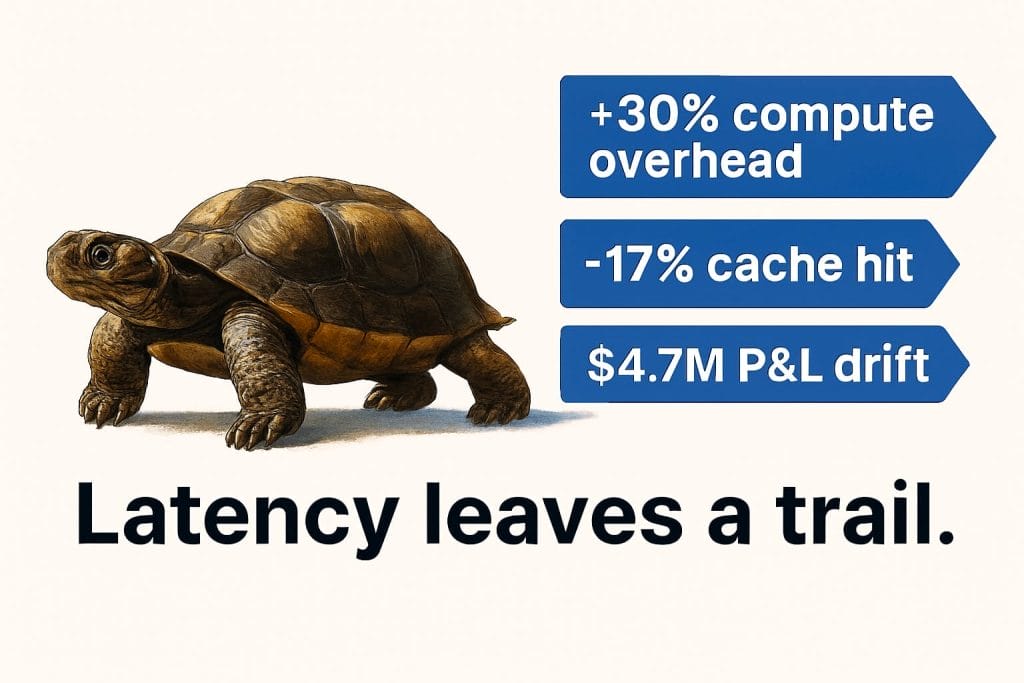
Average query latency rose from 95 ms to 295 ms,
-
Cache-hit ratios dropped 17%,
-
And concurrent I/O spikes during trading windows tripled.
On the surface, the system “worked.”
Underneath, analytics pipelines began to drift — risk models updated too slowly to reflect real exposure.
By the time discrepancies were reconciled, the firm’s daily risk position was off by 2.8%, translating into a $4.7M unrealized P&L deviation.
The servers didn’t fail.
They just lagged — and that was enough.
Why Latency = Financial Risk in Fintech
In real-time finance, every process depends on timing symmetry:
| Process | Latency Sensitivity | Real-World Impact |
|---|---|---|
| Payment routing | <150 ms | Failed or delayed transactions |
| Algorithmic pricing | <100 ms | Mispriced assets or spreads |
| Fraud scoring | <250 ms | False negatives, higher losses |
| Risk analytics | <300 ms | Inaccurate exposure, capital inefficiency |
When latency exceeds those thresholds, data ceases to be real-time, and every dependent function — from compliance to liquidity — begins operating on stale or incomplete information.
The danger isn’t dramatic downtime.
It’s silent misalignment: systems running, dashboards glowing green, while financial truth drifts out of sync.
The Hidden Layer: Database Performance Drift
Investigations into the outage revealed that the latency wasn’t network-related — it originated deep inside the firm’s database tier.
A daily batch process had triggered unoptimized queries across high-traffic tables, locking critical resources during peak hours.
Traditional monitoring tools saw no “errors,” since nothing failed outright.
But query queues built up invisibly, cascading across the stack.
This is a common blind spot in fintech:
Performance degradation happens slowly, beneath SLAs and alerts.
By the time symptoms appear, financial impact is already in motion.
The Financial Cost of Invisible Latency
FinOps leaders are increasingly quantifying latency as a direct cost center.
Here’s why:
-
Operational Inefficiency — Every extra second of system response can increase compute and storage overhead by up to 30% during high-load windows.
-
Lost Opportunity — Algorithmic trading, FX and credit decisioning depend on speed. Even a 100 ms delay can skew arbitrage models or defer loan approvals.
-
Capital Misallocation — Risk models running on delayed data misprice exposure, leading to either over-hedging (capital inefficiency) or under-hedging (loss risk).
-
Erosion of Trust — For fintechs offering APIs to partners, degraded latency translates directly to lost clients and damaged reputation.
In short, milliseconds can move markets.
From Monitoring to Intelligence
The company eventually implemented a performance-intelligence solution to gain visibility into query behavior across workloads.
This wasn’t just about alerts — it was about insight.
The system automatically identified high-latency hotspots in stored procedures and excessive index contention across their primary SQL cluster.
After corrective tuning and intelligent resource redistribution, average latency dropped by 62%, and trading-related API stability improved by 18% within two weeks.
Lesson learned:
In fintech, optimization is risk management.
The Role of Enteros UpBeat
Enteros UpBeat is redefining how enterprises view performance.
By using AI-driven anomaly detection across thousands of database performance metrics — from query patterns to memory allocation — they help IT and FinOps teams pinpoint the earliest signs of system degradation.
Instead of reactive monitoring (“something’s wrong”), teams gain predictive foresight (“something will go wrong”).
That shift is what allows performance to become part of financial governance, not just infrastructure hygiene.
When your data is your product, latency is your liability — unless you measure it.
Building a FinOps Performance Framework
If latency can reshape risk, how should FinOps leaders respond?
Here’s a framework derived from post-incident best practices:
-
Instrument latency across layers — App, API, and DB metrics should feed into a unified latency baseline.
-
Set financial thresholds, not just technical ones — Define latency tolerance in terms of basis points of exposure or cost.
-
Detect before it degrades — Apply anomaly detection on query times and I/O patterns, not just uptime.
-
Correlate with business KPIs — Tie performance metrics directly to transaction success rates, portfolio accuracy, and customer churn.
-
Treat database optimization as continuous FinOps — Tune performance dynamically based on workload patterns and cost impact.
Conclusion
The next generation of fintech resilience won’t be measured in uptime.
It’ll be measured in latency control.
When milliseconds decide margins, data performance isn’t an engineering detail — it’s a fiduciary duty.
The digital lender that learned this the hard way now treats performance data like financial data: audited, reported, and optimized.
That’s the mindset shift defining 2026:
Performance = Trust = Profitability.
FAQ
Q1. What causes “soft outages” in fintech systems?
Soft outages occur when systems technically stay online but degrade in speed or responsiveness — often due to unoptimized database queries, locking, or resource contention. These slowdowns can create hidden risk without triggering alarms.
Q2. How much latency is acceptable in financial platforms?
Most fintech workloads target <150 ms average latency for transaction systems and <300 ms for analytics. Anything beyond that can distort time-sensitive models or delay risk updates.
Q3. Why does latency affect financial accuracy?
Because in real-time finance, models continuously update based on live data. If those inputs lag, models work on outdated assumptions — effectively pricing yesterday’s risk.
Q4. How does Enteros UpBeat help mitigate these issues?
Enteros UpBeat uses patented performance analytics to detect anomalies across databases, workloads and queries — highlighting the exact sources of latency before they cascade into systemwide impact.
Q5. What’s the ROI of database optimization in fintech?
Enterprises report improved compute efficiency (up to 50%), reduced cloud costs, and lower operational risk when optimizing database workloads — turning performance management into measurable financial returns.
The views expressed on this blog are those of the author and do not necessarily reflect the opinions of Enteros Inc. This blog may contain links to the content of third-party sites. By providing such links, Enteros Inc. does not adopt, guarantee, approve, or endorse the information, views, or products available on such sites.
Are you interested in writing for Enteros’ Blog? Please send us a pitch!
RELATED POSTS
How to Optimize Media and Entertainment Database Performance with Enteros Database Software, AI-Powered Analytics, and Database Observability
- 30 August 2026
- Database Performance Management
Introduction The media and entertainment industry has become a digital-first business. Streaming services, digital publishing, online gaming content, advertising platforms, social experiences, content management systems, subscription platforms, and personalized recommendations all depend on databases. Modern media companies process enormous volumes of customer, content, advertising, transaction, and behavioral information. Read more”Indian Country” highlights Enteros and its … Continue reading “How to Optimize Media and Entertainment Database Performance with Enteros Database Software, AI-Powered Analytics, and Database Observability”
How to Optimize Manufacturing Database Performance with Enteros Database Software, AIOps, and Predictive Analytics
Introduction Manufacturing is becoming increasingly dependent on digital infrastructure. Modern factories use enterprise resource planning (ERP), manufacturing execution systems (MES), supply-chain platforms, warehouse management systems, industrial IoT, quality management applications, predictive maintenance, and advanced analytics to manage production. Behind these systems are databases processing enormous amounts of operational information. Production schedules, inventory levels, machine data, … Continue reading “How to Optimize Manufacturing Database Performance with Enteros Database Software, AIOps, and Predictive Analytics”
The Future of Industry-Specific Cloud Optimization with AIOps, FinOps, and AI-Powered Database Management
- 28 August 2026
- Database Performance Management
Introduction Cloud computing has become a foundational component of digital transformation across industries. Banking organizations use cloud platforms to support digital payments and online banking. Healthcare providers rely on cloud infrastructure for digital health applications and patient services. Educational institutions operate learning management systems and virtual classrooms in the cloud. Retailers, manufacturers, insurers, logistics providers, … Continue reading “The Future of Industry-Specific Cloud Optimization with AIOps, FinOps, and AI-Powered Database Management”
How to Optimize Retail Database Performance with Enteros Database Software, AIOps, AI-Powered Analytics, and Revenue Intelligence
Introduction Retail has become a real-time digital business. Ecommerce, mobile applications, point-of-sale systems, inventory platforms, loyalty programs, customer analytics, supply chain systems, recommendation engines, and payment platforms all depend on databases. Retailers also experience highly variable demand. Read more”Indian Country” highlights Enteros and its database performance management platform *Black Friday, holiday shopping, product launches, flash … Continue reading “How to Optimize Retail Database Performance with Enteros Database Software, AIOps, AI-Powered Analytics, and Revenue Intelligence”