Introduction
Growth is a positive signal — until the costs of scaling start outpacing the revenue it’s meant to support. For CIOs and CFOs, this is no longer a hypothetical risk: cloud spend, database licenses, and infrastructure overheads can balloon faster than the value they deliver.
In this article, we explore practical strategies senior IT and financial leaders are applying today to scale effectively while keeping costs under control. These are not abstract principles — but boardroom-tested approaches that shift the conversation from “IT spend” to “business impact.”
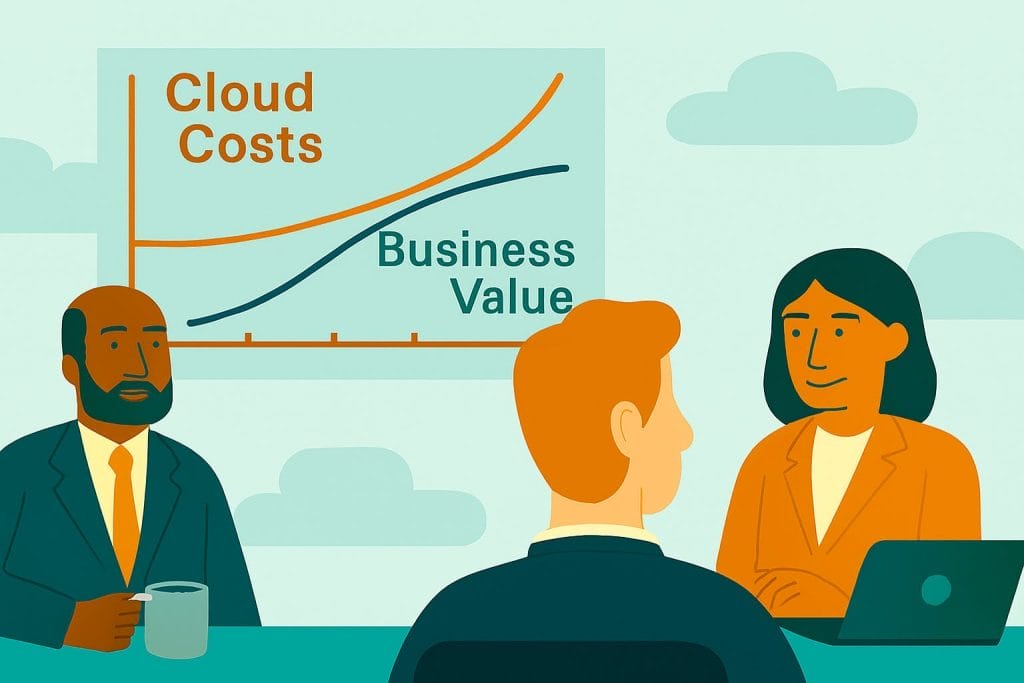
The New Cost Curve Problem
Traditional cost models assumed spend grew in predictable increments. But with elastic infrastructure, expenses often jump in spikes, driven by:
-
Over-provisioning “just in case”
-
Hidden license expansion clauses
-
Lack of visibility into workload-level value
The result? Cloud bills that rise 20–40% year-over-year without matching performance gains.
How Leading CIOs and CFOs Respond
Instead of chasing spend reactively, high-performing organizations are:
a) Making cost a performance KPI.
Not just uptime and latency — but cost-to-value ratios become core operational metrics. Example: “$ of cloud cost per 1,000 transactions served.”
b) Building FinOps visibility at the board level.
Finance and IT share a single view of cost drivers. This shifts the narrative from “IT is expensive” to “here’s where every dollar of IT fuels customer outcomes.”
c) Predicting demand with machine learning.
Rather than scaling only on past usage, leaders apply predictive analytics to forecast demand shifts — avoiding both over- and under-provisioning.
Case Insight: Scaling Without Adding Hardware
One global enterprise reduced license spend by 28% in a single quarter. The shift? They stopped treating license counts as fixed, and instead modeled demand curves based on business activity (seasonal transactions, new product launches).
This not only cut waste — it also gave the CFO a clearer map of how technology spend tracked revenue streams.
What This Means for You
If you’re scaling fast, here are three questions to put on the agenda next quarter:
-
Which of our workloads drive the highest cost-to-value ratios?
-
Where do hidden costs (licenses, idle instances, support overhead) silently erode ROI?
-
How much earlier could we predict spend curves with better visibility?
Conclusion
Scaling isn’t about saying “yes” to every workload or cutting costs blindly. It’s about aligning spend tightly with value — making sure every dollar of IT fuels resilience, innovation, and business growth.
The CIOs and CFOs who master this don’t just manage infrastructure. They redefine how the enterprise views technology investment itself.
👉 Explore more real-world strategies in our full research brief here: [link to Enteros blog].
FAQ
Q1: Why do cloud and license costs spiral so quickly?
Because they often scale in increments hidden in contracts or triggered by short-term peaks. Without visibility, these costs accumulate silently.
Q2: What’s the fastest win for CIOs looking to control scaling costs?
Start by mapping workloads against customer value — cut or optimize those that deliver low ROI.
Q3: How can Enteros help in this process?
Enteros UpBeat uses patented ML technology to detect cost anomalies, forecast spikes, and identify root causes of inefficiency — helping enterprises reduce overspend before it impacts performance.
The views expressed on this blog are those of the author and do not necessarily reflect the opinions of Enteros Inc. This blog may contain links to the content of third-party sites. By providing such links, Enteros Inc. does not adopt, guarantee, approve, or endorse the information, views, or products available on such sites.
Are you interested in writing for Enteros’ Blog? Please send us a pitch!
RELATED POSTS
How Can Banks Prevent Database Bottlenecks in Real-Time Financial Transactions?
- 1 September 2026
- Database Performance Management
Banks can prevent database bottlenecks in banking by continuously monitoring SQL workloads, optimizing queries and indexes, detecting resource contention, analyzing transaction latency, and identifying anomalies before performance declines. Effective database performance monitoring for banks provides real-time workload visibility and faster root cause analysis. Enteros helps financial institutions identify database inefficiencies and maintain reliable, scalable transaction … Continue reading “How Can Banks Prevent Database Bottlenecks in Real-Time Financial Transactions?”
Why Is Database Observability Important for Modern Hospitals and Healthcare IT Teams?
Database observability in healthcare is important because hospitals depend on databases to power EHRs, patient portals, clinical applications, billing, analytics, and other essential systems. It gives healthcare IT teams deeper visibility into SQL workloads, resource usage, bottlenecks, and performance changes. Enteros supports this approach with database observability, AI-powered analysis, anomaly detection, and root cause analysis … Continue reading “Why Is Database Observability Important for Modern Hospitals and Healthcare IT Teams?”
How Can Healthcare Organizations Reduce Cloud Database Costs With AIOps and FinOps
Healthcare organizations can reduce cloud database costs by combining AIOps with FinOps to identify inefficient workloads, detect anomalies, rightsize resources, and connect database performance with infrastructure spending. Effective healthcare cloud database cost optimization focuses on eliminating waste without compromising reliability. Enteros supports this approach through database observability, AI-powered SQL analysis, root cause analysis, performance intelligence, … Continue reading “How Can Healthcare Organizations Reduce Cloud Database Costs With AIOps and FinOps”
What Database Performance Challenges Do Hospitals Face in Cloud-Based Healthcare Systems?
Hospitals face database performance challenges such as slow SQL queries, growing healthcare data, EHR performance issues, database bottlenecks, resource contention, cloud complexity, and rising costs. Cloud-based healthcare systems require continuous database monitoring, workload optimization, anomaly detection, and root-cause analysis. AI-powered AIOps can help hospitals improve database performance, reliability, scalability, and cloud cost efficiency while supporting … Continue reading “What Database Performance Challenges Do Hospitals Face in Cloud-Based Healthcare Systems?”