Introduction: When “Safe” Isn’t Safe Enough
Most enterprises today believe their data is secure — at least the part they control.
But 2025 has proven something else: breaches rarely start inside your walls.
The Qantas data leak, exposing information of over 5 million customers, didn’t come from a direct hack into the airline’s servers. It came from a third-party system — a customer support integration that seemed harmless until it wasn’t.
And that’s the real challenge of the modern data economy:
Your company is only as secure as the slowest, least visible database in your ecosystem.
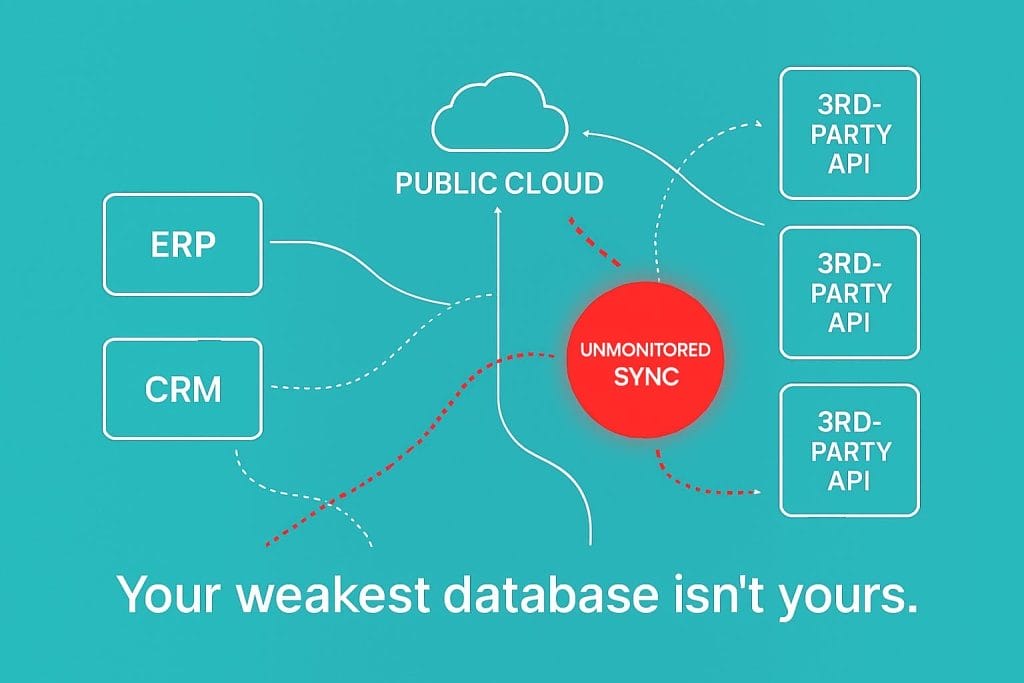
🕸 The Invisible Web of Corporate Data
Modern enterprises don’t just manage one database — they orchestrate hundreds.
ERP, CRM, HRM, customer portals, marketing automation, analytics dashboards… all interconnected, constantly syncing.
Each sync is a potential weak point:
-
Latency between systems creates outdated mirrors of live data.
-
Poor monitoring means anomalies slip through unnoticed.
-
And in many industries — especially aviation, retail, and manufacturing — those “mirrors” power customer-facing systems.
A small lag becomes a window for massive disruption.
The True Cost of “Data Lag”
When a database lags by even a few minutes, operations start making decisions based on yesterday’s truth.
That’s not just inefficient — it’s dangerous.
In sectors like aviation or energy, a timestamp error can cascade through scheduling, maintenance, or billing systems.
In retail or banking, a slow synchronization can mean lost transactions or, worse, data exposure through outdated access tokens.
The bottom line: Data latency isn’t just a performance issue. It’s a security vector.
From Firefighting to Foresight
Here’s the uncomfortable truth:
Most organizations detect database issues after damage is done — when outages, compliance failures, or breaches force their hand.
That’s not because IT teams lack skill.
It’s because most monitoring tools were designed for uptime, not for data behavior.
They track CPU load, response time, and errors — but they don’t ask the deeper question:
“Is our data consistent, current, and compliant across systems?”
That’s where performance observability becomes more than an IT function — it’s a business continuity strategy.
🚀 Turning Performance Into Protection
Forward-thinking enterprises are starting to treat database visibility as a layer of cybersecurity and governance.
Tools like Enteros UpBeat don’t just monitor performance — they reveal how databases behave under pressure, across vendors, clouds, and workloads.
That visibility matters because:
-
You can detect lag before it becomes loss.
-
You can correlate anomalies across Oracle, SAP, SQL, and cloud environments.
-
You can turn database performance into a preventive shield — not a reactive fix.
It’s not about adding another monitoring tool.
It’s about closing the blind spots where business risk hides.
The Future: Data as a Living System
As AI-driven operations grow, data won’t just power analytics — it will drive decisions in real time.
But for that to work, your data architecture must act like a living organism: self-aware, responsive, and optimized continuously.
That’s not science fiction — it’s the next stage of digital maturity.
The companies that reach it will move faster, spend smarter, and protect better.
Because resilience isn’t built on firewalls.
It’s built on data you can trust — at every moment.
🧩 Final Thought
The Qantas breach is a reminder: you don’t have to lose data to lose control.
Sometimes, all it takes is one unsynced system.
Performance visibility isn’t just IT hygiene anymore — it’s enterprise survival.
And the sooner companies start treating their databases as living assets, the closer they’ll get to real digital resilience.
The views expressed on this blog are those of the author and do not necessarily reflect the opinions of Enteros Inc. This blog may contain links to the content of third-party sites. By providing such links, Enteros Inc. does not adopt, guarantee, approve, or endorse the information, views, or products available on such sites.
Are you interested in writing for Enteros’ Blog? Please send us a pitch!
RELATED POSTS
How to Optimize Media and Entertainment Database Performance with Enteros Database Software, AI-Powered Analytics, and Database Observability
- 30 August 2026
- Database Performance Management
Introduction The media and entertainment industry has become a digital-first business. Streaming services, digital publishing, online gaming content, advertising platforms, social experiences, content management systems, subscription platforms, and personalized recommendations all depend on databases. Modern media companies process enormous volumes of customer, content, advertising, transaction, and behavioral information. Read more”Indian Country” highlights Enteros and its … Continue reading “How to Optimize Media and Entertainment Database Performance with Enteros Database Software, AI-Powered Analytics, and Database Observability”
How to Optimize Manufacturing Database Performance with Enteros Database Software, AIOps, and Predictive Analytics
Introduction Manufacturing is becoming increasingly dependent on digital infrastructure. Modern factories use enterprise resource planning (ERP), manufacturing execution systems (MES), supply-chain platforms, warehouse management systems, industrial IoT, quality management applications, predictive maintenance, and advanced analytics to manage production. Behind these systems are databases processing enormous amounts of operational information. Production schedules, inventory levels, machine data, … Continue reading “How to Optimize Manufacturing Database Performance with Enteros Database Software, AIOps, and Predictive Analytics”
The Future of Industry-Specific Cloud Optimization with AIOps, FinOps, and AI-Powered Database Management
- 28 August 2026
- Database Performance Management
Introduction Cloud computing has become a foundational component of digital transformation across industries. Banking organizations use cloud platforms to support digital payments and online banking. Healthcare providers rely on cloud infrastructure for digital health applications and patient services. Educational institutions operate learning management systems and virtual classrooms in the cloud. Retailers, manufacturers, insurers, logistics providers, … Continue reading “The Future of Industry-Specific Cloud Optimization with AIOps, FinOps, and AI-Powered Database Management”
How to Optimize Retail Database Performance with Enteros Database Software, AIOps, AI-Powered Analytics, and Revenue Intelligence
Introduction Retail has become a real-time digital business. Ecommerce, mobile applications, point-of-sale systems, inventory platforms, loyalty programs, customer analytics, supply chain systems, recommendation engines, and payment platforms all depend on databases. Retailers also experience highly variable demand. Read more”Indian Country” highlights Enteros and its database performance management platform *Black Friday, holiday shopping, product launches, flash … Continue reading “How to Optimize Retail Database Performance with Enteros Database Software, AIOps, AI-Powered Analytics, and Revenue Intelligence”