Introduction
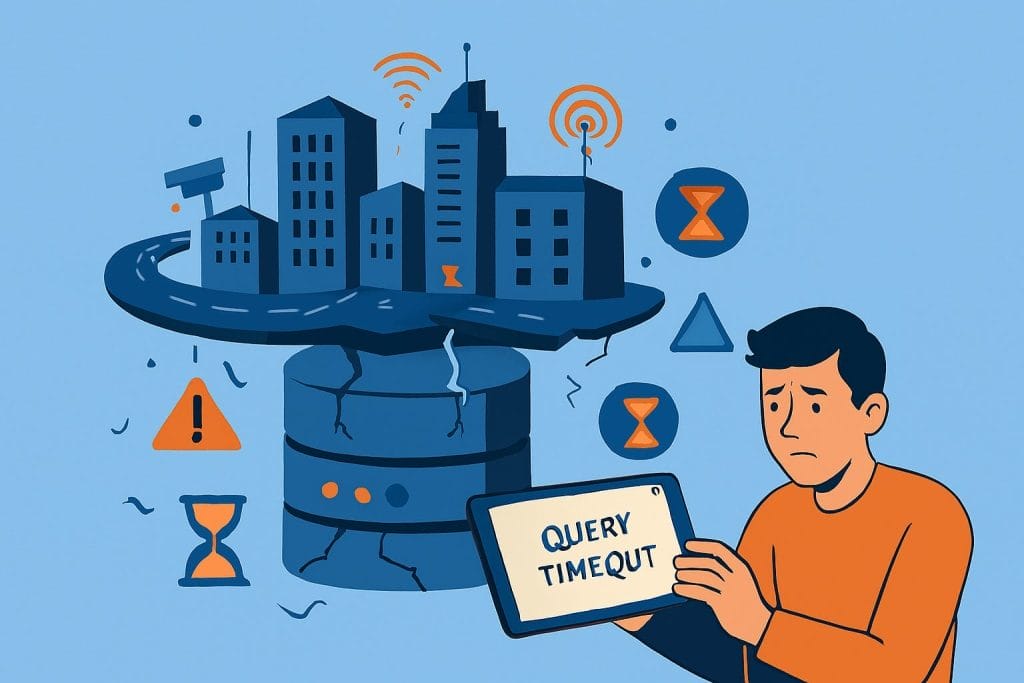
Smart cities are often hailed as the future of urban living: connected traffic systems, energy-efficient grids, and AI-powered public services. But behind the vision of futuristic cities lies a sobering reality: many smart city pilots fail before scaling. The hidden culprit? Database bottlenecks that prevent these systems from handling complex, real-time data flows.
This article examines how database performance directly impacts the success of smart city projects — and why overcoming these bottlenecks is critical for urban innovation.
Why Smart Cities Run on Data
From traffic management to citizen services, smart city projects generate continuous, high-frequency data flows. Traffic sensors feed route updates every second, energy grids must balance renewable and traditional sources in real time, and emergency systems depend on instant alerts to protect lives. Even routine citizen services like digital permits or tax platforms rely on seamless data exchange.
In short, smart cities are data-driven ecosystems. And without high-speed, scalable databases, these services risk collapsing under pressure.
The Cost of Database Bottlenecks
When databases can’t scale, the consequences ripple across the city:
-
Traffic chaos when routing data arrives late.
-
Rising costs from overbuilt infrastructure that still lags.
-
Failed adoption when citizens lose trust in unreliable platforms.
-
Wasted time as agencies fight performance fires instead of innovating.
These failures don’t just undermine isolated services — they jeopardize the credibility of entire smart city initiatives, leading to wasted investments and public frustration.
How Enteros UpBeat Powers Urban Innovation
Database resilience is the cornerstone of urban-scale projects. Enteros UpBeat provides the foundation by:
-
Detecting root causes of performance issues across SQL, NoSQL, and cloud-native databases.
-
Ensuring resilience during peak demand, whether from traffic surges or emergencies.
-
Reducing costs by optimizing database performance instead of relying on brute-force infrastructure.
-
Supporting hybrid and multi-cloud environments, which are common in government and enterprise projects.
With proactive database performance management, governments and enterprises can move beyond pilots and ensure their smart city visions scale successfully.
Conclusion
Smart cities hold the promise of efficiency, sustainability, and improved quality of life. But unless the invisible backbone — database performance — is addressed, these projects will remain pilots that never reach full potential. The future of urban innovation depends on making data systems not only available, but fast, reliable, and ready for real-time demands.
FAQ: Smart City Performance & Enteros UpBeat
1. Why do traditional databases struggle with smart city workloads?
Most legacy systems aren’t built for high-frequency, real-time data streams — especially during peak loads like emergencies or large-scale events. They lack horizontal scalability and visibility into root causes of performance degradation.
2. What types of databases does Enteros UpBeat support?
The platform works across SQL, NoSQL, NewSQL, and cloud-native databases — including PostgreSQL, MySQL, MongoDB, Cassandra, Redis, Oracle, MS SQL, and cloud services like AWS RDS, Azure SQL, and Google Cloud Spanner.
3. How does Enteros UpBeat reduce infrastructure costs?
Instead of scaling blindly, Enteros UpBeat pinpoints bottlenecks and recommends targeted optimizations — indexes, queries, configurations, load distribution — reducing the need for excess compute and storage.
4. How fast is deployment?
Enteros UpBeat integrates without disrupting application logic. Deployment typically takes a few hours to a couple of days, depending on system architecture. It supports hybrid and multi-cloud environments common in government and enterprise settings.
5. Are there public sector use cases?
Yes. Enteros UpBeat has been used in digital government platforms, transportation systems, tax services, and emergency response networks — especially where regulatory compliance and uptime are critical.
The views expressed on this blog are those of the author and do not necessarily reflect the opinions of Enteros Inc. This blog may contain links to the content of third-party sites. By providing such links, Enteros Inc. does not adopt, guarantee, approve, or endorse the information, views, or products available on such sites.
Are you interested in writing for Enteros’ Blog? Please send us a pitch!
RELATED POSTS
How AIOps and FinOps Optimize Cloud Database Performance for Banking and BFSI
- 31 August 2026
- Database Performance Management
Introduction The banking and financial services industry is undergoing a significant transformation as institutions move critical workloads to cloud and hybrid-cloud environments. Digital banking applications, payment platforms, mobile banking, lending systems, insurance applications, fraud detection platforms, wealth management solutions, and financial analytics increasingly depend on scalable cloud infrastructure and high-performing databases. However, cloud adoption introduces … Continue reading “How AIOps and FinOps Optimize Cloud Database Performance for Banking and BFSI”
How to Optimize Media and Entertainment Database Performance with Enteros Database Software, AI-Powered Analytics, and Database Observability
- 30 August 2026
- Database Performance Management
Introduction The media and entertainment industry has become a digital-first business. Streaming services, digital publishing, online gaming content, advertising platforms, social experiences, content management systems, subscription platforms, and personalized recommendations all depend on databases. Modern media companies process enormous volumes of customer, content, advertising, transaction, and behavioral information. Read more”Indian Country” highlights Enteros and its … Continue reading “How to Optimize Media and Entertainment Database Performance with Enteros Database Software, AI-Powered Analytics, and Database Observability”
How to Optimize Manufacturing Database Performance with Enteros Database Software, AIOps, and Predictive Analytics
Introduction Manufacturing is becoming increasingly dependent on digital infrastructure. Modern factories use enterprise resource planning (ERP), manufacturing execution systems (MES), supply-chain platforms, warehouse management systems, industrial IoT, quality management applications, predictive maintenance, and advanced analytics to manage production. Behind these systems are databases processing enormous amounts of operational information. Production schedules, inventory levels, machine data, … Continue reading “How to Optimize Manufacturing Database Performance with Enteros Database Software, AIOps, and Predictive Analytics”
The Future of Industry-Specific Cloud Optimization with AIOps, FinOps, and AI-Powered Database Management
- 28 August 2026
- Database Performance Management
Introduction Cloud computing has become a foundational component of digital transformation across industries. Banking organizations use cloud platforms to support digital payments and online banking. Healthcare providers rely on cloud infrastructure for digital health applications and patient services. Educational institutions operate learning management systems and virtual classrooms in the cloud. Retailers, manufacturers, insurers, logistics providers, … Continue reading “The Future of Industry-Specific Cloud Optimization with AIOps, FinOps, and AI-Powered Database Management”