Introduction
It wasn’t a dramatic server explosion.
It wasn’t a hacker breach.
What brought down global services last week was arguably more insidious: a configuration change, a few milliseconds of added latency, and a ripple effect that exposed how fragile modern cloud dependency really is.
On 29 October 2025, Microsoft acknowledged that a change in its Azure Front Door infrastructure triggered widespread latency, timeouts and service degradation across major systems including Azure SQL Database, Azure Active Directory and downstream services such as Office 365 and even gaming platforms. The Verge+2AP News+2
For enterprise IT and FinOps leaders this incident raises a serious question:
What happens when latency becomes the weak link in your stack?
1. The Anatomy of the Incident
1.1 Trigger: A small change
Microsoft described the root cause as “an inadvertent configuration change” to Azure Front Door (AFD) — the global content and application delivery network. The Verge
While the change was minor, its cascade effect was not. Latency spiked, repeated retries ballooned, and workloads that were expected to be near-real-time started trailing, unnoticed.
1.2 Hidden latency, visible disruption
Affected services didn’t crash—they hung.
-
Timeout errors, rather than 503 failures, piled up.
-
APIs responded slowly, authentication failed intermittently.
-
Business systems—almost as if they were underperforming rather than down—began behaving erratically.
Those are the kinds of issues that never make headlines—but they cost money, trust and time.
1.3 The cost that creeps
One major airline reported check-in failures tied to Azure issues. A global retailer experienced delayed e-commerce traceability. Banking portals saw elevated retry volumes. These aren’t just anecdotes—they signal how performance drift can translate into real business impact. AP News
2. Why Cloud Outages Are Now Latency Outages
2.1 Speed is trust
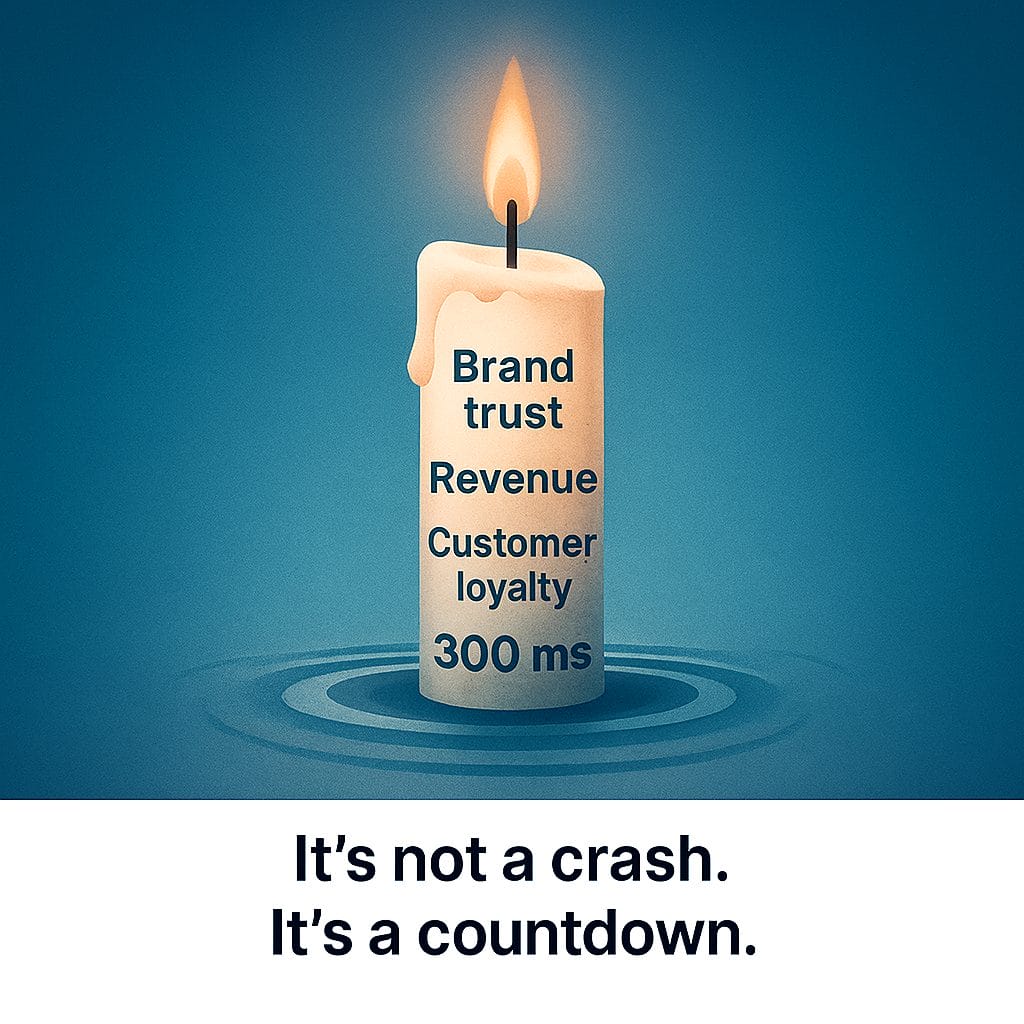
In digital business, performance isn’t just a technical metric—it’s a pillar of customer trust. A service may be “up” at 99.9 % availability, but if critical API responses now take 300 ms instead of 80 ms, workflows slow, sessions abort and revenue suffers.
2.2 Monitoring gaps
Many organisations monitor availability (is the system alive?) but don’t monitor data velocity (is the system keeping up?). The Microsoft case shows how the infrastructure can look healthy while bottlenecks quietly build behind the scenes.
2.3 The domino effect
The original change didn’t hit every region equally—but once the latency spread, the chain reaction began: queuing, retries, spike in I/O contention, increased load, higher error rates. Before leadership realised it, the incident was not just IT trouble—it was business turbulence.
3. The Strategic Response Framework
Step A — Instrumentation at the right layer
Time to switch from “Is it down?” to “Is it timely?”
Track response time percentiles (P95, P99), retry rates, queue depth and backend database metrics tied to real business functions—login flows, transaction pipelines, feed updates.
Step B — Link performance to KPIs
Translate latency into dollars and minutes.
For example:
-
“A 50 ms delay in transaction finalisation = 0.8 % drop in completion rate.”
-
“A 10-minute lag in decision data = 4-hour delay in move decisions.”
This shifts the discussion from tech metrics to business metrics.
Step C — Proactive anomaly detection
Because the slow drift is what kills trust, not the plunge.
Platforms that specialise in monitoring database and application pipelines—such as Enteros UpBeat—help detect emerging bottlenecks before they cascade into incidents.
Step D — Architecture for disruption
Prepare not just for outages, but for performance degradation.
-
Use fail-over flows that respect latency budgets, not just availability.
-
Ensure data pipelines are resilient to queuing spikes and cascading locks.
-
Model performance scenarios—not just disaster recovery.
4. A Quiet Competitive Advantage
Here’s the subtle but critical shift:
While most firms focus on uptime, the best ones optimise for velocity—data, decisions and delivery.
In essence:
The system that delivers truth fastest wins the trust war.
Those enterprises that embedded high-fidelity instrumentation, real-time visibility, and actionable intelligence into their stack did more than survive earlier incidents—they converted them into trust assets.
5. Why This Matters for Today’s CIO & CFO
-
Budget discipline matters more than ever: Invisible slowdowns bleed resources while leadership thinks systems are “fine.”
-
Risk landscape has evolved: It’s no longer just “the system is down.” Now it’s “the system is slow—so business is offline.”
-
Architecture has gone operational: Data performance sits at the intersection of infrastructure, finance and strategy.
Enteros UpBeat is one of the tools emerging for that intersection: providing baseline performance intelligence, anomaly detection across database workloads and helping decision-makers prevent “silent storms”.
Conclusion
The Microsoft event shows that in the cloud era, failure doesn’t always hit like a hammer.
It creeps in like a subtle fault—an API that responds a few hundred milliseconds slower, a database query that holds up a pipeline, a configuration change nobody noticed.
For IT and FinOps leaders, the question isn’t just “Is the system up?” — it’s “Is the system real-time?”
In a world where milliseconds translate into margin and trust, visibility into performance isn’t optional—it’s strategic.
FAQ
Q1. How can I know if latency is my next risk?
Look beyond availability. If your core business functions (login flows, pipelines, decision modules) show creeping response times or increased retries, you’re in drift-land.
Q2. Will adding more hardware solve this?
Not necessarily. Often the bottleneck is locking, queue depth or sub-optimal query patterns—not raw compute. Without visibility, scaling hardware just hides symptoms.
Q3. Can I quantify ROI on performance optimisation?
Yes. Firms have reported measurable gains: reductions in cloud spend of 10–20 %, higher transaction completion rates and faster time-to-value for innovation pipelines.
Q4. What role can Enteros UpBeat play?
By delivering real-time anomaly detection across databases and data flows, Enteros UpBeat gives you the early warning system you need—before latency becomes a business problem.
The views expressed on this blog are those of the author and do not necessarily reflect the opinions of Enteros Inc. This blog may contain links to the content of third-party sites. By providing such links, Enteros Inc. does not adopt, guarantee, approve, or endorse the information, views, or products available on such sites.
Are you interested in writing for Enteros’ Blog? Please send us a pitch!
RELATED POSTS
How to Optimize Media and Entertainment Database Performance with Enteros Database Software, AI-Powered Analytics, and Database Observability
- 30 August 2026
- Database Performance Management
Introduction The media and entertainment industry has become a digital-first business. Streaming services, digital publishing, online gaming content, advertising platforms, social experiences, content management systems, subscription platforms, and personalized recommendations all depend on databases. Modern media companies process enormous volumes of customer, content, advertising, transaction, and behavioral information. Read more”Indian Country” highlights Enteros and its … Continue reading “How to Optimize Media and Entertainment Database Performance with Enteros Database Software, AI-Powered Analytics, and Database Observability”
How to Optimize Manufacturing Database Performance with Enteros Database Software, AIOps, and Predictive Analytics
Introduction Manufacturing is becoming increasingly dependent on digital infrastructure. Modern factories use enterprise resource planning (ERP), manufacturing execution systems (MES), supply-chain platforms, warehouse management systems, industrial IoT, quality management applications, predictive maintenance, and advanced analytics to manage production. Behind these systems are databases processing enormous amounts of operational information. Production schedules, inventory levels, machine data, … Continue reading “How to Optimize Manufacturing Database Performance with Enteros Database Software, AIOps, and Predictive Analytics”
The Future of Industry-Specific Cloud Optimization with AIOps, FinOps, and AI-Powered Database Management
- 28 August 2026
- Database Performance Management
Introduction Cloud computing has become a foundational component of digital transformation across industries. Banking organizations use cloud platforms to support digital payments and online banking. Healthcare providers rely on cloud infrastructure for digital health applications and patient services. Educational institutions operate learning management systems and virtual classrooms in the cloud. Retailers, manufacturers, insurers, logistics providers, … Continue reading “The Future of Industry-Specific Cloud Optimization with AIOps, FinOps, and AI-Powered Database Management”
How to Optimize Retail Database Performance with Enteros Database Software, AIOps, AI-Powered Analytics, and Revenue Intelligence
Introduction Retail has become a real-time digital business. Ecommerce, mobile applications, point-of-sale systems, inventory platforms, loyalty programs, customer analytics, supply chain systems, recommendation engines, and payment platforms all depend on databases. Retailers also experience highly variable demand. Read more”Indian Country” highlights Enteros and its database performance management platform *Black Friday, holiday shopping, product launches, flash … Continue reading “How to Optimize Retail Database Performance with Enteros Database Software, AIOps, AI-Powered Analytics, and Revenue Intelligence”